
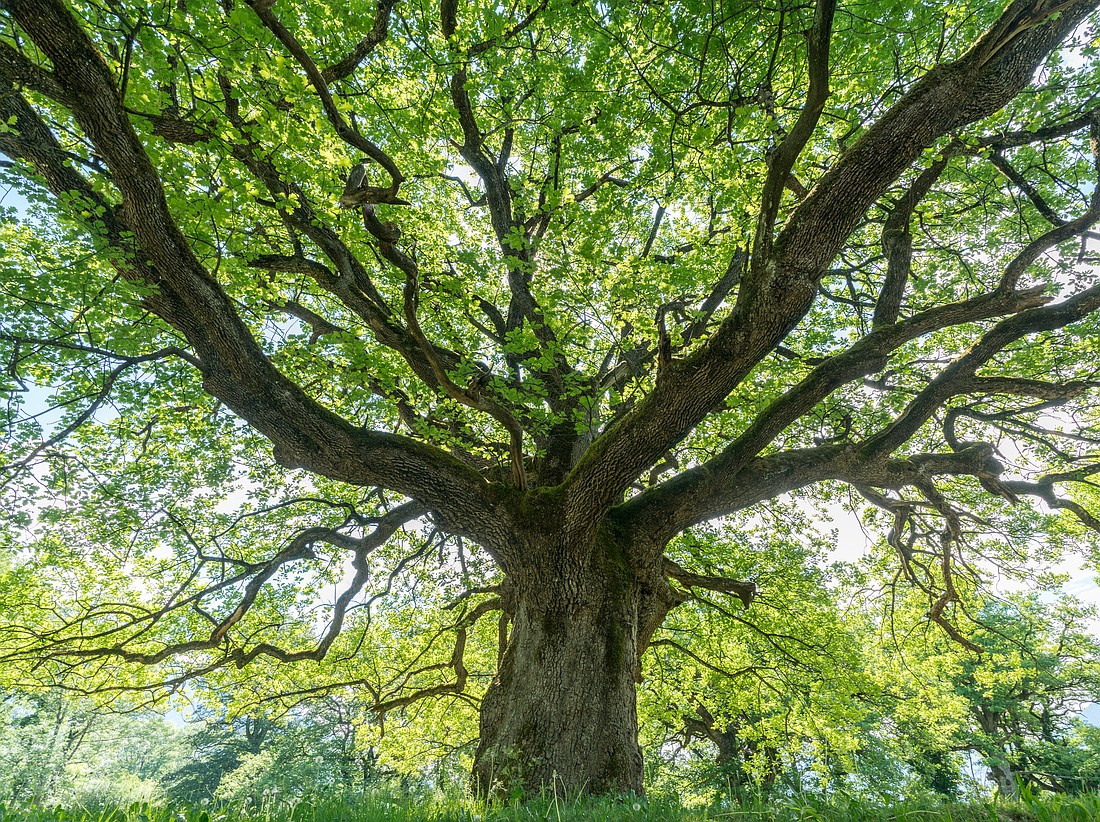

Jacksonville University’s beautiful campus on the bank of the St. Johns River in Arlington is full of large oak trees. They are everywhere and you sometimes crunch acorns underfoot when walking off the paved or beaten paths.
You might see fallen trees awaiting removal, or stumps and large branches that remain after a severe storm.
Perhaps that is why I have been thinking so much about the continuous cycle of life and education in terms of the cycle of mighty oaks growing from tiny acorns into huge trees. Eventually, they make way for new trees to take their place.
What law school deans and legal educators do is gather and plant acorns of ideas, concepts, principles, rules and, most of all, new lawyers.
Our students also learn that they, in turn, are obliged to become teachers and role models themselves, not only for new generations of lawyers who in turn will follow them, but also to educate the public about how our system of equal justice under law is supposed to work in our constitutional democratic form of limited self-government of, by, and for the people.
That is no small thing. The imagery of the rule of law—as a thick forest of protective trees—is reflected in the famous “Devil Speech” from “A Man for All Seasons,” the dramatization of the life and martyrdom of Sir Thomas More.
In a scene from Act One of Robert Bolt’s 1960 play and the film adaptation that won six Academy Awards, More’s future son-in-law urges him to arrest an unscrupulous man whose perjury will eventually lead to More’s execution. More answers that the man has broken no law, adding “And go he should if he were the Devil himself until he broke the law!”
His son-in-law is appalled at the idea of granting the Devil the benefit of law, but More is adamant. “What would you do? Cut a great road through the law to get after the Devil? ... And when the last law was down, and the Devil turned round on you—where would you hide, …the laws all being flat? This country’s planted thick with laws from coast to coast—Man’s laws, not God’s—and if you cut them down—and you’re just the man to do it—do you really think you could stand upright in the winds that would blow then? Yes, I’d give the Devil benefit of law, for my own safety’s sake.”
On the day of the most recent winter solstice, I attended the funeral of a friend who was my college roommate for three of my four years at Princeton. He was a football lineman in college and a newlywed law student at Georgetown who, after serving as a U.S. Justice Department attorney, returned home to become a lawyer for his neighbors.
He lived most of his legal career, died, and is buried in the same hard-working, devout, patriotic part of Pennsylvania where he grew up. Before this big oak of a man fell to the ground, he provided shade and shelter for his wife, nine children, 29 grandchildren and countless neighbors and clients who crammed the church where his funeral service was held.
The funeral was on a day when the frigid cemetery ground was too hard for the internment of the casket and the beautiful steep slope where the gravesite overlooks the home in which my friend raised his large family was too icy to risk graveside prayers.
It helped that inside the snug, warm church the priest leading the service reminded us that each day following the winter solstice would be a bit brighter, especially if we hold on to and think of some of the many things about my friend’s life to celebrate.
In a sense, although my friend was leaving us in a profound way, he could still always be with us. His body died, but his memory and the good works he prepared others to carry forward did not.
Grief brings darkness, loss creates emptiness and inflicts pain. Eventually the passing of a good person’s torch to others can be thought of as turning off a lamp that has done its job well at the arrival of the brightening light of a new dawn, a guiding star, a festival of candles and all the joyful holiday celebrations of new possibilities we observed this darkest season of the year.
These reflections were helpful earlier this year when my own father died less than a week after his 96th birthday. His strong body finally just wore out, but not before he made sure we did not need to lean on him anymore.
In these pages I shared his 10 commandments for a successful good life and cardinal virtues for effective leadership. Before anyone is tempted to nominate him for sainthood, I note that about once a week he would say (using different language), that the least Christian people on earth were Catholics in the church parking lot after mass.
There are many opportunities that we encounter almost every day to use what experience we have gained and to encourage others to do what they can to make each day brighter.
If we have faith as small as a tiny mustard seed, we can move any mountain. Surely considering those who we are privileged to work with and those we teach each day we can have more than enough faith to make a positive difference.
It matters not if many others do not yet join us. Our faith in what we believe to be right and our faith in our mission will save us.
If we recall throughout the fitful imperfect history of humankind even one person, or even a dozen people, or waves of dozens and dozens of communities of people can accomplish in the pursuit of equal justice and the common good, then we can justifiably hope to continue the sometimes gradually, other times the abruptly, shifting upward arc of progress.
Faith, hope and charity are what matter most in living a good worthwhile life, not fortune or fame. That is because happiness, satisfaction and ultimately redemptive renewal earned by overcoming setbacks, missteps and shortcomings come from how well we live our lives, especially in the service of others.
That is why legal education opens many doors to a wonderful life.