
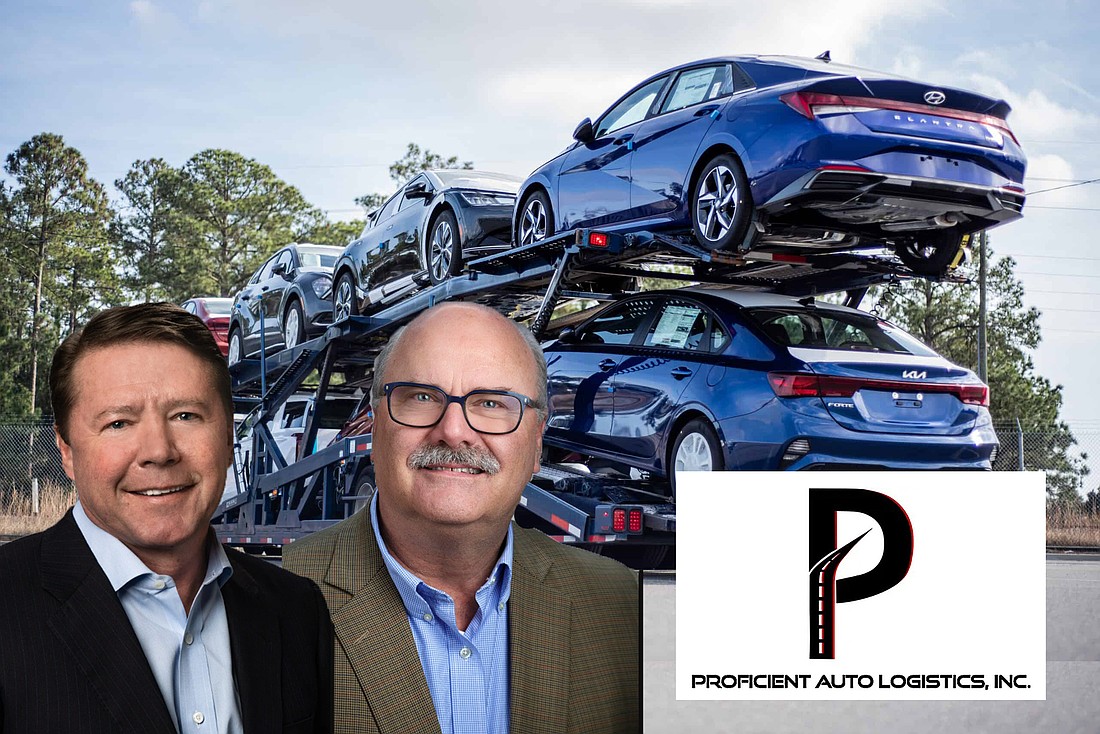
With a mostly weak auto sales market since its initial public offering in May 2024, Proficient Auto Logistics Inc.’s stock has traded mostly below its IPO price and the stock dropped again after its year-end financial report.
Jacksonville-based Proficient, which transports automobiles from manufacturers to dealers, reported 2025 revenue rose 10.7% to $430.4 million but said the car sales market continues to be sluggish.
“Reflecting on 2025, the automotive market peaked in March and April ahead of tariff impacts and the remainder of the year was weaker than our expectations,” CEO Rick O’Dell said in a Feb. 9 conference call, according to a company transcript.
O’Dell said the seasonally adjusted annual rate (SAAR) of auto sales was lower than expected in January 2026, hurt in part by severe winter weather.
He is hoping consumer demand will pick up. However, Chief Financial Officer Brad Wright said, “in 2026, the forecast for SAAR is lower than 2025 actual, and this forecast has weakened since we last reported, reflecting a Q4 that lacked the typical seasonal peaking.”
Wright said any increase in revenue this year “is expected to be a result of our internal initiatives, essentially unaided by the general market.”
Proficient’s stock dropped $2.67 to $7.77 Feb. 10 after the report.
That’s about half its IPO price of $15. The stock has been trading below the IPO price since September 2024.
William Blair analyst Ryan Merkel said in a research note after the report that he likes the company long term but is maintaining a “market perform” rating on the stock.
“The soft demand backdrop, price competition, and high revenue cyclicality warrant a cautious stance. To become more constructive, we need signs of improving auto sales and big-ticket consumer spending,” he said.
However, Raymond James analyst Patrick Tyler Brown maintained an “outperform” rating.
“We believe it presents a unique opportunity in the transport complex to leverage a recovering auto market and declining union carrier share, and benefit from a number of internal ‘self-help’ initiatives,” Brown said in his note.
Barrington Research analyst Alexander Paris also maintained an “outperform” rating.
“As automobile sales recover and PAL continues to take market share, its revenue growth will accelerate and margins will continue to expand, and the valuation discount to its peer group(s) will dissipate, in our opinion,” Paris said in his note.
Another Jacksonville-based trucking company, Landstar System Inc., dropped sharply Feb. 12 after a small company raised fears of artificial intelligence disrupting the traditional freight transportation market.
According to The Wall Street Journal, the selloff of trucking stocks was caused by a news release by Fort Lauderdale-based Algorhythm Holdings Inc., which said its AI technology increased customers’ freight volume by more than 300%.
Algorhythm Holdings was mainly a karaoke equipment company called The Singing Machine Co. Inc. before changing its name in 2024 and selling off the karaoke business to focus on its AI logistics business called SemiCab.
Algorhythm Holdings reported revenue of just $3 million in the first nine months of 2025, but its announcement somehow sparked a big trucking selloff, with Landstar’s stock falling $25.39 to $137.36, a one-day drop of 15.6%.

Morningstar analyst Matthew Young downplayed the impact of AI in a report on Landstar and other transportation stocks after the selloff.
“We don’t see outsize AI disruption risk for the large, profitable providers we cover, as the benefits of the network effect are well entrenched,” Young said.
“Over the past decade, these providers have thwarted numerous IT-related disintermediation threats from new entrants, almost all of which have proven overstated,” he said.
Before completing its merger with PotlachDeltic Corp. Jan. 30, Rayonier Inc. recorded higher earnings in 2025.
The timber and real estate company reported adjusted earnings nearly doubled from 2024 to $89.2 million, or 57 cents a share.
In a Feb. 12 conference call with analysts, CEO Mark McHugh said he expects stronger results in 2026 with the addition of PotlachDeltic.

“As our integration efforts continue, we remain confident that this transaction will deliver significant strategic and financial benefits beyond what either company could have achieved independently,” he said.
Raymond James analyst Buck Horne upgraded Rayonier from “outperform” to “strong buy” after the earnings report.
In addition to increasing its timber portfolio, Rayonier also “controls Potlatch’s top-10 U.S. based lumber manufacturing platform and a wide assortment of new land/carbon-solution ventures including utility-grade solar leases, carbon capture & storage partnerships, lithium exploration, and carbon-credit offsets — all of which are effectively valued at ZERO at current share prices,” Horne said in his research note.
“Most importantly, we remind investors to view Rayonier’s timberland as an alternative ‘store of value’ asset class, a finite resource providing consistent inflation protection
with cash flow upside (unlike gold, silver, or bitcoin),” he said.
Rayonier, which is moving its headquarters from Wildlight in Nassau County to Atlanta after the merger, is also planning to change its name. McHugh said the new name will be announced later in the first quarter.
Firehouse Subs grew its sales by 8.6% to $1.337 billion in 2025, helped by the opening of new restaurants.
However, the Jacksonville-based chain also increased sales from existing restaurants, parent company Restaurant Brands International Inc. said.
Sales at Firehouse restaurants open for more than one year grew by 1.1% for the full year, reversing a decline in 2024, and fourth-quarter sales at those restaurants rose 2.1%.
Operating income at Firehouse rose by $8 million to $56 million as the number of restaurants rose by 104 in 2025 to 1,449.

In a Feb. 12 conference call, RBI Chief Executive Josh Kobza said Canada is Firehouse’s biggest growth market.
“In fact, Firehouse was one of the fastest-growing QSRs (quick-service restaurants) in Canada in 2025,” he said.
“I’m excited about the growing momentum of this brand, and I’m looking forward to even more success in 2026.”
Besides Firehouse, Miami-based RBI also owns the Burger King, Tim Hortons and Popeyes chains.
The 33,041 restaurants combined at the four chains grew sales by 5.3% in 2025 to $46.8 billion.
Jacksonville-based staffing company GEE Group Inc. said revenue in its first quarter ended Dec. 31 fell 15% to $20.5 million, with the company recording a loss from continuing operations of $150,000.
GEE Group said the lower revenue was due mainly to the loss of one large customer after that company was acquired.

In a Feb. 13 conference call, CEO Derek Dewan said labor market conditions continue to impact the company.
“Many of the businesses we serve continue to implement layoffs and hiring freezes, rather than adding new employees,” he said, according to a company transcript.
“Despite the macroeconomic headwinds and staffing industry challenges impacting the demand for our services, we are aggressively managing and preparing our business to mitigate losses, restore profitability and be prepared for an anticipated recovery.”
Connecticut-based Star Equity Holdings Inc. announced Jan. 22 it was interested in discussing a merger with GEE Group, but said the company had not responded to its inquiries.
GEE Group said in a news release after that announcement it would “privately and formally respond to Star in due course; as appropriate.”
“Since then, management and the Board have met to review and discuss multiple unsolicited expressions of interest in the Company and continue to evaluate various strategic alternatives to enhance shareholder value,” Dewan said in the quarterly conference call.
“As we indicated in our press release on Jan. 22, 2026, our Board of Directors, in accordance with its fiduciary duty, will consider any bona fide offer regarding a business combination, acquisition, or other transaction that it believes will enhance shareholder value,” he said.
After announcing plans in September to split into two publicly traded companies, The Kraft Heinz Co.’s new CEO Steve Cahillane said in a Feb. 11 news release he is putting those plans on hold.
“Since joining the company, I have seen that the opportunity is larger than expected and that many of our challenges are fixable and within our control,” said Cahillane, who joined Kraft Heinz Jan. 1.
“My number one priority is returning the business to profitable growth, which will require ensuring all resources are fully focused on the execution of our operating plan. As a result, we believe it is prudent to pause work related to the separation,” he said.
Kraft Heinz’s brands include Maxwell House coffee, which has its only U.S. plant in Jacksonville at 735 E. Bay St.
Maxwell House has been operating a plant at that Downtown location since 1924.
Under the separation plan, Maxwell House would have been grouped into a grocery business, which also included Oscar Mayer, Kraft Singles and Lunchables.
The other company would have included the Heinz, Philadelphia and Kraft Mac & Cheese brands.
Kraft Heinz reported sales in 2025 fell 3.5% to $24.9 billion and adjusted earnings fell by 46 cents per share to $2.60.
Kraft Heinz’s coffee business includes Gevalia and other brands besides Maxwell House.
Total coffee sales rose 3.8% to $867 million, according to the company’s annual report. But coffee sales included higher prices to mitigate higher input costs, the company said.