
Downtown Jacksonville’s Skyway elevated tram faces six potential uses, including rehabilitation, demolition and remaining in place, according to presentations from the Jacksonville Transportation Authority.
JTA debuted the options Feb. 25 at the first of eight scheduled community meetings designed for staff to receive feedback on the Project Development and Environment Study regarding Phase II of the Ultimate Urban Circulator (U2C).
JTA did not present costs for each option. A JTA spokesperson said it was standard for cost expectations to not be included in a Project Development and Environment Study.
After community feedback, JTA said it will hold meetings in May to focus on one of the presented options, which will have a cost expectation included.
The Skyway, a 2.5-mile route with eight stops in Downtown, opened in 1989. Construction costs were $34.6 million, backed by a $100 million grant from the federal Urban Mass Transit Administration, now known as the Federal Transit Administration.
The six options, along with considerations presented by the JTA, are:
No-build
The Skyway could continue operating as is, with two vehicles. The track and those vehicles would remain in operation as long as feasible, with track repairs made as needed to maintain service.
While maintaining status quo offers the most minimal impact from construction Downtown, the Skyway and its vehicles are nearing the end of their lifespan, JTA said. Ongoing repairs would be needed.
Additionally, should the Skyway fully cease operations, JTA would be required to pay back the federal grant.
JTA would have to repay the federal grant should the Skyway not operate through what was determined as its useful lifespan, and the Skyway trams are not expected to last that long.
Rehab the existing vehicles
The second option would keep the Skyway operating as is, but JTA would repair, rehabilitate and rebuild the Skyway vehicle fleet to its original level of 10 vehicles, up from the two operating trams it maintains today.
The existing Skyway would remain in service with new or improved vehicles, including an automated control system mounted within the trams. Skyway trains now are controlled from a central location.
The option would have the fewest potential impacts to the Skyway, the JTA said, though rehabilitating vehicles could be difficult given that the train parts are no longer manufactured.
People-mover trains
Adapting the system for new, automated people-mover trains would require removing the Skyway’s center guide beams, retrofitting the elevated structure and completing needed structural updates.
This option would reduce the risk of obsolescence, compared with running the Skyway without improvements or by rehabilitating the vehicles, the JTA said. It would provide more frequent service, though significant infrastructure upgrades would be required.
Conversion for NAVI vehicles
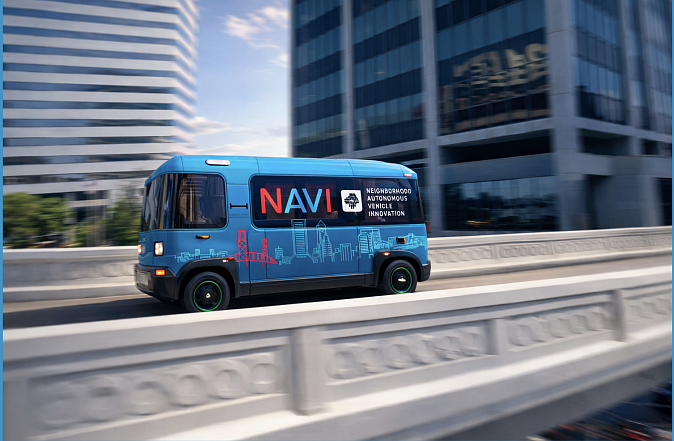
JTA has planned to convert the Skyway into a roadway for Neighborhood Autonomous Vehicle Innovation (NAVI) vehicles as part of the U2C.
The NAVI shuttles are part of the first phase of the U2C program. At $65 million, the initial phase provides autonomous vehicle service along a 3.5-mile stretch mostly along Bay Street.
Under the conversion option, the existing rail structure would be replaced with a dedicated roadway with ramp connections to ground-level streets at the Rosa Parks, Leila Street and Kings Avenue stops.
The option reduces further obsolescence risks and expands connectivity, JTA said, though major structural modifications would be required.
According to the JTA, capital improvements for the conversion would require $240.08 million of funding from the local option gas tax, plus $6.77 million for the U2C fleet.
Current NAVI vans were made by Ford Motor Co., though future vehicles are expected to be manufactured by Holon, a Germany-based company that plans to open a $100 million manufacturing operation in Jacksonville.
The JTA plans to reserve 100 electric self-driving vehicles from Holon for the U2C, including an initial batch of 14 that will be bought at $409,000 each.
Replacement with NAVI
Demolishing the Skyway structure would allow for construction of new street-level stations for NAVI vehicles, JTA said.
The option provides flexibility for growth of the system and improves Downtown sight lines, the JTA said. But removing the Skyway structure entirely could require JTA to pay back the federal grant, and there could be a high cost to remove the elevated structure and construct dedicated NAVI lanes.
Repurpose as multiuse trail
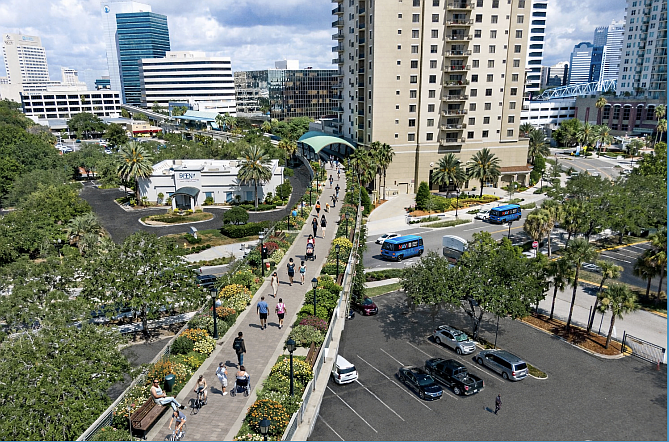
The JTA’s final option would forego vehicles altogether and instead transform the Skyway into a walking and cycling trail that would connect with the Emerald Trail network, the 30-mile network of multiuse paths under construction in and around Downtown.
NAVI vehicles would operate on streets within dedicated lanes.
This option allows flexibility for growth, the JTA said, though it would create slower travel times. JTA said it was uncertain whether the trail conversion would require repayment of the federal grant.