
Nearly seven years after agreeing to buy Worldpay Inc. in what came to be viewed as a failed deal, Fidelity National Information Services Inc., or FIS, shed its remaining stake in the payments technology firm Jan. 9.
Global Payments Inc. completed its previously announced acquisition of Worldpay in a deal that included FIS acquiring a credit processing business called Global Payments Issuer Solutions.
FIS had previously sold a 55% interest in Worldpay to private equity firm GTCR in early 2024 while retaining a minority stake.
Global Payments agreed in April 2025 to buy the entire business from FIS and GTCR in a deal that valued Worldpay at $24.25 billion.
FIS paid $43 billion to buy Worldpay in the deal first announced in March 2019.
The acquisition produced disappointing results for the Jacksonville-based financial technology company and investors soured on the deal by 2022. FIS’ stock dropped from about $150 in mid-2021 to the low $50s in mid-2023 before the company announced the agreement to sell a majority stake in Worldpay to GTCR, which valued Worldpay at $18.5 billion.
With the increase in value of Worldpay in the last two years, GTCR touted the sale of its stake to Global Payments as “one of the largest strategic sales in the history of the private equity industry” in a Jan. 12 news release.
Instead of dwelling on Worldpay, FIS touted its acquisition of Issuer Solutions in a Jan. 12 news release on the transaction. The company is renaming the business FIS Total Issuing Solutions.

“We are pleased to have closed this strategic acquisition ahead of schedule, enabling us to start 2026 in a strong position to deliver greater value to our financial institution and corporate clients,” FIS Chief Executive Stephanie Ferris said in the release.
FIS said Total Issuing Solutions processes more than 40 billion transactions a year with a client presence in more than 75 countries.
The company said it expects to generate an additional $500 million in adjusted free cash flow in 2026 with the addition of the business.
“We’re looking forward to capitalizing on the unique opportunities this acquisition brings to our Banking and Payments business and building momentum through the year,” Ferris said.
As analysts publish their outlooks on stocks for 2026, many are taking the same view on Jacksonville-based Regency Centers Corp.
They like the company’s performance but think its stock is fairly valued, leaving no room for big price increases.
Mizuho Securities analyst Haendel St. Juste downgraded the developer and operator of grocery-anchored shopping centers from “outperform” to “neutral” in his Jan. 8 outlook report on real estate investment trusts.
That followed two similar reports on Regency in December as KeyBanc Capital Markets analyst Todd Thomas downgraded the company from “overweight” to “sector weight” and J.P. Morgan analyst Michael Mueller downgraded it from “overweight” to “neutral.”
“We upgraded Regency to Outperform in July 2024 on a thesis that Regency should outperform peers because of a significant growth inflection that was primarily driven by its signed-not-occupied pipeline and its re/development pipeline,” St. Juste said in his report.
“Furthermore, we viewed Regency’s elevated exposure to grocery (about 80% of Regency’s centers are grocery-anchored) as a positive, offering further support in a volatile macroeconomic climate,” he said.
“Today, we see less relative opportunity for outperformance from Regency going forward given a slowing earnings growth profile and better valuation-adjusted alternatives within the space and our view that investors should trim exposure to Shopping Centers due to peak fundamentals and diminishing tailwinds from post-Covid occupancy recapture and signed-not-occupied pipelines.”
St. Juste said he is downgrading the entire shopping center sector to “neutral.”
However, UBS analyst Michael Goldsmith has a more positive view on the stocks.
“In our view, 2026 marks the beginning of a pivotal turnaround for REITs, offering an increasingly attractive risk/reward profile. We forecast total returns of 9%-11%, well
above 2025 of 2.9%,” Goldsmith said in a Jan. 8 report.
He said shopping centers are one of his preferred subsectors among REIT stocks.
“We think passing the historically challenging 1Q bankruptcy period should give investors more confidence in the group,” Goldsmith said.
He also said tenant demand is strong in high-quality grocery-anchored centers, but he maintained a “neutral” rating on Regency.
“We have a favorable view of the company’s suburban grocery-anchored portfolio and Regency’s clearly defined earnings algorithm which should drive consistent, sustainable growth,” he said
However, his rating “reflects our view that shares are currently fairly valued.”
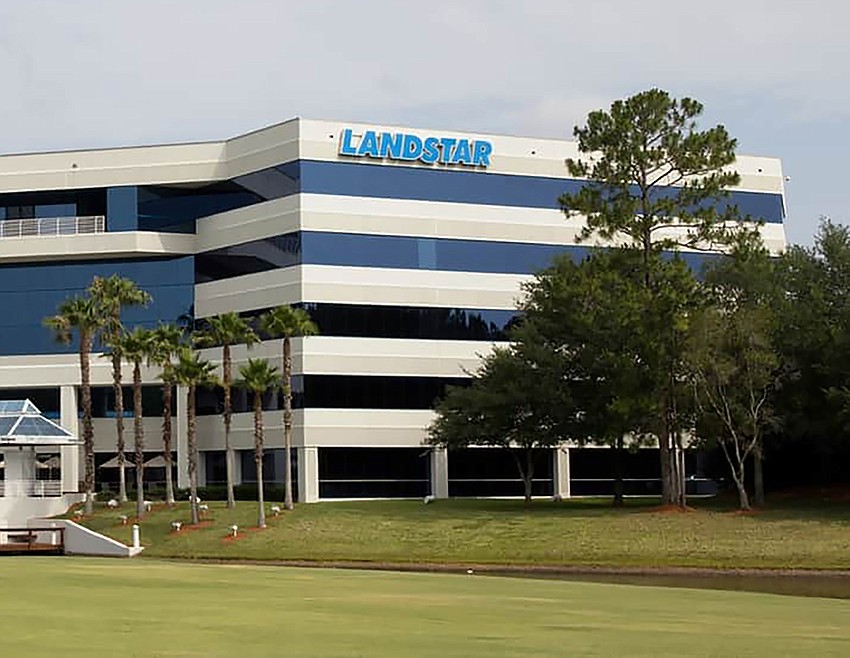
Wells Fargo analyst Christian Wetherbee upgraded Jacksonville-based Landstar System Inc. from “equal weight” to “overweight” on the prospects of improved conditions for trucking companies.
“We believe continued spot rate improvement is possible as truckload capacity is rationalized and demand is consistent/improves,” Wetherbee said in a Jan. 6 report on freight transportation stocks.
“Landstar’s BCO model and high degree of spot exposure provides more than average revenue exposure (both volume and yield) when the cycle inflects more positively,” he said.
BCOs are business capacity owners who own their trucks and contract with Landstar to haul freight.
“We observed early signs of stabilization in its BCO business in 3Q with loads ticking positive and revenue per load flattening and improving sequentially,” Wetherbee said.
Susquehanna Financial analyst Bascome Majors also sees better conditions for trucking companies.
“We’re finally seeing early signs of more material improvement in the truckload supply/
demand balance three-plus years into the post-pandemic freight recession,” Majors said in a Jan. 8 report.
However, he maintained Landstar at “neutral,” saying he is looking for attractive entry points to buy the stock.
Besides a recovery for trucking stocks, Wetherbee said his other key theme for transportation stocks is mergers and acquisitions in the railroad industry.

“We believe it’s less about Union Pacific & Norfolk Southern near-term and more about how others benefit. Intermodal is the focus of competition, and we think both (logistics company) Hub Group & CSX are positioned to benefit from share shift opportunities,” he said.
Wetherbee maintained an “overweight” rating on Jacksonville-based CSX Corp.
“CSX’s fundamentals appear to have bottomed, paving the way for mid-teens EPS growth in 2026 and 2027—well ahead of the peer average of about 10% in 2026,” he said.
“This outlook is driven by operational improvements, cost tailwinds, and strategic intermodal opportunities,” he said.
Safe & Green Holdings Corp. announced Jan. 7 it is changing its name to Olenox Industries Inc., the name of a business it acquired a year ago.
Safe & Green is a company that produced modular structures but expanded its operations with the purchase of Olenox Corp., which acquires and operates underdeveloped oil and gas assets.
Olenox founder Michael McLaren has been CEO of Safe & Green since January 2025.
Safe & Green was headquartered in Jacksonville for one year before moving its offices to Miami in 2023.
It now lists its headquarters office as a property it acquired last year in Conroe, Texas.
The company said the name change is part of a rebranding initiative for its operations as it becomes an energy and infrastructure solutions business.
“Under the Olenox Industries name, we are aligning our corporate identity with a fully integrated platform spanning energy, technology and infrastructure,” McLaren said in a news release.
“We are building a scalable, resilient business positioned to deliver long-term value across multiple high-growth markets,” he said.
Safe & Green trades under the ticker symbol “SGBX” but said it will change its symbol in line with the new corporate name.
Safe & Green reported revenue of $2.4 million and an operating loss of $8 million in the first nine months of 2025.

Firth Third Bancorp and Comerica Inc. moved closer to completing their merger with shareholders of both companies overwhelming approving the agreement at Jan. 6 special meetings.
The companies said the merger will create the ninth-largest U.S. bank with $290 billion in assets.
“We believe that this merger of two long-standing institutions will create new opportunities to drive innovation, foster deeper relationships, and deliver stronger support for the customers and communities we proudly serve,” Comerica CEO Curt Farmer said in a news release.
Cincinnati-based Fifth Third has 14 branches in the Jacksonville metropolitan area, according to Federal Deposit Insurance Corp. data. It has been in the Jacksonville market since a 2007 acquisition of Casselberry-based R-G Crown Bank, which had nine branches in Northeast Florida.
Dallas-based Comerica has no branches in the Jacksonville area but before agreeing to the merger, it had been seeking to hire bankers in North Florida to pursue middle market commercial customers.
Comerica has just five Florida branches, all in South Florida. Fifth Third has 192 offices in the state.
Fifth Third agreed in October to buy Comerica by issuing stock valued at $82.88 per Comerica share, based on the value of Fifth Third shares at the time.
Comercia’s stock was trading at $70.55 before the Oct. 6 merger announcement.
Fifth Third’s stock had risen 13% by the time of the shareholder meetings and with the increase in value, Comercia’s stock has risen to close at $92.45 Jan. 6.
Fifth Third said 99.7% of its shares voted in favor of the merger and Comercia said 97% of its shares voted in favor.
The companies expect to complete the deal in the first quarter of this year.