
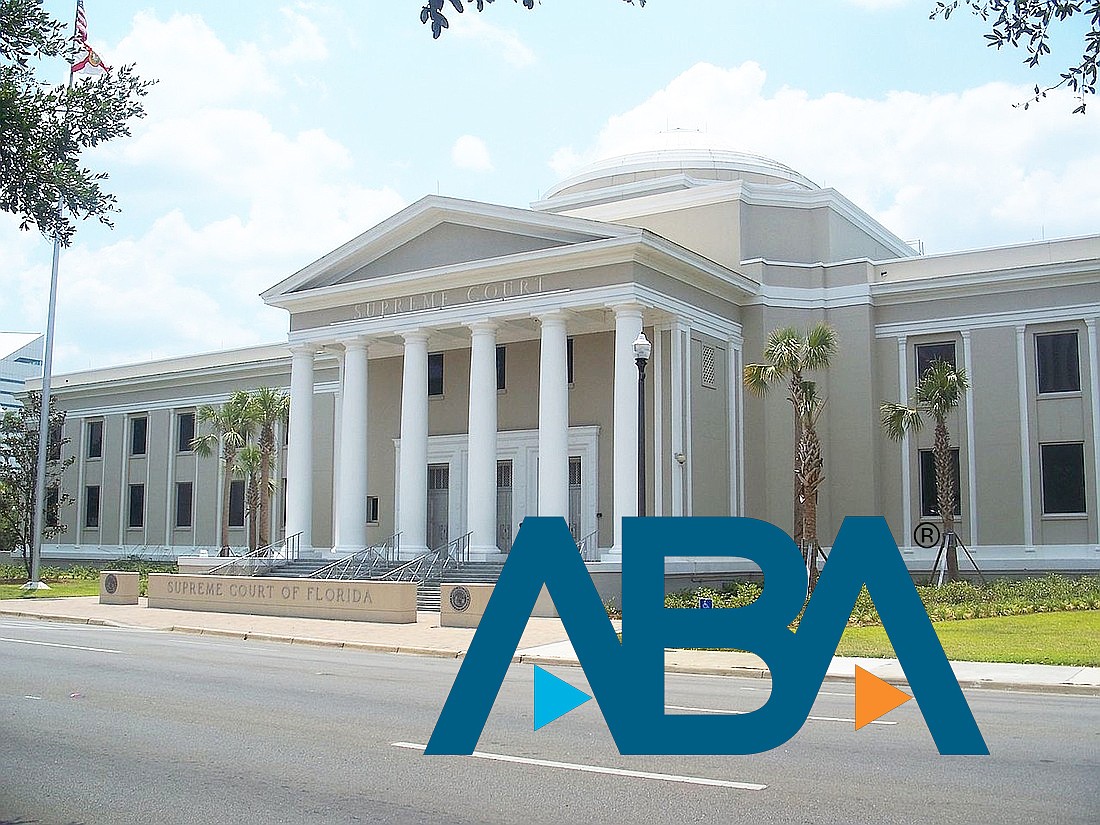
Under a rule amendment adopted by the Florida Supreme Court, the state will no longer rely on the American Bar Association as the sole accrediting agency for law schools whose graduates are eligible to sit for the state’s general Bar examination.
On Jan. 15, the court announced it had adopted the amendment to its Rule of the Supreme Court Related to Admissions to the Bar 4-13.2 (Definition of Accredited).
The court also adopted conforming amendments to Rules Regulating The Florida Bar 1-3.9 (Law Faculty Affiliates), 4-6.6 (Short-Term Limited Legal Services Programs), 11-1.2 (Activities), 11-1.3 (Requirements and Limitations), 11-1.8 (Practice After Graduation), 12-1.2 (Definitions), 20-3.1 (Requirements for Registration), and 21-2.1 (Eligibility) and Rule of the Supreme Court Relating to Admissions to the Bar 3-14.1.
The court appointed the Workgroup on the Role of the American Bar Association in Bar Admission Requirements in March 2025 to study the possibility of expanding law school accreditation opportunities. The group submitted its final report in October and the court, at its December conference, voted to approve the rule changes.
The motion states: “Based on its independent study and its consideration of the workgroup’s report, the Court is persuaded that it is not in Floridians’ best interest for the ABA to be the sole gatekeeper deciding which law schools’ graduates are eligible to sit for the state’s General Bar Examination and become licensed attorneys in Florida. Instead, the rule changes create the opportunity for additional entities to carry out an accrediting and gatekeeping function on behalf of the Court.
“The Court’s goal is to promote access to high-quality, affordable legal education in law schools that are committed to the free exchange of ideas and to the principle of nondiscrimination. To be clear, under the rule changes, graduates of ABA-accredited law schools will continue to be eligible to sit for the bar examination, and the rule changes do not preclude any law school from continuing to seek ABA accreditation.”
The court states that the effect of the amendment is to expand the accrediting agencies by which a law school may be approved or provisionally approved for purposes of graduate eligibility to sit for the state’s general Bar examination. At present, the ABA is the sole programmatic accreditor recognized by the U.S. Department of Education to accredit programs in legal education that lead to the first professional degree in law.
In the motion, the court acknowledges that additional programmatic accreditors for legal education programs may be recognized in the future and expresses its support for that possibility. The amendment is intended to accommodate that outcome, the motion states.
Chief Justice Carlos Muniz and Justices John Couriel, Renatha Francis, Jamie Grosshans and Meredith Sasso concurred. Justice Jorge Labarga wrote a dissenting opinion.
Justice Adam Tanenbaum, whose appointment to the Supreme Court was announced Jan. 14, was not involved in the evaluation or the opinion.
The amendments will become effective at 12:01 a.m. Oct. 1, 2026. Because the amendments were not published for comment before their adoption, interested persons have 75 days from Jan. 15, 2026, to file comments with the clerk of the state Supreme Court in Tallahassee.