
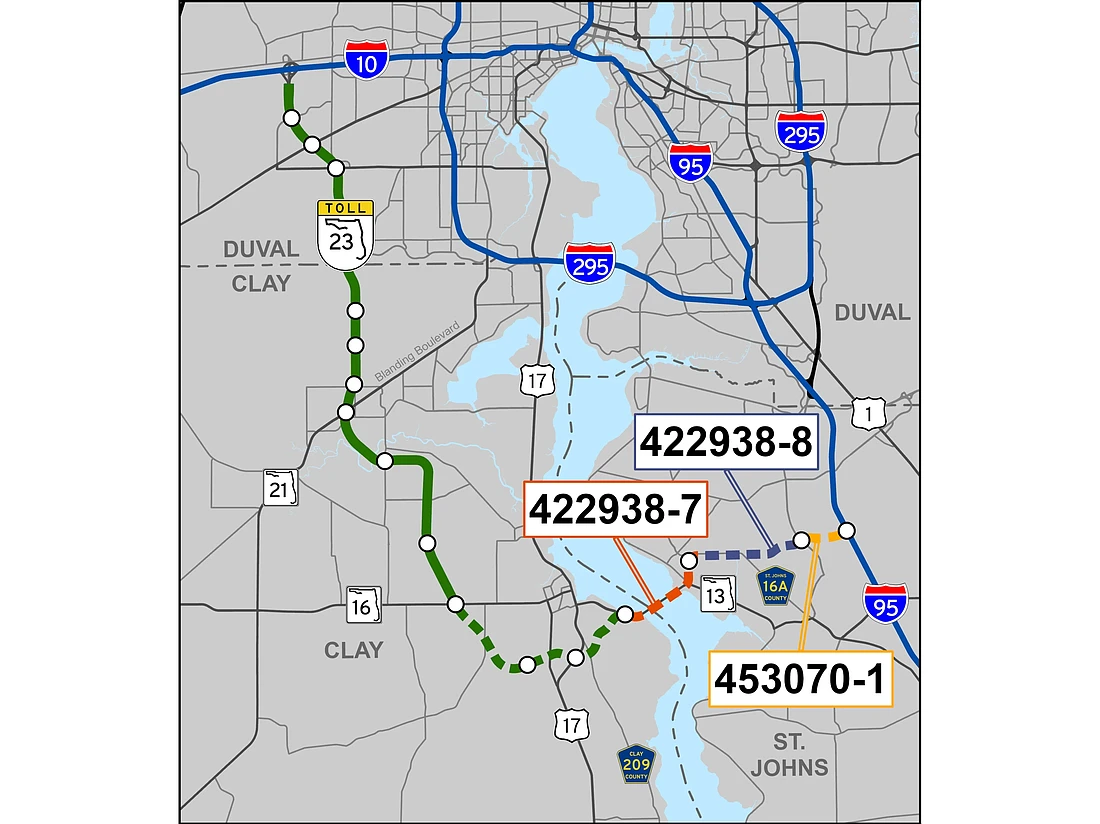
The Florida Department of Transportation has scheduled an open house in St. Johns County for residents to learn more about the third and final phase of the First Coast Expressway.
The event is set for 4:30 p.m. Feb. 3 at the World Golf Village Renaissance St. Augustine Resort. During the two-hour open house, attendees will be able to view project displays, ask questions and speak with members of the project team, according to a news release.
A virtual option will be offered during the same time period. Information and instructions for participating online are available at nflroads.com/virtualmeetings.
At full build-out, the expressway is planned as a 46-mile, $1.8 billion toll road connecting Interstate 10 in Duval County to I-95 in St. Johns County.
Medley-based MasTec Civil LLC is the general contractor for the $205 million third segment, which includes construction of about 2.7 miles of new four-lane, limited-access toll roadway. The project will include roadway resurfacing, earthwork, drainage improvements, installation of traffic signals, lighting, signage and tolling infrastructure. Construction is scheduled to begin in early February, with completion estimated in 2031.
The third phase also includes a new bridge over the St. Johns River just south of the Shands Bridge, which is intended to increase capacity and relieve congestion on major regional roadways, including Interstate 295, Florida 21, U.S. 17 and International Golf Parkway, according to the FDOT website.
The northwestern, first segment of the expressway was completed in summer 2019, with toll collection beginning July 13, 2019. It stretches from Interstate 10 to Blanding Boulevard, which is also called Florida 21.
The central, second segment runs from Blanding Boulevard in Middleburg south and then east through Green Cove Springs. Plans include a new bridge over Black Creek that is under construction near the Lake Asbury community in Clay County.
By staggering construction across fiscal years and dividing the project into separately funded segments, transportation planners were able to secure funding while keeping the project moving forward, according to FDOT.