
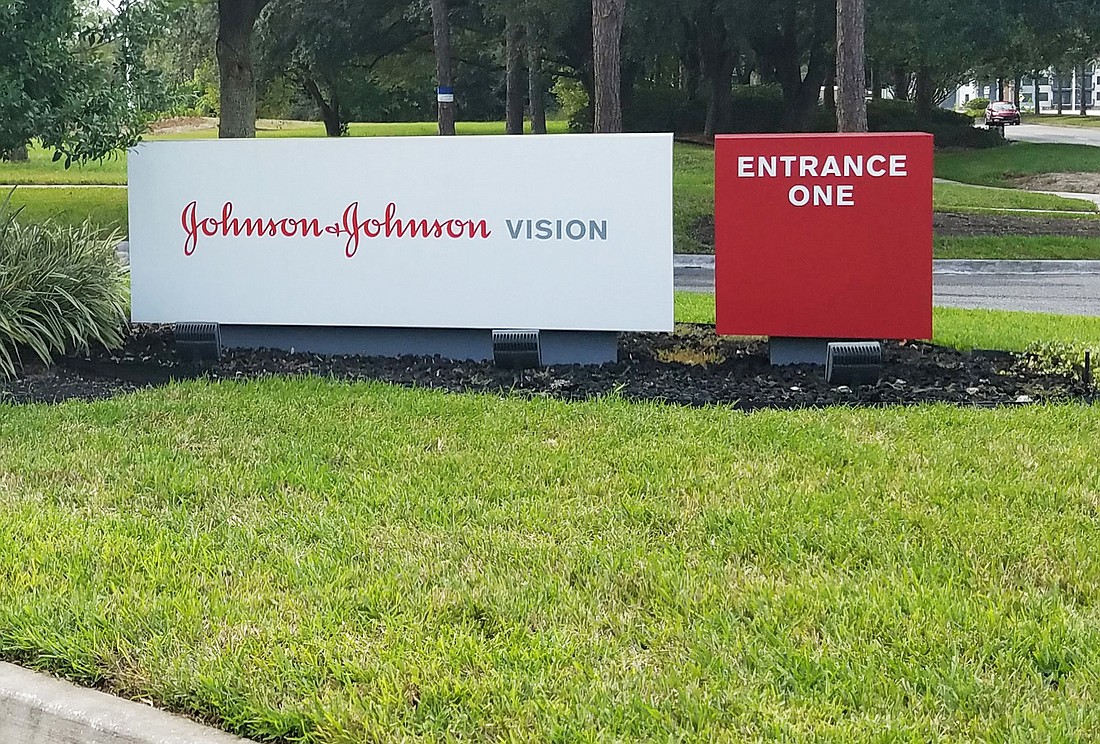
As Johnson & Johnson seeks city incentives to help expand its Jacksonville-based vision products subsidiary, company officials are touting the growth potential of the unit.
During a Jan. 21 conference call with analysts to discuss fourth-quarter results, officials of the New Jersey-based medical products giant said the company is developing new products in its contact lens and surgical vision business.
“We have doubled down and are really focusing on Vision as one of our three priority areas within MedTech,” said Tim Schmid, worldwide chairman of Johnson & Johnson’s MedTech division, according to a company transcript of the call.
The other two priority areas within MedTech are cardiovascular and surgery products.
Johnson & Johnson reported sales in the Vision business rose 6.8% to $1.42 billion in the fourth quarter and rose 5.3% for all of 2025 to $5.47 billion.
Contact lens sales rose 5.3% in the fourth quarter to $1.01 billion.
The company’s application for incentives with the city of Jacksonville said 90% of its contact lenses sold in the U.S. are made at its Jacksonville facility.
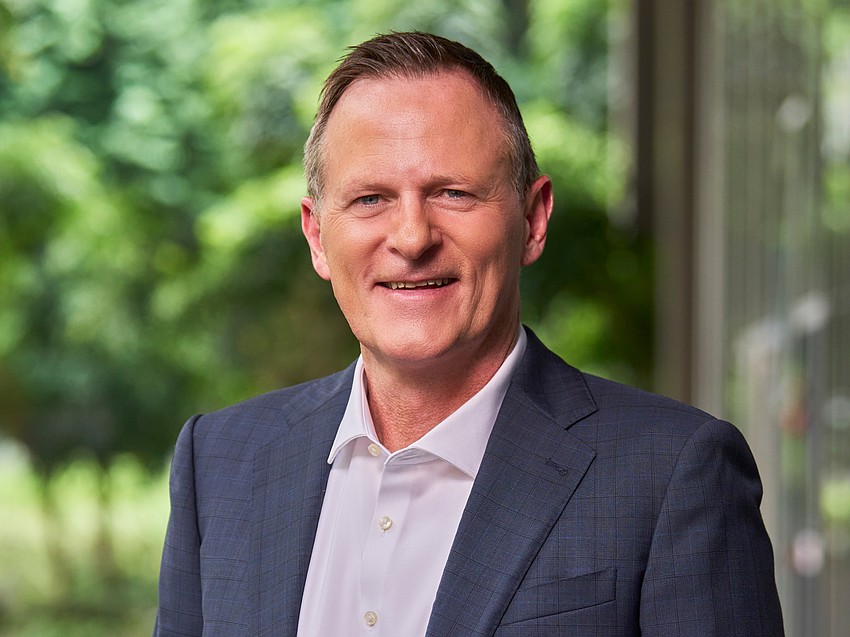
“Underlying demand is robust and we saw tremendous growth at roughly 5.3% with share gains driven by the continued rollout of our ACUVUE OASYS 1-Day family,” Schmid said.
“We’ve added to (the portfolio) with the addition of a product focused on multifocal astigmatism, the only product or only daily disposable available for patients suffering with both presbyopia and astigmatism. And so we believe that’s going to be a nice growth driver for the future,” he said.
Johnson & Johnson’s surgical vision products, which are made at facilities outside of Jacksonville, grew nearly 11% in the quarter, Schmid said.
“That’s all driven by our doubling down of our focus on premium intraocular lenses,” he said.
“We’re confident that our Surgical Vision business can continue to be a strong double-digit grower for the foreseeable future.”
Johnson & Johnson in October announced a plan to spin off its orthopedics business as a separate company, and Schmid said that process is helping the Vision subsidiary.
“We’re focusing very much on portfolio optimization, and I do think the ortho separation enables greater capital allocation to Vision, supporting both R&D, commercial execution, and digital transformation,” he said.
Johnson & Johnson Vision is seeking $12 million in city incentives to support construction of a packaging distribution facility in Northwest Jacksonville and install new high-tech equipment at its Southside campus, where the subsidiary is headquartered and contact lenses are manufactured.
Documents filed with the city Office of Economic Development said the company plans to invest $50 million for construction of the facility plus $500 million for the manufacturing equipment.
A publicly traded holding company said Jan. 22 it wants to discuss a merger with GEE Group Inc., but the Jacksonville-based staffing company has not responded to its inquiry.
Connecticut-based Star Equity Holdings Inc. criticized GEE Group’s acquisition strategy in a news release and said the company would be better off if it joined Star Equity.
Star Equity owns 5.4% of GEE Group’s stock.
“We believe strongly that becoming part of a larger entity is the best way to increase value for GEE Group’s long-suffering stockholders,” it said.
“Remaining a very small public company would be a poor outcome for JOB stockholders due to GEE Group’s high SG&A expenses, including public company costs, as a percentage of revenue. A combination with Star Equity would immediately eliminate the need for duplicative public company costs and create potential for future cost-saving synergies and other performance enhancing benefits,” it said.
“JOB” is GEE Group’s ticker symbol.
Star Equity reported revenue of $115.4 million in the first nine months of 2025, including $104.4 million from its business services division which provides recruitment services.
GEE Group reported revenue of $96.5 million in the fiscal year ended Sept. 30.
In a December conference call to discuss fiscal 2025 results, GEE Group CEO Derek Dewan said the company’s business has been impacted by weak demand for hiring that began in the second half of 2023.
Dewan also said the company has identified acquisition opportunities, but Star Equity said in its release GEE Group shouldn’t be pursuing additional acquisitions.
“In short, GEE Group wants to be a buyer, but it should be a seller,” it said.
In a Jan. 6 letter to Dewan, Star Equity CEO Jeffrey Eberwein said “we could be willing to pay a meaningful premium” above GEE Group’s end of 2025 stock price of almost 20 cents a share.
GEE Group said in a news release it "intends to privately and formally respond to Star in due course; as appropriate."
Despite reporting lower revenue and earnings for the fourth quarter and expressing a gloomy outlook for freight traffic in 2026, CSX Corp.’s stock rose to a 52-week high Jan. 23 after its earnings report.
“CSX set a sober top-line outlook for 2026 to low-single-digit revenue growth, underpinned by ‘modest volume growth’ on roughly flat industrial production, partially offset by company-specific initiatives,” Susquehanna Financial analyst Bascome Majors said in a research note after the report.
However, CSX officials outlined cost-cutting initiatives and said they expect profit margins to improve.
“Although the revenue guide concerns were spot on (low-single-digit growth on a very modest volume increase amid a challenging macro), the big upside surprise came from a margin expansion guide of 200 to 300 basis points,” or 2 to 3 percentage points, Evercore ISI analyst Jonathan Chappell said in his note.
“Investors wanted to see that the new CEO could drive margin reversion without help from the macro, and this guide gave them just that,” he said.
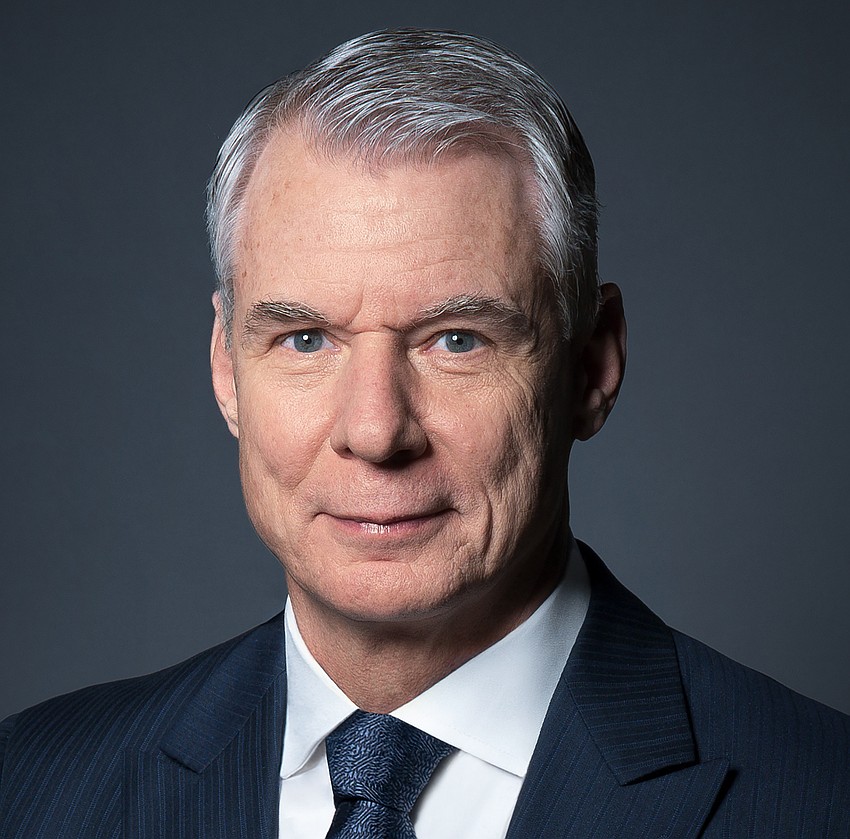
“Newly minted CEO Steve Angel’s focus on combining improved service with a unique internal (industrial development) strategy, while having a disciplined focus around ROIC (return on invested capital), could open growth conduits and market share opportunities over time that could ultimately drive earnings and FCF (free cash flow) longer term — possibly stronger than currently anticipated, in our view,” Raymond James analyst Patrick Tyler Brown said in his note.
Investors seemed willing to overlook the gloomy revenue outlook. CSX’s stock rose as much as $1.77 to $37.55 Jan. 23, after CSX’s report, which came after the market closed the previous day.
“Overall we characterize this as reflective of the sluggish freight environment; though we are encouraged by the fluidity of the network and the turning of the page on construction projects. Accordingly, we see the guide as a floor for what we hope will be better than expected quarters in 2026,” RBC Capital Markets analyst Walter Spracklin said in his note.
“We remain constructive on CSX in 2026, as we believe the stage is set for potential earnings beats in 2026,” he said.
Ahead of its fourth-quarter earnings report scheduled for late on Jan. 28, Landstar System Inc. said it will report lower revenue and its earnings will be reduced further by “highly elevated insurance and claims costs.”
Revenue fell 2.9% to $1.17 billion and earnings per share were expected to be 70 cents, down from $1.31 the previous year, with its results reduced by 49 cents in insurance and claims costs.
The Jacksonville-based trucking company said in a Jan. 21 Securities and Exchange Commission filing that it incurred costs of $11 million, or 24 cents a share, related to “two separate tragic vehicular accidents” which occurred in the fourth quarter. Landstar, which transports freight across the country, did not give details or the location of those accidents.
Landstar also incurred costs of $5.7 million, or 13 cents a share, resulting from a jury verdict in a case involving another accident.
Landstar said it acted as broker for that freight shipment, but not the motor carrier, and it is appealing that verdict.
The company also incurred costs of $5.3 million, or 12 cents a share, because of an increase in its claim reserves.
Besides the insurance and claims costs, Landstar said it also recorded $2.1 million, or 5 cents a share, in non-cash charges related to its ongoing process to sell its Mexico subsidiary.
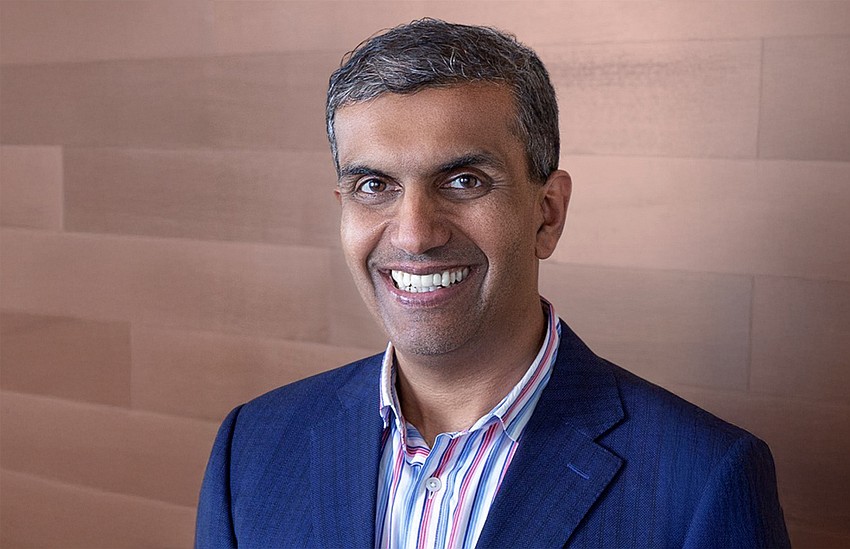
Fidelity National Information Services Inc., or FIS, said Jan. 22 it appointed Anil Chakravarthy to its board of directors.
Chakravarthy is president for the customer experience orchestration business at software company Adobe.
His appointment increases the size of the Jacksonville-based financial technology’s board to 10 directors.
“Anil’s expertise in customer experience orchestration and AI-powered solutions aligns perfectly with FIS’ strategic priorities and vision to unlock financial technology across the money lifecycle,” FIS Chief Executive Stephanie Ferris said in a news release.
Cadre Holdings Inc. said Jan. 20 it is raising its quarterly cash dividend from 9.5 cents per share to 10 cents, the third straight year it has increased the dividend.

Jacksonville-based Cadre manufactures safety products mainly for first responder markets.
“This latest increase underscores the strength of our financial position and our disciplined approach to capital allocation,” CEO Warren Kanders said in a news release.
“Complementing shareholder returns, we continue to maintain significant flexibility to further our strategy and invest in both core organic growth and M&A objectives that best serve our shareholders,” he said.
Cadre was one of the best performing stocks among Jacksonville-based companies in 2025, rising 26%.