
The city of Jacksonville could lose about $375 million in revenue should property tax reform approved by the Florida House of Representatives become law, City Council auditors said March 3.
House Joint Resolution 203, which the House passed Feb. 19 on a vote of 80-30, would gradually exempt properties with homestead exemptions from ad valorem taxation, outside of school district levies.
The exemption would phase in over 10 years, beginning in 2027.
The bill proposes an amendment to the Florida Constitution that gradually increases the state’s homestead exemption for nonschool district taxes by $100,000 each year. If approved by the state Senate, the joint resolution would lead to a statewide vote in November, which would need at least 60% support to become law.
The state Senate has not passed the House resolution or a similar measure, which is a requirement to put the issue on the ballot. Senate Appropriations Committee Chair Ed Hooper said in February the Senate’s measure would not be as “generous” as the House’s, according to National Public Radio affiliate WUSF in Tampa.
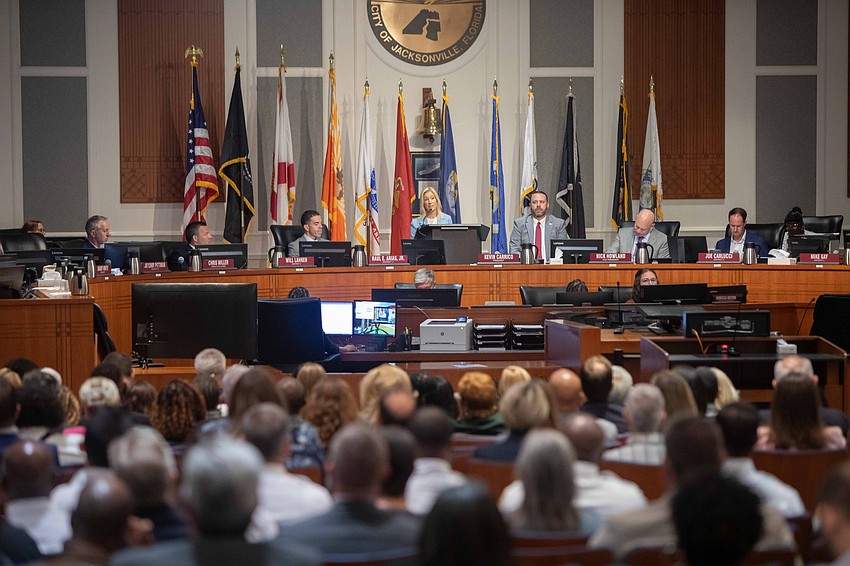
Based on figures from property tax collection in the 2025-26 fiscal year, Council Auditor Kim Taylor said the city would lose about $375 million in revenue in its 2026-27 budget if the House resolution were approved by the Legislature and voters.
Members of Jacksonville’s Finance Committee expressed concern that the city could be unprepared to take that revenue hit in the next budget.
The bill approved by the House does not allow local governments to reduce spending for law enforcement officers, firefighters and other first responders, which accounted for $1.2 billion of the 2025-26 budget, Taylor said.
“Non-JSO/JFRD (Jacksonville Sheriff’s Office/Jacksonville Fire and Rescue Department) funding is about $830 million. Within that number there is at least $170 million in costs that cannot be cut (e.g., unfunded pension liability costs, debt, and some state obligations), which leaves around $660 million,” Taylor wrote in an email to the Daily Record.
“Of that amount, using rounded numbers, about $130 million is personnel, about $140 million is other departmental costs, and the roughly $390 million is the remaining non-departmental line items.”
The $660 million funds city departments that include Public Works ($64.32 million); Parks, Recreation and Community Services ($57.78 million); and the Public Library system ($42.39 million), along with other departments and outlays for public health, nonprofits that provide some community services, incentives for economic development projects, Downtown redevelopment projects and other initiatives.
That spending would need to be cut by $375 million to make up for the revenue loss from the House resolution and meet a state requirement to set a balanced budget.

“If it’s $375 million, we can get rid of nonprofit (spending), everything we give to UF Health, every cash incentive can go away. And we’re about halfway there,” Council member Will Lahnen said.
In the 2025-26 budget, Council approved giving $56 million to the University of Florida Health Jacksonville to cover indigent costs. The city is scheduled to pay $44.61 million on completion grant incentives for Downtown redevelopment projects in the 2026-27 fiscal year, although Council and the administration have made an effort to identify funding sources for those ahead of schedule.
Among the nonprofit spending approved by Council in the 2025-26 budget were $57.11 million on the Kids Hope Alliance; $2.13 million in homelessness initiatives; $2 million for Journey Forward, which funds efforts toward neighborhood development economic development and violence prevention; and more.
“I think we need to be planning for something,” Finance Chair Joe Carlucci said.
“If we plan for nothing, then we’re going to be scrambling for two weeks in the middle of the budget.”
Carlucci suggested creating a subcommittee or a special committee within Council to plan for how property tax reform would affect the city’s budget.
Council President Kevin Carrico, who has the power to create such committees, did not immediately respond to a question from the Daily Record.
Mayor Donna Deegan is set to propose her annual budget in July, potentially four months before the statewide vote, and the Finance Committee will take it up in August.
“It’s way too early to make budget adjustments based on what may or may not pass,” Phil Perry, a spokesperson for the mayor’s office, wrote in a statement.
“Any property tax reduction bill still has to pass the Senate (there could also be a special session on the topic), go to the voters in a ballot referendum that passes with 60% approval, and then follow the to be determined implementation dates provided in the legislation, which would likely bleed into the following budget year. Regardless of what happens, Mayor Deegan will propose a balanced budget to City Council in July.”
A poll released March 4 by the University of North Florida showed that 56% of Floridians supported the phasing out of homestead property taxes.
Florida law requires that cities approve a balanced budget before the start of the fiscal year, which starts Oct. 1 for Jacksonville. The 2025-26 budget totaled $2.02 billion.
“The mayor is doing her budget review right now. They’re doing it in fantasy land,” Council member Rory Diamond said.
“There’s no criticism. They have to do it this way based on current projections.”