

As Otto Aerospace starts interior demolition toward its Jacksonville production facility to build business jets, the city is reviewing a permit application for a $12.1 million renovation of a Cecil Airport hangar for research and development.
Balfour Beatty Construction LLC is the contractor for the conversion of Hangar 825 at 6105 Flightline Road in West Jacksonville. The city’s permit March 23 allowed the contractor to move ahead with interior demolition of 59,130 square feet of space at a project cost of $500,000.
The Jacksonville Aviation Authority owns the property.
The conversion permit in review explains the building previously was used for aircraft maintenance, repairs and overhaul. The project will convert the space into an aircraft research and development facility.

Activities will include research, development, manufacturing and production operations for a small experimental aircraft, the permit application explains.
“The mixed occupancy facility provides industrial/storage spaces for aircraft and office spaces for engineering & general business,” it says.
About Otto
Texas-based Otto announced in June 2025 it would establish a facility to build its Phantom 3500 business jet at Cecil Airport. The company was known then as Otto Aviation but changed its name in September 2025.
Otto said it would build more than 600,000 square feet of office and manufacturing space by Jan. 1, 2032. Plans called for creation of at least 400 jobs at an average $90,000 salary by the end of 2031, with possible expansions that would increase the workforce to 1,200 by 2040.
Otto said it plans to relocate its headquarters to Jacksonville.
The company said its total capital investment in Jacksonville would be $430 million.
A letter with the permit from global integrated design firm DLR Group in Houston says by way of background that Otto Aerospace is relocating from Fort Worth to design and produce its flight test vehicles for the purposes of Federal Aviation Administration certification of the Phantom 3500.
Activities will include technical design and office work; small-component tooling and production; material and component testing; airframe assembly and maintenance; and painting, data logging and limited paint, welding and other fabrication work.
It says Hangar 825 is a former U.S. Navy structure on the west side of the airfield and its primary runway. Global aerospace company Boeing most recently occupied the structure, which is equipped with fire protection, a fire alarm and mechanical, engineering and plumbing systems that are more modern and updated “than the +/- 60 year age of the building overall.”
“While repairs are needed in a number of areas, the building is generally in operable condition, with many of the obvious deficiencies which would impact usabilty for OTTO” included in the scope of work, the letter says.
The Duval County Property Appraiser shows the buildings on the site were developed between 1970 and 2018.
Otto has said the first test flight of the Phantom 3500 is planned for 2027, with certification and deliveries targeted for 2030.
Otto said it designed the carbon-fiber twin-engine jet with fuel efficiency, extended range and reduced emissions in mind. The aircraft features a laminar flow design in which the fuselage is shaped somewhat like a football.
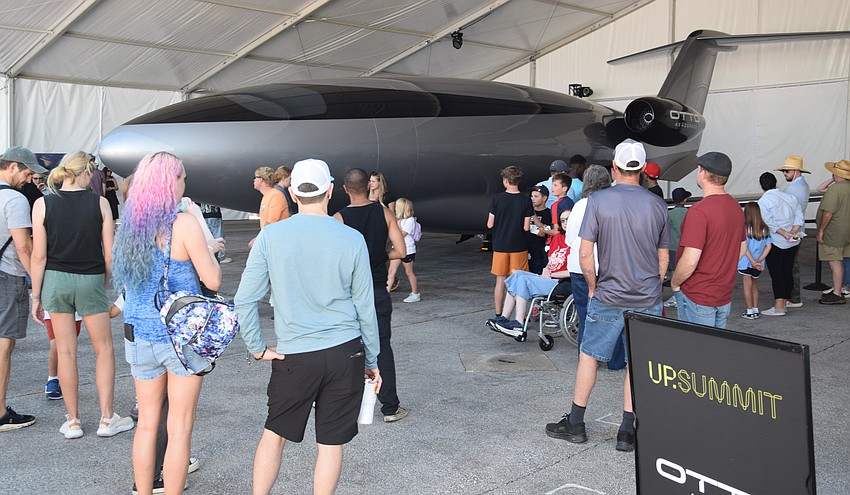
According to the company, the design reduces drag by 35% and fuel usage by more than 60% compared with traditional business jets.
“With a range of 3,500 nautical miles and a cruise altitude of 51,000 feet, the Phantom 3500 is poised to redefine the standards of business aviation,” Otto said in a release.
In September 2025, Cleveland-based Flexjet placed an order for 300 of the Otto jets.
Incentives for Otto
In May 2025, the JAA board approved an incentive package for Otto that comprised:
• A $22.5 million investment by JAA for site preparation and design/construction to extend taxiway E-1 to the property where Otto plans to build its facility.
• Abatements on rent and common area maintenance fees on Hangar 825, worth $3.73 million.
• Rent credits on Hangar 825, worth $1.5 million.
In June 2025, Jacksonville City Council approved a $20 million incentive package for the aircraft company. The 18-0 vote constituted final action on a 20-year, 75% Recapture Enhanced Value Grant for Otto.
A REV grant is a refund on added tax revenue generated by a new development.
Additionally, the state of Florida has approved more than $430 million in Corporate Income Tax Credits and High Impact Performance Incentive grants to facilitate the establishment of the manufacturing plant and long-term operations, which will occupy 80 to 100 acres at Cecil Airport.