
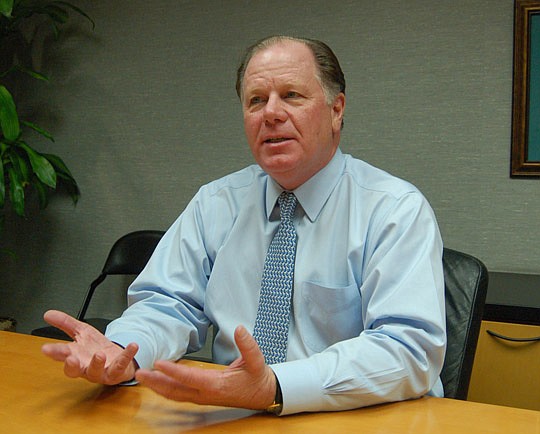
Mark Lamping is wrapping up his second full week on the job as the first president of the Jacksonville Jaguars in 15 years.
New Jacksonville Jaguars owner Shahid Khan, owner of Flex-N-Gate in Champaign-Urbana, Ill., named Lamping president on Feb. 13 and he started work Feb. 27. He joins General Manager Gene Smith and head coach Mike Mularkey in setting the direction of the Jaguars.
His professional career includes experience as a marketing executive with and CEO of New Meadowlands Stadium Co., where he ran MetLife Stadium. The company is the joint venture between the NFL New York Giants and the New York Jets to develop and operate the New Jersey stadium.
Lamping, 53, is a St. Louis native. He and his wife, Cheryl, have been married for 31 years and have three adult children.
He met with Daily Record reporters Tuesday afternoon at EverBank Field. These are excerpts from the interview.
If Peyton Manning goes to Denver, where does Tim Tebow go? Are you interested?
I am glad we’ve got smart people like Gene Smith and Coach Mularkey that’ll weigh in on what to do there.
Your opinion?
Whatever helps the team be in a position to give our fans what they want.
Define your role.
Gene Smith and I are basically peers. Gene has responsibility for all the football and I have responsibility for all the business and we both report to Shad.
How involved are you going to be in the business community and the community in general?
Very involved. I don’t think you can do a job like the job I have without being very involved. As an organization, we certainly take a lot out of the community and we need to be equal in terms of giving back to the community. I am moving here. I am going to establish roots here. We are in a rental place at the Beach and are looking to purchase a home shortly. My wife is in charge of that. I am going to let her focus on that and I am going to focus on the job.
How do you predict ticket sales?
They’re tracking really well. I think we would be in a stronger position in 2012 than we were in 2011. The pace that we’re on would suggest we should be optimistic, but we have a long way to go. We are now just getting into the new serious season-ticket piece of our sales challenge.
I’m optimistic, but we have a lot of work ahead of us.
Coming from iconic franchises in St. Louis and New York with large populations to draw from to a smaller market in Jacksonville, how hard will it be develop the fan base?
I’ve been fortunate enough to be involved in some successful situations in the past. Not all of them were sort of a slam-dunk success when you walk in the door. You want to be involved with things that are successful. I would not have made the commitment to come here if I didn’t think that we could be successful down here.
There are a lot of reasons why I think we can be successful. I tend to look at what we have and not at what we don’t have. We’ve got one professional team that does business in North Florida and Southern Georgia. I just came from New York where there were 10 major league teams, so there’s not a lot of clutter (in the Jaguars market).
All you have to do is to listen to the radio today. All they are talking about is football, and the overwhelming majority of that is about the NFL.
There is a huge number of football fans in Northern Florida and South Georgia and they are very knowledgeable and passionate fans. There is great potential.
Sometimes Jacksonville reminds me of St. Louis a little bit in a lot of different ways. One is the attitude. I came from St. Louis and sometimes in St. Louis we were our own worst enemy. We were very protective of things that were St. Louis. The other side of the coin was we were always a little envious of Chicago.
When you go through that, sometimes you don’t spend as much time focusing on those things that are really unique, and special, and different about where you are.
This is one of the most geographically desirable places to live in the country. If you live here you probably take it for granted a little bit. So there are some similarities between St. Louis and Jacksonville.
Think about the pride that Jacksonville had when the Jaguars came here. We shocked the world, right? You had all this great success and sometimes you go through tough economic times, and it’s hard to remember when it was really good.
I don’t know any reason why Jacksonville can’t sort of rediscover its swagger a little bit. There are a lot of wonderful things that have happened here, that are happening here and will continue to happen here.
All of the fundamental elements you need to be successful exist in this marketplace.
How do you develop the regional brand?
We’ve been given a great opportunity. We owe the community a product that they can be proud to support. The idea of being able to develop a regional brand, there is no question why it can’t happen. We just need to make it easy for people to do that.
We have to be really strong locally, so our focus is always going to be on our core, which is Jacksonville, and we need to try to grow the brand regionally, but not at the expense of what we are doing here. We have to realize Rome wasn’t built in a day.
If you want to build regionally, you can’t do it by simply deciding, hey this month we are going to do a little focus on Gainesville. You just can’t send 20 people into a sales market and say report back in a couple of weeks with how many tickets you sold.
You have to made a commitment to that community. Before you ask someone to do something for you, they almost have to feel inclined to help you out. We need to make a long-term commitment to those markets.
That means having our games broadcast (there), having a presence there in terms of players, coaches, staff, being sort of day-to-day as it relates to our presence in those markets, and then take the time to advertise, take the time to do outreach, take the time to try to build our business.
You can’t build your business by starting at, ‘would you please buy tickets to the Jaguar games?’ It has to start well before.
‘We care about this community, we are going to be a member of this community, we hope that you will feel good enough about us to want to get in a car and drive two hours to go to a game on Sunday.’
What’s your most important task right now?
To make sure that as an organization, we’re focused on providing our fans everything we possibly can to continue to earn their support.
How will you do that?
First, we have to make sure we’re all going in the same direction throughout the organization. Then, spend a lot more time listening to our fans than talking to our fans and be flexible enough and creative enough to give our fans what they want as opposed to giving them what we have available to sell.
Do you anticipate changing the game-day experience?
I haven’t had a chance to experience it, but I can tell you the game-day experience is one of the biggest challenges, in football probably more than any other sport.
The reason for that is obvious. There has been a very quick advancement in technology. The evolution of high-definition broadcasting, the pricing of very high-quality televisions has gotten within the reach of most of the community. So, the game-day experience has to be separate and distinct and different than somebody watching at home on their new 42-inch flat-screen.
It’s a great opportunity. The sports business is a great one in that your customers come to you. They come to us 10 times a year. We have the opportunity to do everything we can to sort of control that environment.
We have to realize the game-day experience doesn’t begin when they walk through the gate; it begins when they leave their home. It extends when they come into the parking lot, as they tailgate, as they enter the stadium, what happens during the game, what happens after the game and how they can efficiently get home.
If we do everything we can to make it a unique experience, to make it an enjoyable experience and one that fans can feel welcome, feel safe and feel they’re getting a great value, I think we can be successful.
It’s different today than it was just a couple of years ago.
In the time you have been here, have you been able to give the stadium the white-glove treatment to assess its pluses and minuses?
A little bit. Not as much as I had planned to. I’ve been sort of focused on our offices right now getting to know my co-workers. To be involved, to help where I can. To begin to set about defining the culture that is important to Shahid and that will slowly but surely grow. First up will probably be spending a lot of time with the stadium folks.
This is a little bit of different experience with me. I’ve always been involved with stadiums that we’ve owned and operated. We are a tenant, and a lot of our key guest services are outsourced. But the good news is, if you look at some of the customer service ratings, the game day staff here does an exceptional job.
So you are looking at building the fan base before considering a new stadium?
I’ll be involved with the stadium in the next couple of weeks, that’s for sure. But I’m not thinking at all, in any stretch of the imagination, that the development of a new stadium is anywhere near our short-term objectives. Some of the best stadiums that I have been involved with, some of the best stadiums in the country, continue to evolve. Stadiums that are built and don’t change in response to customers’ changing needs and desires are stadiums that get stale very quickly.
Whether a stadium is 15 or 16 years old or 20 to 25 years old, this stadium needs to remain sensitive to what the customers demand. It’s a more competitive marketplace than it has ever been. The economy has made it even tougher. You are asking a lot for somebody to spend their hard-earned money to go to a football game. You better make sure you are giving them what they want and what they expect. I will be spending a lot of time trying to figure out if there are ways to improve the guest experience as it relates to the stadium piece of that takeaway.
Is your staff set or are evaluations ongoing?
I think evaluations happen every day whether you’re the first year in the organization or the 10th or 20th. We are always evaluating how you can do things better and how we can work together. I’ve been very pleased with the staff that we have found here. Does that mean that there won’t be some tweaking? Obviously, every organization evolves. Sometimes that evolution happens quicker when there is an ownership change.
First we have to understand where we want to end up. We have to make sure that everyone is given the resources and the ability to make the decisions to get there. To be successful, we need to have a little higher level of accountability.
In an earlier interview, Shad Khan stated that his son, Tony, would have a role in the organization. Has that role been identified?
I’ve had the chance to be with Tony a little bit. I think Tony’s focus, right now, is he is still in Champaign. I think his initial assignments will grow naturally with what his expertise and skills are. Maybe you might see him spending a little more time helping in terms of helping support Gene and his staff in terms of developing and acquiring statistical information. Helping support the decision-making process.
Is bringing a Super Bowl back to Jacksonville on your agenda?
Not right now. Not for me. That’s a community assignment, not a Jaguars assignment.
Obviously, a Super Bowl is great for the community. If it’s important to the community, then there are a lot of people that would need to get involved to try to achieve that.
What keeps you in the sports business?
It’s unbelievably fun because of the energy of the people you work with and you’ve got this great dynamic in sports that your customers come to you. They come to your house and you have the ability to control the environment they’re in. That doesn’t happen very often.
I was young when I started working in sports. I’m not quite young now, but there are a lot of high-energy people who want to build a team.
It’s fun and I like to have fun when I work. I’m not the most serious person in the world and I know how lucky I am to have this job.
When I met with the staff, (I said) we have to remind ourselves how lucky we are. When your neighbor asks where you work and you say you work at the Jaguars, 95 times out of 100, they say, ‘that’s cool. That must be a great place to work.’
During a post-game interview, former Jaguars quarterback Mark Brunell said he thought he had the best job in the world because he was getting paid millions of dollars to play a game played by children in their backyard.
That’s right. I don’t think the compensation of the activity level is the same here but it’s still just as much fun. We are just as fortunate.
I like the business of sports. The business is totally different than the sport itself.
Having been fortunate enough to have talked to a lot of young people who wanted to get into sports (business), you have to establish right up front that No. 1, you’re going to have to work a lot more than you ever thought you were going to work. You’re going to be working weekends. You may get the opportunity to maybe cross paths with a player or a coach, but you’re not going to be around the players.
If you’re coming to work because ‘hey I love baseball or football,’ that’s not the right reason to come to work here. Wanting to provide great customer service is a great reason to work here.
These are small companies. This is a high-profile company in North Florida and Southern Georgia. We are by definition a small to midsize company. You would think we’re Fortune 500 given the amount of publicity we get, but we’re not.
That means everybody around here needs to be prepared to do a lot of high-level strategic work, but at the same time be the type of people who aren’t afraid to pick up trash when they walk through the concourse.
Has anything surprised you about Jacksonville as a community?
It’s a lot more like St. Louis than Manhattan, I’ll tell you that. I’ll tell you a story.
My wife and I like to get out and walk a lot. The first year up in New York, we lived in the city, so we were walking all the time. Everybody had so much on their minds, I bet in the 12 months that we lived at 65th and Broadway, two or three times, somebody said something when you walked by them on the sidewalk. That’s walking every day and passing a million people.
I came down to see Shad in the middle of January and spent an afternoon here. My wife joined me. You know how that goes. We stayed out by the beach. We got up the next morning and we were walking up the sidewalk and here comes a pack of bike riders. They came flying by and they say hello. They’re flying at 25 miles an hour and it’s ‘hey, how you doing?’
That, in a nutshell, is the difference between where I was and where I am now. It has been amazing how quickly we have met people and how people have reached out to try and help us.