
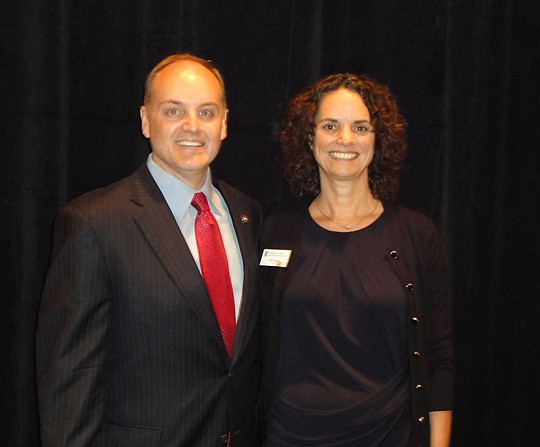
by Michele Gillis, Staff Writer
After the latest Florida legislative session, Realtors have a lot to celebrate.
With an additional $1.1 billion to spend this year, this year's Florida legislative session went a bit differently than in past years. Instead of all the drama of last year's budget shortfalls, legislators could focus on the task at hand which allowed most of the Realtor initiatives to be passed by the end of the session.
John Sebree, vice president of public policy for the Florida Realtors, explained the numerous victories to the Northeast Florida Association of Realtors last month at the Jacksonville Marriott.
According to Sebree, the budget surplus and the outcome from the 2013 legislative session proves that the real estate market is doing really well.
"The reason the legislature was working in a deficit or the reason they get to sit on a big pot of money is because you are not selling houses or you are selling houses," said Sebree. "When the real estate market is moving, there's a lot more money in doc stamp revenue coming into the legislature."
The main goals for the industry were sales tax on commercial leases, property insurance and affordable housing. They also addressed concerns about foreclosures, squatters/adverse possession and affordable housing tax loopholes.
Though no bills were passed regarding sales tax on commercial leases, Sebree is confident that legislators know how the Realtors feel about it and that it should pass in the next legislative session.
"The thing that really got them to feel for us on this topic this year is that we are the only state that charges sales tax on commercial leases," said Sebree. "That's a really big deal. The legislature loved hearing about his issue this year. It was a really incredible education campaign. We could kick ourselves that the bill didn't go anywhere this session, but we had to start somewhere."
According to Sebree, Publix told the legislators that if they get rid of the sales tax on commercial leases, they will commit to open five new stores in Florida.
"Think of the jobs that will be created," he said. "I think it is funny when those that do the scoring of the bills in the legislature say that doing away with the tax will cost $1.5 million. But the truth of the matter is that if you do away with the tax, the economic stimulus that it creates in the economy would more than make up for the loss."
The huge win for the real estate community were the bills that dealt with property insurance.
"We were able to get the Citizens clearinghouse provision in about five different bills," said Sebree. "Under current law in Florida, if you go into Citizens insurance, it should have been proven already that there isn't a private insurance company that wants your business."
This wasn't happening, and Sebree said there are many policies that can be taken out of Citizens right now.
"The clearinghouse now requires all insurance agents to run their policies through the clearinghouse to see how many other companies could write the policy," said Sebree. "If they will write it within 10 or 15 percent of what Citizens' rate would be, they have to put the policy in a private company. They are required to do it anyway, but they were not doing it."
Now, Citizens won't take any policies unless they have gone through the clearinghouse to prove that no other company can write their policy.
"This is huge win," he said.
As far as affordable housing, lawmakers allocated more than $200 million from the large national mortgage settlement last year to numerous housing programs.
$136 million will go to State Housing Initiative Program (SHIP) and State Apartment Incentive Loans (SAIL).
"That is wonderful because that is more money than they have received in many years," said Sebree. "Another $70 million will go to ancillary housing programs."
Foreclosure relief is on the horizon with the passage of HB 87. Currently, foreclosing on a mortgage is a long process in Florida, about 853 days, which is more than the national average.
"It lessens the time a lender can go after you for a deficiency judgment from five years to one year," said Sebree. "It also allows the lienholder to expedite the foreclosure process."
A major score was getting HB 903 passed, which deals with squatters and adverse possession.
"People were going into these houses that were empty and claiming adverse possession," said Sebree. "First of all, it is not adverse possession. It takes years and years to claim adverse possession. These were squatters."
Another win for the Realtors was HB 437 to ensure the tax loophole was closed which allowed for-profit affordable housing builders to form non-profit subsidiaries primarily to pay lower property taxes.
Sebree said other wins involved homestead rentals, hidden liens, green energy tax incentives, appraiser changes, septic tank study and unlicensed activity.