
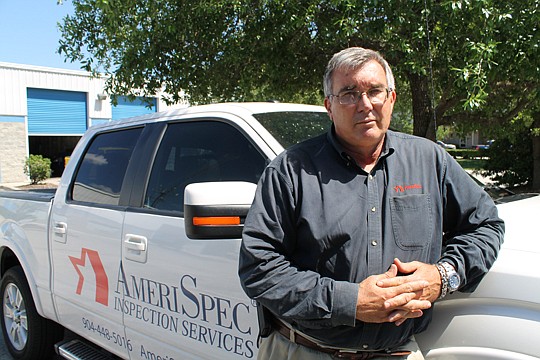
By Carole Hawkins, Staff Writer
Charles Gifford won’t pull any punches if a house he inspects has problems.
“Our forte is straight forwardness with no puffery,” said Gifford, owner of Amerispec of NE Florida. “We call it like we see it. Period. I’m not going to compromise who we are to get your business.”
That uncompromising nature can be a good thing.
Agents who want a satisfied customer for the long haul want that kind of inspection, he said.
So do builders who want to catch steps missed during construction.
Gifford began his career working for builders in Gainesville and Jacksonville. He was formerly a project manager for Richard Dostie at his Eagle Harbor and Fleming Island developments.
In 1992, Gifford purchased an Amerispec franchise and began running it on the side. Home inspection franchises were relatively new, and it was a chance to get in on the ground floor.
In those days, project managers could work from 6 a.m. to mid-afternoon, leaving Gifford enough time afterward to perform one inspection per day. The business grew until home inspections became his full-time job.
Twenty-two years later, Gifford runs a mid-size home inspection shop, with enough staff to meet any due-diligence period specified in a home purchase agreement.
Home inspection is an art not a science, he said, where relationships matter as much as pests and dry rot. Doing it well takes communication, a systematic approach, following protocols and a breadth of knowledge.
Good inspectors evaluate failure points in structures and guide clients towards the remedy. They also spot code violations — problems that can cause unsafe conditions later.
One recurring problem for Jacksonville has been failures with stucco construction.
In the 1990s, many builders misunderstood or ignored ASTM instructions for plastering stucco onto wood frame houses, and now water intrusions have invaded many wall cavities.
Some builders began using house wrap in the mid-90s. Others ignored it until in 2002, when the code authority required it.
“That’s a lot of houses,” Gifford said.
When there are problems on a used home, a good home inspection can help a Realtor negotiate a fair price.
On a new house, it can save builders from dealing later with steps that may have been skipped in the rush of construction, like forgetting to finish the attic insulation.
“I think builders are more receptive today to having inspections done on their property,” Gifford said. “It reduces their call backs if you discover things during the construction process. They aren’t going to have to take care of it two or three years down the road.”