
The landowners seeking a rezoning that would create a St. Johns County “agrihood” mixed-use development are pursuing three separate legal actions in response to the county commission’s denial of their request.
Among its actions, property owner Robinson Improvement Co. filed a complaint in the U.S. District Court for the Middle District of Florida on Oct. 22 that included claims that the county’s denial amounted to an unlawful taking of private property without compensation. In addition, the complaint contained an equal protection claim, saying the county treated the project differently from similar, but approved developments.
According to state records, Robinson Improvement Co. is headquartered in Jacksonville at the Garrett, Wood & Co., P.A. accounting firm. The company’s registered agent is Michael W. Garrett. The company’s president is William Travis Carter of Atlanta.
Robinson Improvement Co. is affiliated with the Robinson family and its descendants, which have owned the land for more than 100 years.
Developments cited in the complaint include Greenbriar, which is planned as a mixed-use development allowing up to 3,500 homes and 2.5 million square feet of nonresidential space, and Silverleaf, which is zoned for 17,600 homes and 2.9 million square feet of nonresidential space.
Also on Oct. 22, Robinson Improvement served the county a notice of claim under Florida’s Bert J. Harris Jr. Private Property Rights Protection Act, a pre-suit notice. The statute allows property owners to seek relief in claims that government action unfairly limits the use of their land.
Those two steps came after Robinson Improvement filed a petition Oct. 3 in St. Johns County Circuit Court seeking to overturn the commission’s decision to deny the rezoning. The petition functions as an appeal, arguing that commissioners acted incorrectly when they denied the request.
The rezoning request
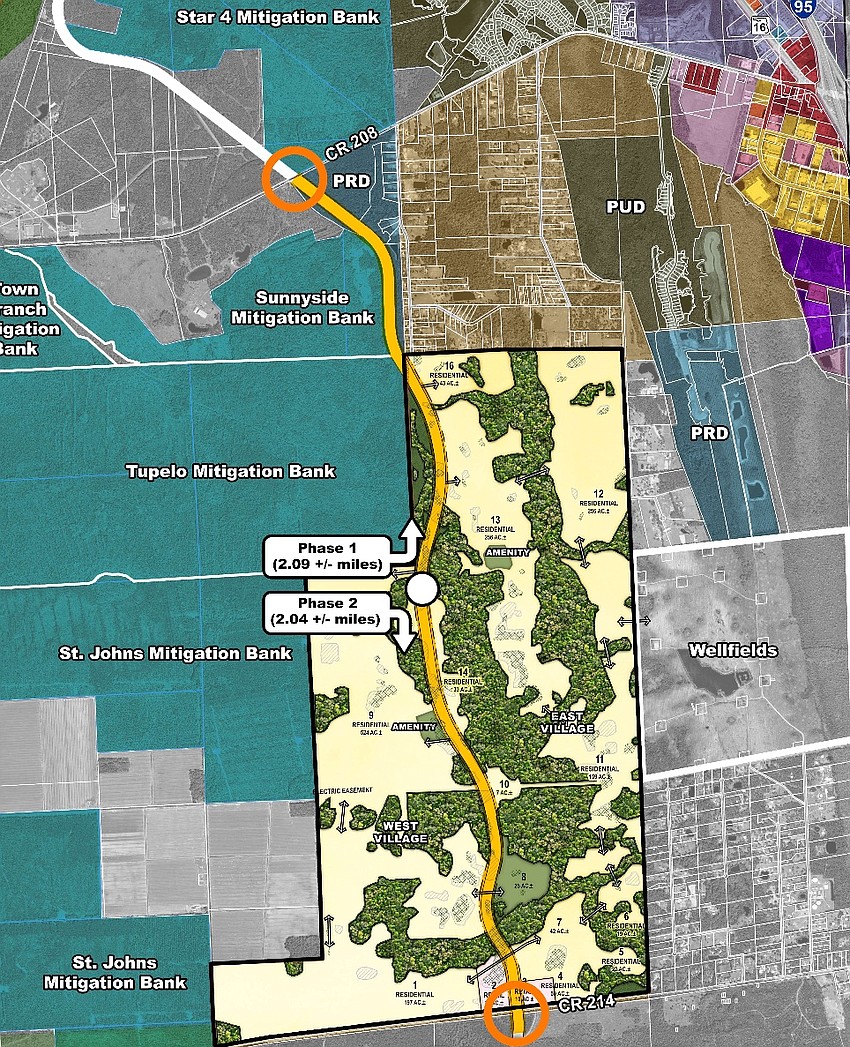
Robinson Improvement seeks to rezone 2,600 acres from Open Rural to Planned Urban Development between County Roads 208 and 214, just west of Interstate 95. The agrihood project could involve up to 3,332 residential units, including up to 2,077 single-family homes, 340 townhomes and 915 age-restricted single-family units, along with commercial and other uses.
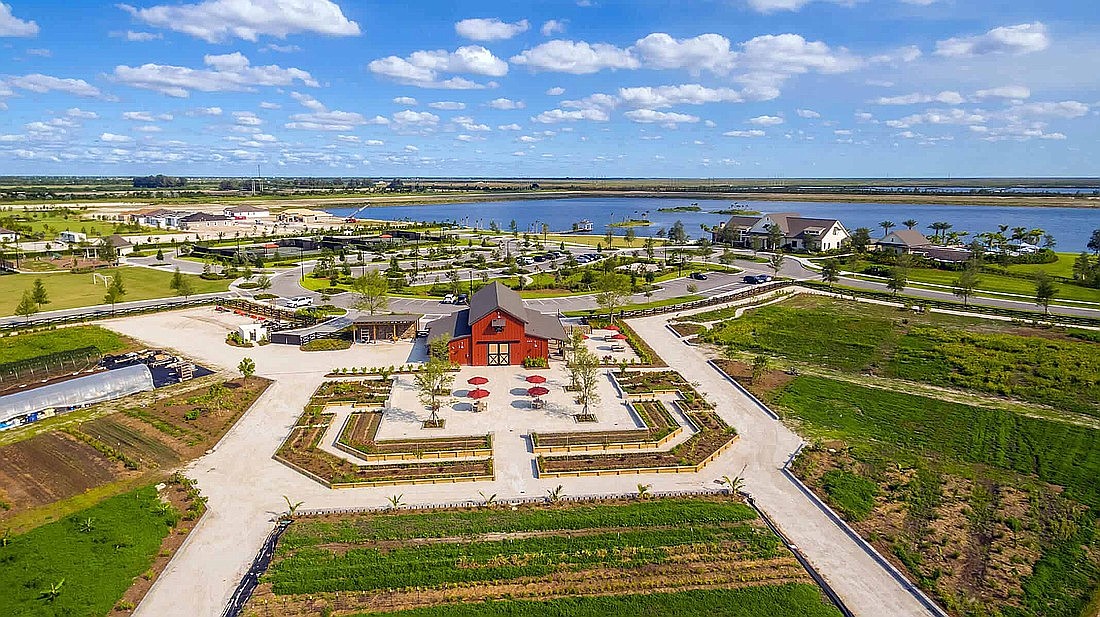
According to Freehold Communities, the Boston-based developer once on tap to oversee the Robinson Improvement project, “Agrihoods are defined as an organized community that integrates agriculture into a residential setting.”
The land has been used for timber harvesting for more than 100 years, according to documents filed by Robinson Improvement.
The dispute centers on the expansion of County Road 2209, which is designed to ease congestion by diverting traffic from I-95 for about 7 miles. In exchange for development rights, Robinson Improvement agreed to build a 4-mile stretch of the road that would run through the agrihood property. It also agreed to donate about 7 acres to the county to support the roadway project.
The county has until Dec. 21, 2027 to request the donation of a portion of the land needed for County Road 2209, for which it holds rights. After that, the county would have to pay for the acreage.
The St. Johns County Board of County Commissioners unanimously voted to deny Robinson Improvement’s rezoning request in November 2024. Commissioners cited concerns of traffic impacts, timing and lack of a detailed site plan.
Circuit Court Judge Howard Maltz issued an order Oct. 16 requiring the county to provide, in writing, its reasoning through an order to show cause, giving it 60 days to respond.
In its notice of claim, the company estimates the loss in fair market value at $46.5 million. Robinson Improvement is giving the county 90 days to compensate the landowner, agree to arbitration or mediation or issue a written statement of allowable uses.
Magistrate’s recommendation
The dispute comes amid continued debate over growth and land use in St. Johns County, where several residential and commercial projects have faced opposition from residents, county commissioners and the Planning and Zoning Agency in recent months, including Tocoi River Estates, a smaller development of 205 homes about 9 miles west of the agrihood land.
Citing a need for more information, the St. Johns County Board of County Commissioners voted Sept. 16 to delay a decision on a special magistrate’s recommendation, which sided in part with Robinson Improvement.
In August, Circuit Court Judge J. Michael Traynor’s nonbinding opinion found the county’s denial of the PUD application unfairly burdened the company’s property rights. He recommended approving a revised PUD requiring the County Road 2209 segment to be built before homes are occupied, capping units at 350 by 2031 with phased limits, creating large-lot buffers near neighbors, and setting aside land for a fire station and a school. Robinson Improvement agreed to those provisions.
Traynor concluded that the company had a reasonable expectation that the site could be rezoned, consistent with a 2019 decision by the county commissioners to change the land use from Rural Silviculture to Residential-B as part of its comprehensive plan.
The board did not set a date for when the issue will return, leaving the status of the project — and the county’s legal strategy — unresolved.