
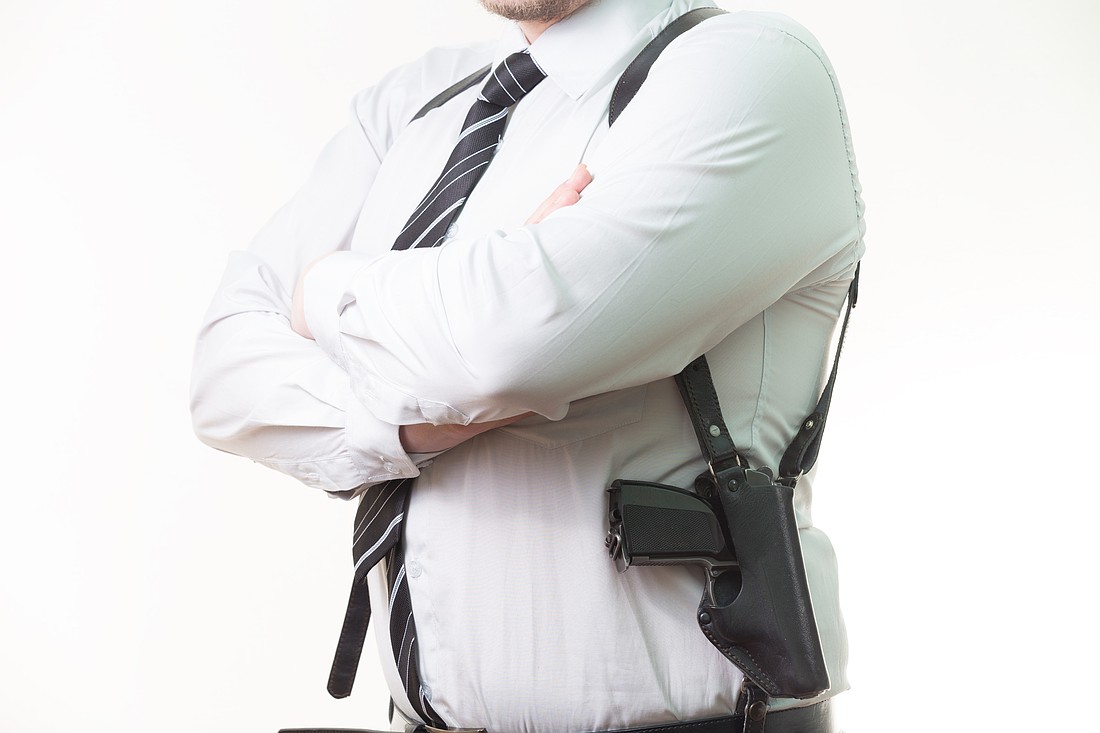

A recent advisory opinion from Florida Attorney General James Uthmeier has sparked discussion across Florida’s legal communities about whether prosecutors’ right to carry firearms extends to the place where justice is most visibly served.
In October, Uthmeier opined that state attorneys, assistant state attorneys and their investigators are legally permitted to carry firearms into courtrooms.
He correctly points out that prosecutors fall within the definition of law enforcement officers in Chapter 790, Florida Statutes. Among other things, Chapter 790 exempts those defined as law enforcement officers from licensing requirements and from the chapter’s penal provisions.
Uthmeier’s opinion was prompted by a dispute in Florida’s 12th Judicial Circuit, where Chief Judge Diana Moreland issued an administrative order allowing state attorneys and their staff to carry firearms into court facilities where their offices are located, but not into courtrooms or courthouses without prosecutors’ offices.
State Attorney Ed Brodsky disagreed with the administrative order and sought clarification from the attorney general who concluded in his advisory opinion that the order contravened Florida law.
Section 943.10, however, defines a law enforcement officer as a person with the authority to make arrests – something attorneys in state attorneys’ offices cannot do.
Chief Judge Moreland’s administrative order, titled “Security and Operations of Court Facilities,” relies on that statute to disallow prosecutors from carrying firearms or weapons into courtrooms and other restricted areas.
Supporters of Uthmeier’s stance argue that prosecutors often face threats stemming from their work and should enjoy the same rights as other law enforcement officers to protect themselves both inside and outside the courtroom.
There is, however, obvious room for concern in introducing more firearms into an already tense environment where armed bailiffs are already responsible for security.
Between 4,000 and 5,000 people enter the Duval County Courthouse each day.
Prosecutors work in close proximity to defendants, witnesses, and others whose lives are often dramatically affected by what happens in courtrooms across the state.
And again, prosecutors are not required to be licensed or obtain firearms training before carrying a weapon.
Beyond the practical concerns, deeper questions arise about the symbolic implications of introducing more firearms into the courtroom.
These spaces are designed as sanctuaries for reasoned argument, where disputes are resolved through law rather than force.
The presence of armed lawyers risks subtly reshaping perceptions about how justice is administered.
Could an armed prosecutor alter the dynamic between the state and the defense?
Might jurors interpret a visibly armed prosecutor as an implicit signal of danger, unintentionally eroding a defendant’s presumption of innocence?
And if prosecutors are permitted to carry, why shouldn’t defense attorneys or other courtroom participants claim a right to do the same?
These are not mere abstractions; they go to the heart of what the courtroom is intended to represent.
The wisdom of arming prosecutors in the courtroom can be debated, yet the legal reality remains that Moreland’s directive carries more weight.
The attorney general’s opinions, by contrast, are advisory and not binding. Judges’ administrative orders have the same effect as other judicial orders.
They are to be followed unless overturned by a higher court.
Regardless of one’s position, the issue serves as a reminder that even well-meaning efforts to promote safety can raise unexpectedly complex questions at the intersection of law, policy and reason.
Brian Coughlin is the president of the Jacksonville Bar Association for 2025-26. He is a director at Bedell Law Firm, focusing on criminal justice matters.