
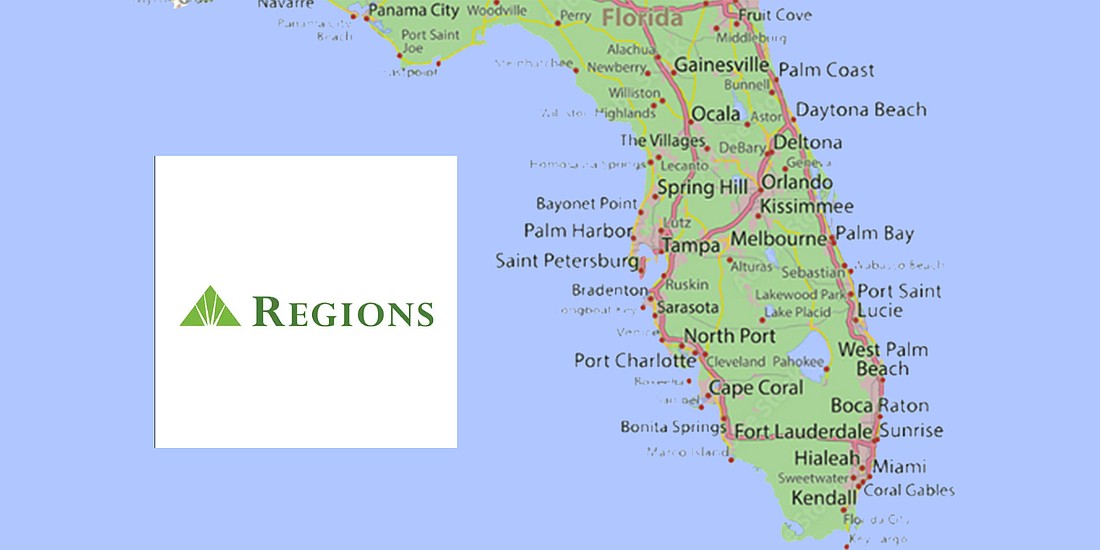
Forty years after new laws first allowed out-of-state banks to enter Florida, the state continues to be a target for expansion.
The list of banks that want to cash in on Florida includes Alabama-based Regions Bank, which already has a large presence in the Jacksonville area and the rest of the state.
The latest data from the Federal Deposit Insurance Corp. said Regions had 1,250 branches in 16 states as of June 30, 2025, with 270 of those in Florida, including 14 in the Jacksonville metropolitan area.
At an investor conference last month, Regions Financial Corp. CEO John Turner said the bank may add 16 to 20 branches in Florida as part of a plan to grow by 135 to 150 offices over the next five years.
He cited Miami as its main target in the state but in response to a question about growth in the Jacksonville market, a company spokesman said by email that the bank may expand in Northeast Florida.
“While we expect the greatest level of activity in Miami, Atlanta, Houston, Memphis and Nashville, we are evaluating our entire footprint – with a focus on Florida,” he said.
“The goal of this strategy is to ensure we have the right number of branches in each market, located where customers live and work, and that each branch delivers a modern, differentiated experience aligned with how customers bank today,” he said.
At the March 11 RBC Global Financial Institutions Conference, Turner said branch growth by JPMorgan Chase & Co. has caught his attention.
JPMorgan Chase Bank has been growing in the Jacksonville market over the last two years. The latest FDIC data shows Chase Bank has 29 branches in the metro area, up from 20 two years ago, and the company recently said it plans to add four more.
“With respect to the likes of JPMorgan, who are building branches in our footprint, we’re always looking at branch applications across our footprint, so we know who’s opening what branches when and where,” Turner said, according to a company transcript of his presentation at the conference.
Turner said Regions looks at data on relationships by its customers with other banks in its markets.
“As they begin opening their branches, we’re countering that activity with outreach with different kinds of offers and things to ensure that we maintain those relationships,” he said.
Although many customers do their banking online, Turner believes brick-and-mortar offices are important.
“We find customers still associated with branches. They want to come into branches when they need advice and guidance, when they have a problem, when they are doing something that they don’t have a lot of experience doing or it’s the first-time event,” he said.
“We think branches still provide an important connection to our brand.”
American Banker reported last month that several out-of-state banking companies are expanding in Florida with a focus on South Florida, including Ohio-based Huntington Bancshares, New Jersey-based Valley National Bancorp and West Virginia-based WesBanco.
The newspaper said strong deposit growth at South Florida banks is attracting interest from out-of-state institutions.
Data provided recently by another bank that is not looking at Florida suggested Jacksonville is one of the most attractive deposit markets in the country. However, the data is not what it seems.
An investor presentation by Mineola, New York-based Hanover Bancorp Inc., which operates exclusively in the New York City metropolitan area, was intended to highlight the attractiveness of the New York market.
The presentation included a slide of the top 10 U.S. metro areas for bank deposits per branch that showed Jacksonville ranking ninth with $426 million in deposits per branch. New York ranked third at $829 million.
The latest FDIC data showed 256 commercial bank branches in the Jacksonville metropolitan area with $118.65 billion in total deposits, or about $463 million per branch.
However, those numbers are inflated by a large number of deposits credited to just two offices in Jacksonville.
Bank of America is listed with $63.1 billion in deposits in its Jacksonville branches. That includes $58.6 billion credited to its branch at 9550 Regency Square Blvd.
That doesn’t mean Jacksonville residents are flooding the branch with deposits. That reflects a large number of institutional accounts of the bank that are credited to that single branch.
EverBank is listed by the FDIC with $29.2 billion in deposits, including $27.2 billion in deposits at its headquarters office at 301 W. Bay St. in Downtown Jacksonville.
EverBank does much of its business online with depositors all over the country, and those deposits are credited to the single branch.
Eliminating those two branches from the total brings the total amount of deposits at the remaining 254 branches in the market to $32.8 billion, an average of just $129 million per branch, well below the total reported by Hanover Bancorp.
Shoe Carnival Inc. is moving full speed ahead with its plans to change the corporate name to Shoe Station Group Inc.
However, the footwear chain controlled by former
Jacksonville Jaguars owner Wayne Weaver is slowing the pace of conversions of Shoe Carnival stores to Shoe Station.
The company announced plans last year to convert most of its stores to the Shoe Station brand, which targets a higher income customer than Shoe Carnival.
After converting 101 stores to Shoe Station in fiscal 2025, 34% of the company’s 426 stores now operate under that brand.
“When we evaluated the performance of those 101 stores, particularly the second-half results, we observed meaningful variability in in-store sales performance across the converted locations,” interim CEO Cliff Sifford said in a March 27 conference call with analysts.
“Some stores are performing very well. Others have not yet achieved the results we expect from the model,” he said.
As a result, Shoe Carnival is slowing down the pace of conversions as it evaluates market data. It plans to convert only 21 more stores to Shoe Station over the next six months.
“We are not stepping back from our rebanner strategy. We are being disciplined about its pace and targeting,” Sifford said.
“We recognize that (the) Shoe Carnival banner continues to serve an important customer base in a meaningful number of locations, and we will continue to manage both banners with discipline and intent,” he said.
However, the company expects to change the corporate name to Shoe Station as planned after its June annual shareholders meeting.
Shoe Carnival reported sales in the fourth quarter that ended Jan. 30 fell 3.3% to $254.1 million and sales at stores open for more than one year fell 3.5%.
Earnings fell by 20 cents a share to 33 cents.
The company projects fiscal 2026 earnings of $1.40 to $1.60 a share, down from $1.90 in fiscal 2025. The company estimated 2025 earnings were reduced by about 66 cents per share because of its investment in the rebanner strategy.
Earnings were $2.68 a share in fiscal 2024.
Weaver is chairman of Shoe Carnival and its largest shareholder. He and his wife, Delores, control 31.7% of the stock.
Community First Credit Union of Florida reported earnings quadrupled in 2025 to $27.97 million, with assets growing 10% to $3 billion.
The 90-year-old Jacksonville-based credit union said membership grew by 5.8% last year to 188,741.
“Our expansion into new markets has resulted in record deposits, strengthening our lending capacity and fueling the success of our commercial lending portfolio,” CEO Sam Inman said in a March 25 news release.
Community First opened two new branches in 2025 and has 24 offices and more than 450 employees.
Jacksonville-based Cadre Holdings Inc. said March 26 it agreed to acquire Alien Gear Holsters for $10.3 million through a court-supervised bankruptcy auction.
Idaho-based Alien Gear’s parent company, Tedder Industries LLC, filed for a Chapter 11 bankruptcy reorganization in December.
Cadre, which provides equipment for law enforcement, first responder, military and nuclear markets, has a strategy of expanding through acquisitions.
The addition of Alien Gear would be its seventh acquisition since going public in 2021.
“This transaction represents a compelling opportunity to acquire a recognized holster brand with an established direct-to-consumer presence, Cadre President Brad Williams said in a news release.
Cadre expects to close the deal in the second quarter, subject to bankruptcy court approval.

Jacksonville-based ParkerVision Inc. reported a 2025 net loss of $7.4 million, or 6 cents a share.
The Jacksonville-based developer of wireless technology had no revenue last year as it continues to focus on several lawsuits against major telecommunications manufacturers alleging they have infringed on ParkerVision patents.
Several trials that ParkerVision had expected to begin have been delayed in the past year. In a March 23 news release, CEO Jeff Parker said despite the delays, “we still believe that 2026 will be a pivotal year for ParkerVision’s patent enforcement activities.”
ParkerVision had $4.4 million in cash and cash equivalents on its balance sheet at the end of 2025 and about $2.3 million in working capital.