
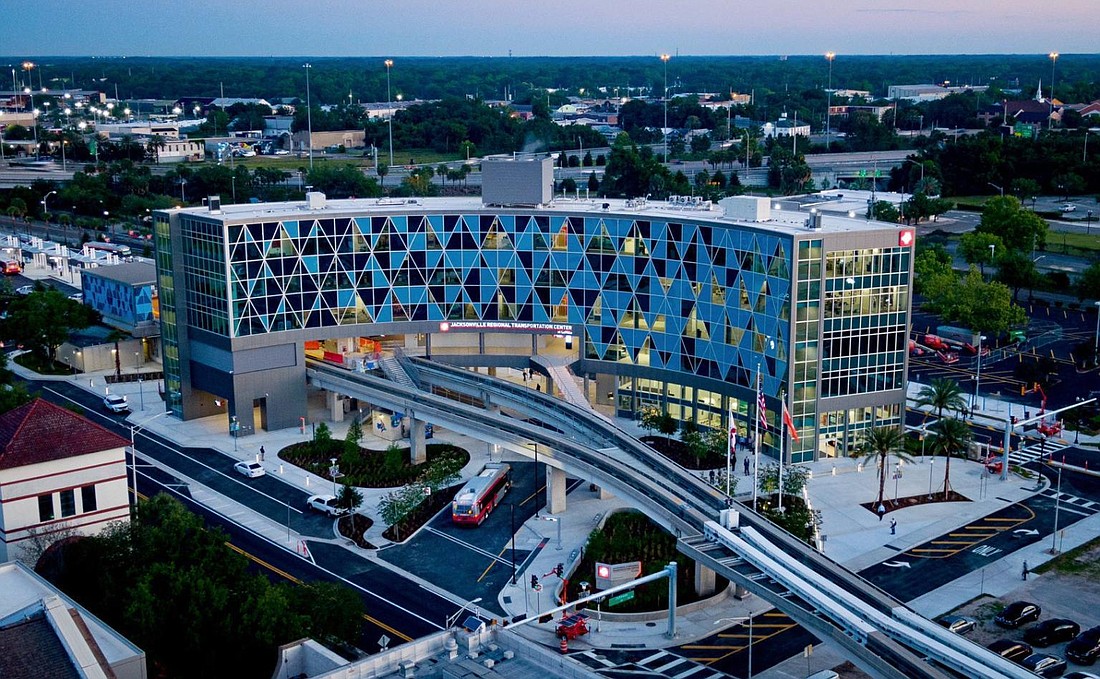
Board members of the Jacksonville Transportation Authority took further steps to replace CEO Nat Ford during an Aug. 4 meeting, setting plans to name an interim CEO in several weeks and later hire a long-term successor.
Board members said they expect to hire an interim CEO during their Aug. 27 board meeting. The interim hire would already be a JTA employee applying for the role and would remain eligible for consideration for the full CEO position. The interim leader would guide the authority after Ford’s departure for Dallas Area Rapid Transit, where he is scheduled to take over as CEO on Oct. 26 after being named to the postion on July 21.
Jessica Shepler, JTA senior vice president of public affairs, said Ford would leave in October. She said she could not provide an exact date for his departure.
Ford, who was not present at the Aug. 4 meeting, announced his resignation July 3, with initial plans to depart in January 2027. That exit date was pushed up after the DART board announced it selected Ford to head that organization.

Board members also established their initial requirements for a candidate to replace Ford long-term while deciding to use an outside firm to find a CEO. The board’s minimum qualifications for the CEO, not all of which would need to be met by the next CEO as determined by board discretion, included:
• A bachelor’s degree from an accredited university.
• Five years of experience in an executive or senior leadership role in a transit or transportation agency, or in a comparable public or private sector enterprise.
• Five or more years of experience in a major transportation program or industry of similar complexity, including experience in managing a bus, fixed guideway, or multimodal transportation system.
• Either being a resident of the five Northeast Florida counties serviced by JTA or establishing establish residency in those counties within 12 months of accepting the CEO position.
Candidates with experience managing a highway or roadway department, overseeing road and bridge construction or managing a significant engineering or public works operation in the public sector will also be given consideration.
The board will retain an outside firm to find its CEO and to lead the process to replace Ford. That company will be selected through JTA’s procurement process, in which companies submit proposals to the authority, those proposals are scored according to preset criteria and the board makes the final selection.
Members had weighed the notion of not including a search firm in the hiring process until they were sure they would not hire internally. After learning about standard employment practice from William Moseley, their outside labor attorney through the Jackson Lewis law firm, members settled on the search firm process.
“There’s a lot of talent in this JTA, but I think we should leave no stone unturned to look for the very best,” board member Elaine Brown said. “This is a time right now that we are going to make a really big change for Jacksonville and the JTA, and I think it should be as broad a search as we can possibly get.”

Chance for a new direction
During initial board discussions, several members said they felt the board had a chance to set a new direction for JTA by selecting a new CEO. With JTA suffering from budget deficits in recent years, members said this was a time to reconsider the authority’s path forward.
“I’m not sure it’s benefited us recently to be on the bleeding edge of technology from an expense standpoint, from (a) what we can deliver standpoint,” member Max Glober said. “When we’re looking at a CEO, we need to have fiscal responsibility as one of the top criteria that we’re looking for.
“We’re going into a really tough budget year with the (Jacksonville City) Council. We’re going into an uncertain future where sales tax revenues continue to decline, and I think that that’s something that we need to kind of flag on our end and make sure we have someone who’s very effective at tying these communities together and driving us forward.”

Slowing sales tax revenue and lower fare collection have been two fiscal pinch points for JTA, which has suffered recent revenue shortfalls.
JTA had a $14.2 million budget deficit in fiscal year 2026 and a projected deficit of $17.5 million in fiscal year 2027.
To respond to the budget shortfall, JTA’s board approved the elimination of five bus routes, reduced the frequency of four bus routes and made more cuts while increasing some bus fares for FY27, though the budget still had a projected deficit of $2.31 million, which would need to be cut via administrative reductions.
“I think there’s some real questions that we need to answer before we go down the criteria… Such as, what do you think the overall problems are at JTA? What do you think are some solutions that we need to address?” member Daniel Vallencourt said. “Let’s make NAVI better. Do we want to be mode agnostic? Do we want to be driving buses around with 10 people in? Do we want routes that nobody’s on? These kinds of questions. This is our chance to set that tone.”
NAVI, which stands for Neighborhood Autonomous Vehicle Innovation, is the first portion of JTA’s Ultimate Urban Circulator program, known as U2C. The first phase, which cost $65 million, runs autonomous vehicles along a 3.5-mile stretch mostly along Bay Street. NAVI vehicles are operational from 7 a.m. to 7 p.m. weekdays. Further phases would expand into Brooklyn, San Marco, Springfield and Riverside.
Debuting June 30, 2025, NAVI ridership averaged 41.66 daily riders from July 2025 through June 2026, less than a quarter of the JTA’s goal of 280 riders a day by 2035.