
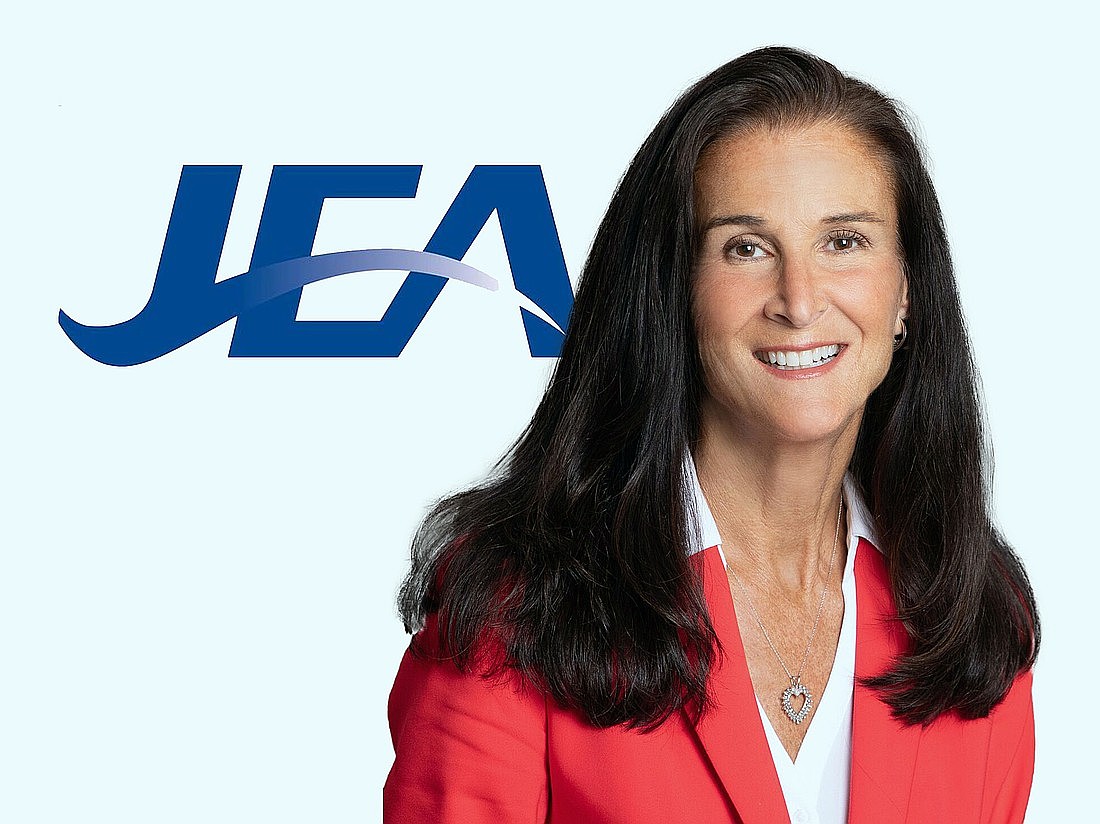
JEA CEO Vickie Cavey scored “well above” typical government entities in a survey among emploees of the city-owned utility about her job performance, according to results provided to the Daily Record.
But comments from respondents presented a polarized view of Cavey, with many praising her and others portraying her as vindictive and abusive.
The survey, ordered by the Council Special Committee for Special Investigatory Committee on JEA Matters, drew responses from 138 employees, 46 of whom indicated they interact with or observe Cavey at least once per week in a work-related setting. Indiana-based human relations consultant SelectionLink conducted the survey.
In its 36-page report, SelectionLink gave Cavey a score that “indicates a favorable level of employee advocacy among those with regular, ongoing exposure to the CEO. On key trust and fairness items, 55% of employees feel that employees who disagree with the CEO are treated fairly, and 67% feel that communication with the CEO is open and two-way.”
“At the same time, 14% of employees have observed the CEO speaking negatively about employees behind their backs, 14% have observed behavior they would describe as intimidating or hostile, and 32% confirm fear of negative consequences for speaking up about CEO-related concerns,” SelectionLink wrote in its synopsis.
Respondents regularly worked in JEA’s headquarters Downtown, as requested by Council, which commissioned the report.
Nine respondents indicated they worked with Cavey daily, and 14 said they saw her two or three times a week.
Results from the SelectionLink survey, while offering a better opinion of Cavey across many categories, played similarly to results from a JEA-commissioned survey of all JEA employees.
Among those respondents of the JEA survey, 46% said they felt that Cavey and executives understand what is really happening at the utility, compared with 65% at similar utilities. The results showed that 49% of employees said they had confidence in JEA’s chiefs, compared with 72% of similar utilities.
The Council investigatory committee commissioned the SelectionLink survey in May, with the expectation that results would be presented to JTA’s board. Council members specified the survey should be directed toward employees who worked in JEA’s headquarters, after former JEA Chief of Staff Kurt Wilson told members of the investigatory committee that Cavey’s misconduct was largely directed toward employees who worked in those offices.
“This high participation rate demonstrates a strong willingness among employees to provide candid feedback and lends confidence to the reliability of the results,” SelectionLink’s executive summary read.
SelectionLink’s survey asked 36 quantitative questions and 11 open-ended comment questions covering key organizational dimensions, including communication and workplace environment; diversity, equity and inclusion; leadership and ethics; respect and professional conduct; and retaliation and psychological safety.
Some JEA employees described Cavey as “intimidating” and “hostile” with a greater focus on her self image than improving JEA or its employees. Respondents repeated allegations of racism and toxicity toward employees that first emerged in February.
Other JEA employees defended Cavey, saying the allegations against her served a political purpose. The real issue, some of those respondents argued, were those on Council who sought to discredit Cavey for personal gain.
On July 29, JEA announced that Cavey was taking a leave of absence for up to 60 days.
Survey specifics
SelectionLink’s quantitative questions asked employees to answer with one of five answers – strongly disagree, disagree, neither agree or disagree, agree and strongly agree. In a report provided to the Daily Record, the company grouped results containing “strongly disagree” and “disagree” as “unfavorable,” results containing “strongly agree” and “agree” as favorable, and results containing “neither agree nor disagree” as “neutral.”
Cavey’s scores on each category of the survey were as follows:
• Employee engagement: 82% favorable, 9% unfavorable, 9% neutral.
• Survey credibility and confidentiality: 68% favorable, 18% unfavorable, 14% neutral
• Communication and workplace environment: 71% favorable, 18% unfavorable, 11% neutral
• Diversity, equity and inclusion: 78% favorable, 11% unfavorable, 12% neutral
• Leadership and ethics: 75% favorable, 18% unfavorable, 7% neutral
• Respect and professional conduct: 74% favorable, 15% unfavorable, 11% neutral
• Retaliation and psychological safety: 64% favorable, 24% unfavorable, 15% neutral
Cavey scored best on questions asking if she treated employees ethically and with respect, while she scored worst on questions asking if employees feared retaliation for speaking about Cavey’s actions.
In open-ended responses, some respondents described a JEA culture in which Cavey created a hostile culture that led to employee stress and racial discrimination. Others saw Cavey as a personable CEO who treated employees fairly and discriminated against nobody.
“When a stressful situation arises, typically due to last minute knee-jerk decisions of the CEO, the CEO is not calm, or collected and becomes irritated and angry, often unleashing frustration on those around her,” one respondent wrote. “I have witnessed multiple situations that have resulted in subordinates feeling so dejected, and so denigrated that it left them in tears.”
“When I have interacted with Vickie on an individual level she is always professional, courteous and presents a very positive attitude. In her communications with JEA as a whole, she is again very professional and straight forward, “ wrote another respondent. “I believe in Vickie, we have a leader who truly cares about JEA and the Community we serve.”
While some comments echoed concerns about a racist culture Cavey had created, first alleged in 2025 by then-Council President Kevin Carrico, others defended Cavey and said she didn’t “have a racist bone in her body.”
“I have watched her go down on Senior Day and love on ladies of color, she goes down to the customer experience area on the first floor where 99% are people of color and she loves on them, and I have seen many pictures at events where she is reaching out to young people of color to talk with them and try to get to know them,” one comment read.
“There is a visible disparity in how different groups are spoken to, supported and evaluated, especially comparing women and minorities to how white men are treated,” read another comment. “This creates an uncomfortable and exclusive environment.”
In some instances, commenters blamed Council members and the investigatory committee for creating an uncomfortable culture around JEA. One commenter, saying they feared for their job because they answered the survey, asked for Council members to respect employees and their confidentiality.
“The City Council SIC (special investigatory committee) and the Council Secretary should be ashamed of themselves,” one commenter wrote. “You have been duped into being political pawns as part of an effort to destabilize JEA in an effort to ultimately sell JEA again. You have smeared and defamed a CEO simply because she is female and because she has exhibited more backbone than all of you have combined. This committee has been an absolute waste of City resources!”
The SelectionLink survey is the second of three surveys looking into JEA’s culture and leadership. In addition to the survey released in June in which JEA employees showed mixed feelings regarding leadership, the utility commissioned an investigation of leadership through law firm Jackson Lewis and attorney Cherie Silberman. The results of that investigation have yet to be released.
February allegations
Allegations against Cavey emerged in February after Carrico told The Florida Times-Union that she had fostered a racist, toxic workplace culture at JEA.
In a February statement provided to the Daily Record, Carrico said he would push for a change of leadership at JEA.
“Since becoming Council President and as a leader of this community I have unfortunately taken numerous meetings and calls from JEA employees with allegations of racism, toxic corporate culture, and other leadership challenges associated with the CEO,” Carrico wrote.
“I am currently having conversations with community leadership interested in addressing these challenges and moving our utility forward.”
Since Carrico and Wilson made allegations against Cavey, the Council committee has investigated JEA’s culture.
In mid-February, Carrico drew scrutiny for nominating Paul Martinez, his boss at Boys and Girls Clubs of Northeast Florida, to replace Arthur Adams on JEA’s board of directors after Action News Jax revealed texts between Carrico and Adams showing Carrico made Martinez’s nomination as a “big favor” to a friend.
After Action News Jax reported on Carrico’s text messages, Martinez withdrew from consideration and Carrico nominated Randy Wyse, head of the Jacksonville Association of Firefighters, to the JEA board. Wyse’s nomination, along with the renomination of board member Joseph DiSalvo, have been deferred indefinitely by Rules Committee Chair Mike Gay.
Carrico dismissed allegations of misconduct in his nomination of Martinez, saying in a statement that “political noise and unfair attacks sought to distract from (Martinez’s) lifetime of service.”
The intended recipient of Carrico’s “big favor” has not been identified, nor is it known what the favor was.
Cavey has denied accusations of racism and inappropriate workplace behavior.
In a February press conference, Mayor Donna Deegan heavily alluded to former mayor Lenny Curry and allies of his lobbying firm, Ballard Partners, as leading a “smear campaign” against Cavey. That campaign, Deegan said, came after JEA opted not to extend a contract with Ballard in January 2026.
Deegan told reporters to “connect the dots” after she was asked about Curry and Ballard colleague Jordan Elsbury’s involvement. Curry and Elsbury, who served as Curry’s chief of staff, both denied being involved.
After a reporter asked Cavey if she was pressured to extend the contract, Deegan urged Cavey to “tell the truth and shame the devil.” “I would not call it a pressure campaign,” Cavey said.
Curry, a partner with Ballard, works out of Jacksonville, Tallahassee and Washington, D.C., according to his company profile. He said on radio show First Coast Connect on Feb. 23 that he was in the nation’s capital “most of the time.”
Curry is also registered to lobby for JEA, although he said that he’s registered to lobby for all of Ballard’s clients and has never represented JEA.
Both Curry and Elsbury have denied Deegan’s allegations.