
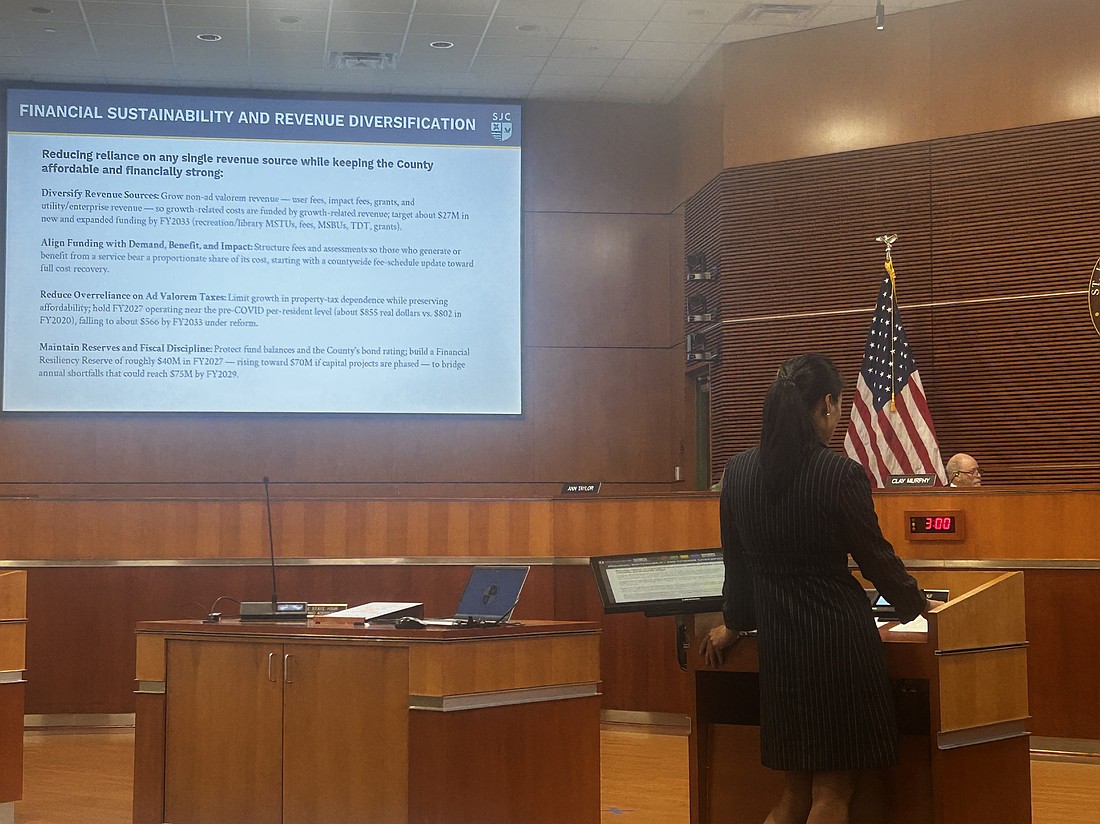
St. Johns County Administrator Joy Andrews presented a proposed $1.46 billion fiscal year 2027 budget July 21 to the Board of County Commissioners, which approved flat millage rates from the current year.
Andrews said the recommended budget was “drafted with uncertainty” ahead as the county monitors the potential impact of the Nov. 3 state vote on an amendment to the state constitution to increase the homestead exemption on nonschool property taxes.
The proposed amendment would increase the exemption from $50,000 to $150,000 in FY 2028 and $250,000 in FY 2029. It would reduce taxes for most property owners and in turn reduce tax revenue for local governments.
“This is a budget that we’re presenting to protect and preserve what we have, and that is our infrastructure, our assets and our human capital,” Andrews said.
If voters approve the amendment, Andrews said the county’s property tax revenue could fall by roughly $66 million in fiscal year 2028 and $130 million in 2029, spanning the general fund, fire district and transportation trust fund. By fiscal year 2032, she projected the annual loss would increase to about $213 million, with a cumulative loss of $830 million.
“Let me just say this again: It’s $830 million cumulatively by 2032,” Andrews said.
In response, the county has begun a phased plan that includes assessing which operations and funding sources are most exposed to the amendment, pausing new spending that would create long-term recurring costs and, if the amendment passes, holding a workshop with the board on reshaping service delivery under constrained revenue.
Andrews said the county has already implemented a hiring pause, with exceptions for public safety, legally required and grant-funded positions, avoiding up to $8.2 million in spending this budget year. The county also is reviewing its capital improvement program, deferring about $7.9 million in discretionary, property-tax-funded projects and evaluating alternative revenue sources — including fees, special assessments and tourism development taxes — with a goal of generating roughly $20 million in new funding by fiscal year 2033.
The FY 2027 recommended budget totals $1.46 billion, excluding multiyear capital and grant carryforward appropriations that will be added at the tentative budget hearing Sept. 3.
Andrews recommended holding all millage rates flat from FY 2026, including the general fund rate of 4.4999, the transportation trust fund rate of 0.8444 and the fire district rate of 1.4700, which applies countywide except in the city of St. Augustine.
The recommended aggregate millage rate is 6.7559, 2.06% above the rolled-back rate of 6.6196.
The Property Appraiser’s certified valuation reflects a 6.7% increase in countywide taxable value for FY 2027, made up of a 3.7% increase from new construction and a 3% increase from existing properties, according to the presentation. Homesteaded property owners are limited to a 2.7% increase in assessed value under the state’s Save Our Homes provision.
Under the recommended rates, the owner of a home assessed at $500,000 would pay $3,415 in county property taxes, $94 more than at the rolled-back rate, the presentation shows.
The budget includes 32.25 new full-time positions, out of 55.74 requested, and eliminates one position. Thirty of the new positions are firefighters.
The capital improvement plan totals $264.72 million, funded primarily through $126.3 million in utility services debt proceeds, along with impact fees, transportation trust revenue and grants.
Commissioners Clay Murphy, Sarah Arnold and Christian Whitehurst voted in favor of the proposed millage rates. Commissioners Krista Joseph and Ann Taylor voted against them, saying they wanted the rates lowered.
As part of its vote, the board authorized the county administrator to set the approved rates and scheduled the first public hearing on the budget for 5:01 p.m. Sept. 3 in the County Auditorium.
Wade Schroeder, the county’s director of the Office of Management and Budget, told commissioners that the proposed millage rates represent the maximum rates for the budget process and can only be lowered from this point forward.
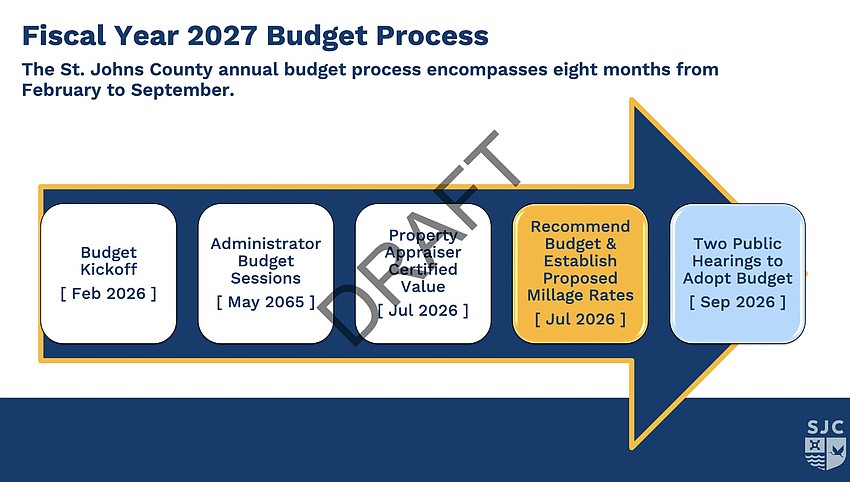
Next steps in the FY 2027 budget process:
• Aug. 24: Property Appraiser mails Truth in Millage notices to property owners.
• Sept. 3: First public hearing on the FY 2027 budget, 5:01 p.m.
• Sept. 15: Final public hearing and budget adoption, 5:01 p.m.