

With major stock indexes soaring to record highs in recent weeks, many financial news sites are posting stories comparing 2026 to the 1999 stock market.
A frenzy over the potential of artificial intelligence has helped send the market soaring in recent weeks, just like the potential of the internet fueled a market surge in the late 1990s.
Jacksonville-based Fidelity National Information Services Inc., or FIS, is one example of a stock that created a buzz because of ties to AI.
The financial technology company announced a partnership with AI giant Anthropic May 4 to develop tools to help banks uncover financial crimes.
The announcement after the stock market closed sparked a series of stories overnight from market-related websites saying FIS was poised for big gains, with reports the stock was up as much as 7% in after-hours trading.
By the time the market opened May 5, traders came to their senses and realized there were no financial projections from FIS associated with this partnership.
The stock opened 73 cents higher at $48.01 but that was its high for the day and by the close, FIS had dropped to $46.61, down 67 cents on the day.
FIS is a well-known Fortune 500 company. A much smaller, lesser-known Jacksonville-based company created even more hysteria at the height of the dot-com bubble in 1999.
Florida Banks Inc. was a relatively obscure company started in 1997 to build a chain of community banks throughout Florida.
The company in 1999 announced it would start offering full-service internet banking, a concept that is commonplace now but was considered revolutionary in 1999.
Suddenly, Florida Banks was the hottest attraction on Wall Street. The stock jumped from $8.44 when it made the announcement on a Monday afternoon to a high of $43 by Wednesday.
Traders came to their senses and realized the relatively small company was unlikely to make a fortune off its internet plans, and the stock settled back to $13.37 by the end of that week.
Florida Banks was eventually sold to The South Financial Group in 2004 for $22.84 a share.
The dot-com bubble burst in early 2000. Nobody can say for sure how long the AI rally will last, but a 4% drop in the tech-heavy Nasdaq Composite index on June 5 did make some investors nervous.
A blog post last week by Owen Lamont, portfolio manager at Acadian Asset Management, summed up what some market observers are thinking.
“Perhaps, when 2031 rolls around, we’ll look back and see today’s market valuation as another triumph of the efficient market hypothesis, with 2026 prices being justified by high subsequent earnings over the next five years,” Lamont wrote.
“Perhaps. But for me, today’s optimism is yet another way in which 2026 is looking like 1999,” he said.
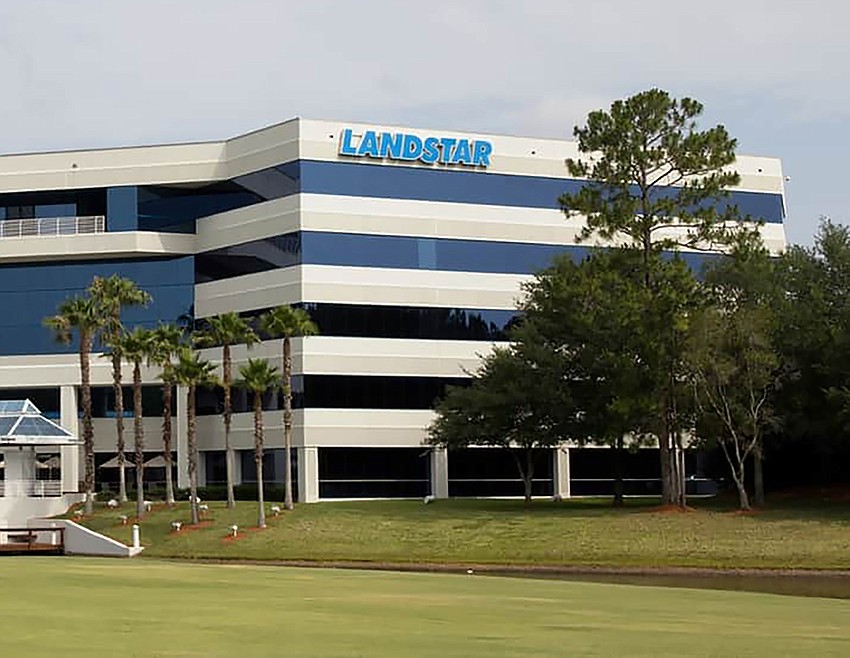
Trucking and logistics stocks are not in any kind of bubble, but a stronger outlook for the industry has sent Landstar System Inc. to a record high.

The stock has nearly doubled in price over the last seven months to a high of $228.46 on June 8.
Wells Fargo analyst Christian Wetherbee raised his 2027 earnings estimate for Jacksonville-based Landstar by 90 cents to $8.50 a share and set a price target of $240, about 28 times his earnings forecast.
“While we are also valuing Landstar at the upper end of its historical valuation, we believe the rich multiple is underwritten by solid spot exposure and outsized industrial exposure given their flatbed franchise which should be a key beneficiary of five consecutive months of improving industrial activity,” Wetherbee said in a June 5 report.
Wetherbee maintains an “overweight” rating on the stock.

Rayonier Inc.’s timber business was impacted by wildfires in Georgia in April, but CEO Mark McHugh said the fire damage was much less than the damage in the region from Hurricane Helene in 2024.
“The impact of the fires will be significantly less than the impact of the hurricanes we saw a couple of years back, just in terms of the magnitude of salvage volume that will come to market,” McHugh said in a June 3 presentation at the annual REITweek conference in New York.

“We deal with a number of fires every year. I think over the course of the last 25 years in Rayonier’s history, we’ve had two casualty events that have risen to the level of kind of $10 million or so of casualty loss. So in the grand scheme of things relative to the size of the company, these tend to not be very material events,” he said.
About 10,000 acres in Georgia were damaged by this year’s fires.
After merging with PotlatchDeltic Corp. in January, Rayonier now has about 3.2 million acres of timber across the South from Florida to Texas and another 900,000 acres in Idaho, Washington and Oregon.
“The combined company will enjoy much larger scale as well as significantly enhanced diversification,” McHugh said.
“Timber supply-demand dynamics are highly localized in nature so we think the combined company shareholders will benefit from both the geographic and end-market diversification impact of this merger.”
Rayonier and PotlatchDeltic both had real estate development operations, but the merger also gave Rayonier entry into the wood products manufacturing business.
Rayonier now operates seven wood product mills.
“Rayonier didn’t own any manufacturing assets prior to the merger, but we’re really excited about the opportunity to integrate this very large-scale, low-cost manufacturing platform into our portfolio,” McHugh said.
“We really see this platform as another tool in our capital allocation toolkit with which we can optimize portfolio value over time.”
Raymond James analysts removed Rayonier from a list of their current favorite stocks during REITweek but said they still have a positive view on the company.
“We continue to believe that Rayonier’s fortress balance sheet, prime U.S.-based forestry, and about $200 million of dry powder to execute highly accretive stock repurchases makes it one of the most attractive REITs among all property types, particularly at an approximately 35% discount to our net asset value estimate,” they said in a June 1 report.
REITweek is an annual conference presented by the National Association of Real Estate Trusts, or Nareit.
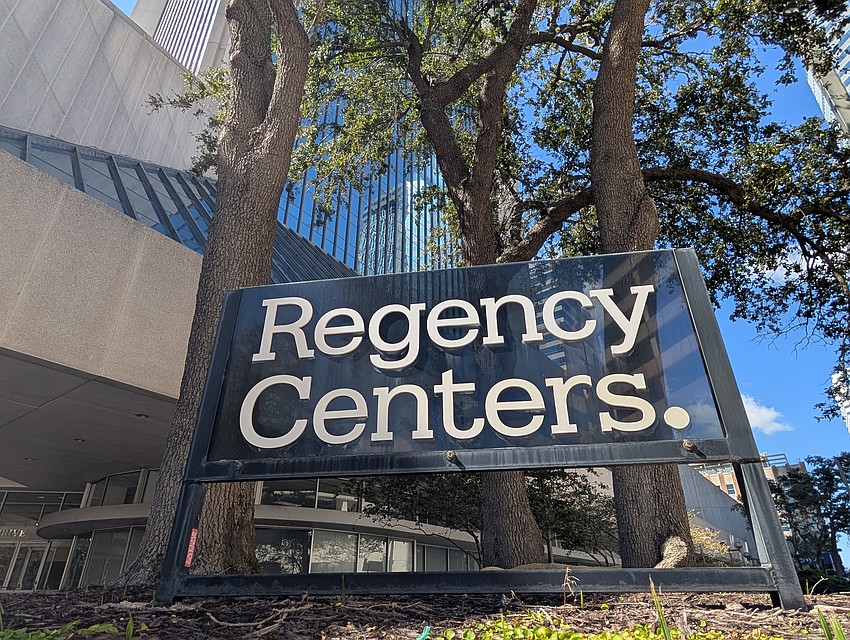
Regency Centers Corp. officials said in another June 3 REITweek presentation that a lack of new supply is creating high demand for space in the company’s shopping centers.
Chief Operating Officer Alan Roth said some retailers are signing leases on spaces that won’t be vacant for several years, just to ensure they can secure sites.
“It’s an environment right now where retailers are locking in space because they know that lack of supply is there,” Roth said.

“They’re willing to sign a deal today that perhaps may not open until 2028, 2029.”
Jacksonville-based Regency operates 481 properties across the country, mainly grocery-anchored shopping centers.
CEO Lisa Palmer said the company continues to expand its portfolio but acquisition opportunities are difficult, so Regency is focusing on developing its own centers.
“The best use of our free cash flow is our development program and redevelopment. That will be the highest priority,” she said.

Star Equity Holdings Inc., which has been seeking to buy Jacksonville-based GEE Group Inc., announced June 3 it intends to nominate its chief operating officer, Rick Coleman, to a seat on GEE Group’s board of directors.
The Connecticut-based holding company’s Star Equity Fund LP owns 5.4% of GEE Group stock and has been pressuring the staffing company to accept a buyout offer.
Star Equity also said it is recommending GEE Group shareholders remove two incumbent directors, Peter Tanous and Thomas Vetrano.
Tanous and Vetrano were both reelected at GEE Group’s last annual meeting in September and would not be up for reelection at this year’s annual shareholders meeting.
GEE Group has not announced a date for this year’s meeting.
Medtronic plc reported a small increase in earnings for the fiscal year ended April 24 but is projecting bigger gains for fiscal 2027.
The Ireland-based medical device maker said adjusted earnings rose by 4 cents a share in fiscal 2026 to $5.53, but it is projecting 2027 earnings to reach $5.90 to $6 a share, with revenue growth of 6.75% to 7.25%.
“The macro backdrop has been challenging and dynamic — but MedTech is structurally resilient because the fundamentals are durable,” CEO Geoff Martha said in a June 3 conference call, according to a company transcript.
“People are living longer, chronic disease is rising, and the demand for medical procedures will only grow,” he said.
Medtronic does not report data for its Jacksonville-based subsidiary which makes surgical products for ear, nose and throat doctors.
But Chief Financial Officer Thierry Pieton said in the call that the ENT business grew revenue by a mid-single-digit percentage in the fourth quarter of the fiscal year, with international markets growing revenue by a high single-digit percentage.
Medtronic was the third-best performing stock in the S&P 500 index after the earnings report, rising 11% in the week ended June 5, according to investing website Seeking Alpha.