
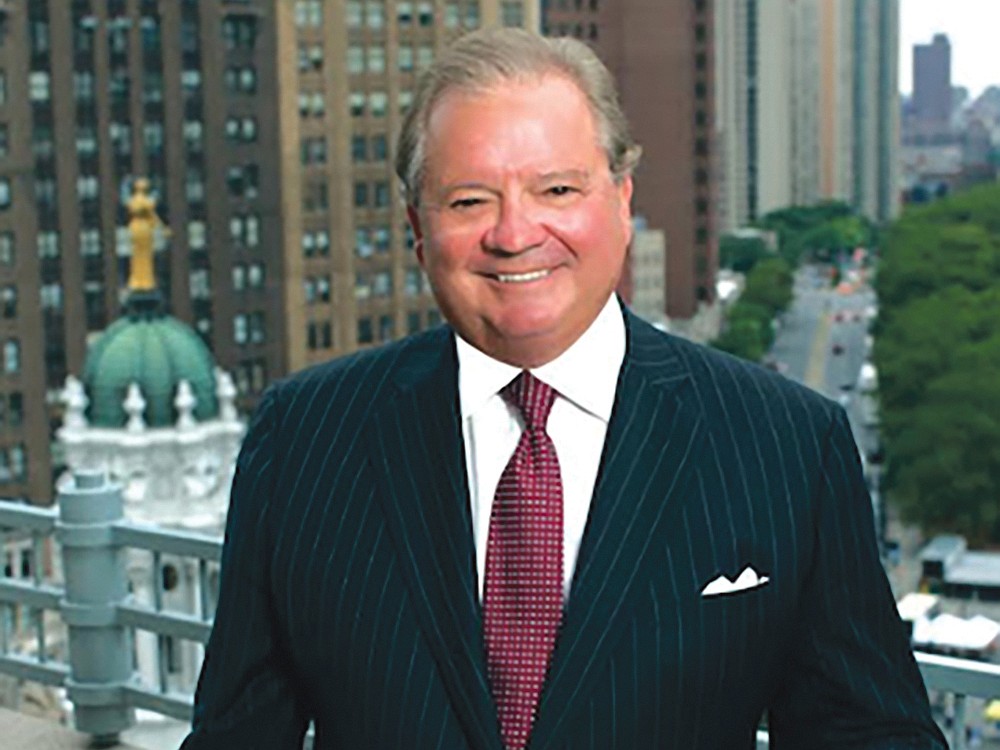
“Congratulations. Impressive. Keep going. Take law school to the next level. And then to an even higher level. Do not go anywhere. Make this law school your final career success and statement. There is much more that you can do to continue building something very special in the service of this community and beyond.”
Those are the friendly, complimentary and motivating words 4th Circuit Chief Judge Lance Day to yours truly.
The warm comments came after he heard the news that the recent routine two-year review of Jacksonville University College of Law’s initial provisional accreditation, in our view, could not have gone better.
The ABA site visit review for full accreditation already is scheduled for March 2027.
With heartfelt gratitude I replied that the privilege and pleasure of continuing the fulfilling work is in the hands of heavenly and terrestrial higher authorities, not to mention my wife, a strong-minded redhead.
Self-consciously and accurately, I acknowledged that the remarkable achievements of the city’s law school were set in motion and preordained during a decade of careful planning by many talented people long before I came to town.
Then after the school’s launch four years ago, its dramatic Artemis II-like upward trajectory has been fueled by its hard working, dedicated, innovative, entrepreneurial and steadily prudently growing faculty, staff and student body.
On their bold audacious mission to join the stars of legal education, the pioneering law school crew quickly rocketed free of the gravity of weighty challenges that can keep startups at low altitude in the stale atmosphere of outdated conventional wisdom.
They continue to accelerate past major milestones propelled by boosters in the local bench and Bar, government and civic leaders, businesses, public interest organizations and from people who we serve.
The collective team effort that made success the only option has been piloted by the law school’s founding father and visionary leader who dreamed big and then delivered even more, JU President Tim Cost.
On May 1, 2026, Cost spoke to our second graduating class at a pivotal moment. It was the last time he formally addressed our law students as the university’s president before he became JU’s chancellor, and just as the law school confidently readies its application for full accreditation.
Earlier on the same day we spoke about accreditation and the law school’s future, our chief judge spent a significant amount of time at the law school with students, as he often does. He joined a distinguished group of other leading lawyers doing the same, Florida Supreme Court Justice Meredith Sasso, incoming Florida Bar President Michael Orr and our energetically supportive friend Patrick Kilbane.
Kilbane also organized a fireside chat program that evening with Justice Sasso in the Duval County Courthouse under the auspices of the Federalist Society. It was well attended by judges, practitioners and students.
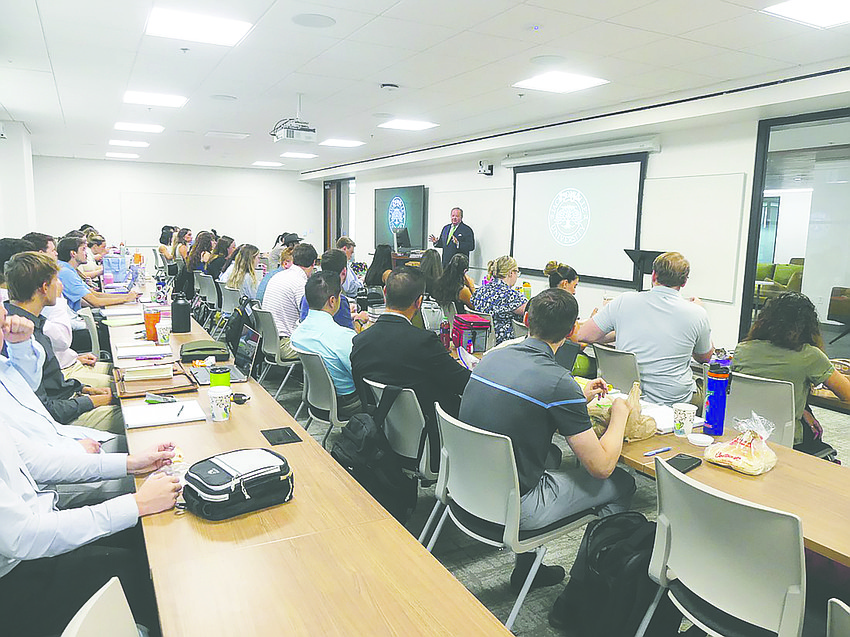
Each of these accomplished guests shared their priceless wisdom, offered advice and encouragement in lively conversations with our students. It was a master class in professional values and ethics by inspiring people who teach and live the virtues of our honorable profession through the splendidly routine performance of their excellent legal work.
In turn, our students impressed our guests, as they did the ABA site visit team, that they will become new members of our profession who are well equipped to carry on its best traditions. That includes in tough, worrisome, confusing times, walking with people driven by fear, despair, doubt and disillusionment on a contemporary “Road to Emmaus” journey, serving as revelatory sometimes unrecognized underappreciated guides from darkness into brighter, better days.
I would not trade one of them for another law student anywhere in the world.
You hear people say that America does not make anything anymore. Well, our nation’s law schools, professional role models, supervisors and mentors produce lawyers whose excellence and integrity are unrivaled. And U.S. legal education and training is getting better than ever.
Law students throughout America are learning more about professionalism than ever before. This involves being prepared to bravely, proudly and competently stand up for truth, fairness and other people, especially for the less advantaged and underrepresented.
It means upholding a code of professional conduct that requires courteous dignified dialogue, respect and kindness.
Imbuing new lawyers with the knowledge and responsibility to carry on the best qualities of professionalism is paramount because they are the arsenal of democracy and a framework for a moral just society drawn from all faiths and beliefs.
We should counter the trend in the interest of job placement to be dismissive of academic fields across the liberal arts, sciences and humanities of which law is an apex discipline. It is not either/or but rather synergistically all.
As Sir Walter Scott’s fictitious barrister Paul Pleydell observed in the novel “Guy Mannering,” “A lawyer without history or literature is a mechanic, a mere working mason; if they possess some knowledge of these, they may venture to call himself an architect.”
We especially have to prioritize the pursuit of truth. Lately truth has become a rare commodity. A regular reader of these commentaries from St. Augustine, Dulcy Freeman, wrote to this writer about the ageless maxim: “The truth hurts for a little, lies hurt forever.” Consensus about truths is a prerequisite for solving difficult problems, without it we cannot.
In the well-known words of my late boss, Sen. Daniel Patrick Moynihan, a progressive liberal Democrat from New York who served as a White House counselor and diplomat under Republican Presidents Nixon and Ford, “You are entitled to your own opinion, but not your own set of facts.”
Easier said than done given the acutely partisan social, economic and culture wars that divide us. That includes disagreements over whether armed conflicts are just wars.
Increasingly, people fight over these issues in a digital world that amplifies discord, ignores or masks provable facts and falsehoods alike and oversimplifies complexity. The isolation and misinformation generated by our digital AI-driven world that divides us disconnects us from each other and reality.
Yet we are not helpless. Lawyers are trained to rely on evidence rather than slogans to help people challenge and confirm facts, break through the thin ice of dogma to grasp, surface and unknot complex issues, promote equal justice according to the rule of law and courageously uphold the rights of free people against the abuse of power. We stand for peace, prosperity and progress.
America’s newest law school graduates worked hard to gain the knowledge and skills to complement their good-hearted aspirations to excel in their careers while doing good.
They have the right stuff to make maximum use of their God-given talent every day to do something good for someone else.
We have every reason to believe they can and will make us even prouder in the future than we were on their commencement day.