
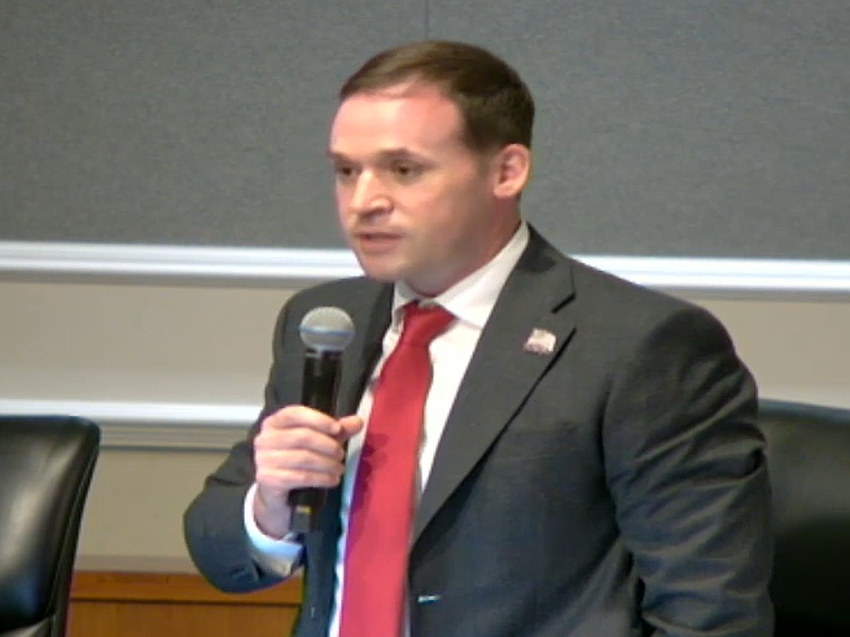
A bill that would limit public hearings and take some decision-making on zoning deviations from elected officials with the stated intent of speeding development is set to come under consideration by Jacksonville City Council.
Ordinance 2026-0364, introduced by Council member Rory Diamond, allows for the city’s Planning Department to grant applications for administrative zoning deviations without a currently required public hearing and with eased requirements for approval.
In a text message, Diamond said the ordinance was designed to address Jacksonville’s need for affordable housing by speeding up approvals for infill residential projects.
“The purpose of the Bill is to make administrative deviations administrative,” Diamond wrote in a text. “We need the housing and this provides a faster, more transparent process to allow for the building on small infill lots.”
Administrative deviations allow for changes to individual property requirements without a full rezoning or land use change. Deviations can apply to lot sizes, requirements for parking spaces, landscaping and structure height.
Under present code, the city’s zoning administrator reviews and can grant applications for administrative deviations. That decision comes after a required informal public hearing, for which neighbors within 350 feet of the applicable property are notified.
Any person who believes they are adversely affected by the zoning administrator’s decision can appeal the decision to the Planning Commission, an appointed body. After a more formal public hearing before the commission, that body determines whether the administrative deviation criteria were properly considered and applied by the zoning administrator to the facts presented.
If the commission determines the criteria were not properly applied, the commission can remand the matter to the zoning administrator for further review. Final decisions by the commission or the zoning administrator may be challenged further under Florida state law, but cannot be appealed to Council.

Diamond’s bill would trim those processes and move the zoning administrator’s responsibilities to the Planning Department. Additionally, administrative deviations would scale back public notice requirements.
Current ordinance code requires that notices of applications be mailed at least 14 days in advance of the first scheduled hearing to all owners of real property within 350 feet of the boundaries of the property involved in the application, and to all neighborhood organizations qualified to receive notice.
Diamond’s bill would alter those requirements so that all neighbors within 300 feet of the applicant would be mailed a summary of the administrative deviation requested. That notice would provide directions on how to view the full application and where objections could be sent.
From that point, the Planning Department would have 30 days to approve or deny the application. Any failure to provide a decision within 30 days would result in an automatic approval.
The new legislation also alters how the commission would vote on appeals. The commission, not the zoning administrator, would have final say on appeals. Additionally, instead of considering if the zoning administrator made any errors in their decision, the commission would consider the appeal de novo, applying all information anew.
Additionally, the commission’s decision could be appealed to Council by any party adversely affected. Appeal fees for administrative deviations are listed at $650 on the city’s website.
Critics say Diamond bill takes away from communities who want to offer feedback on applications before the commission and Council.
“The community having an opportunity to participate in public hearings for matters that affect their property, their daily lives, anything that matters in the city of Jacksonville is extremely important,” commission Chair Moné Holder said.
“It’s their right. It’s a fundamental part of democracy. Removing that part of the access is something that is concerning to me.”
“We oppose this bill both in concept and execution. It would eliminate the current Administrative Deviation process handled by Zoning Administrators and shift all responsibility to the Planning Department, reducing transparency and public involvement,” a city spokesperson wrote in a statement.
“It removes public hearings, cuts back on required notifications, and shortens the timeframe for citizens to respond — making it harder for residents to participate or resolve disputes.
“It also weakens existing design‑standard safeguards by allowing approvals based on meeting only one of several criteria. The bill further risks automatic approval of incomplete or problematic applications if the Planning Department cannot meet a 30‑day deadline, while simultaneously overburdening the department with no additional resources. Ultimately, limiting public input is likely to push more disputes to City Council and LUZ, lengthening meetings, increasing workload, and frustrating citizens.”

Additionally, the bill would relax requirements for the department to grant administrative deviations. While current ordinance code requires that the zoning administrator reports positive findings on six issues to recommend approval, Diamond’s bill would require that the Planning Department make a positive finding on one of the six requirements to grant approval.
Those requirements include the following:
Diamond’s bill is set to appear before the Council’s Neighborhoods, Community Services, Public Health and Safety; Rules; and Land Use and Zoning committees. Holder expected the bill would also appear before the commission for a recommendation.