
Northeast Florida’s warehousing and logistics market is “rebalancing” as of the first quarter of 2026, market reports show.
The reset comes after years of construction when developers built in pursuit of tenants after the pandemic that generated significant online commerce and a population migration into Florida.
That growth led to an almost 74% increase in the industrial vacancy rate in Jacksonville from the first quarter of 2025.
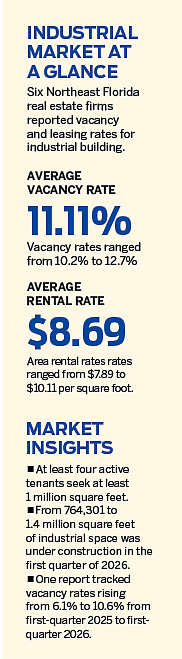
The rate rose 4.5 percentage points from 6.1% to 10.6%, the Colliers commercial real estate firm reported in its first-quarter 2026 industrial market report for Jacksonville.
“Jacksonville’s industrial market is rebalancing as construction slows,” Colliers reported.
“As the development pipeline tapers off in 2026, the market is shifting from a phase of oversupply to one of recovery.”
Colliers found that 5.1 million square feet of industrial space was under construction as of the first quarter of 2025, compared with 764,301 square feet this year.
Yet, the higher vacancy rate over the past year was driven by speculative construction projects, “many of which came online without preleasing in place,” Cushman & Wakefield said in its Q1 2026 Marketbeat report.
Cushman & Wakefield said that most of the leasing activity came in the North and South Jacksonville submarkets, with vacancy pressures “most pronounced” in the Westside.
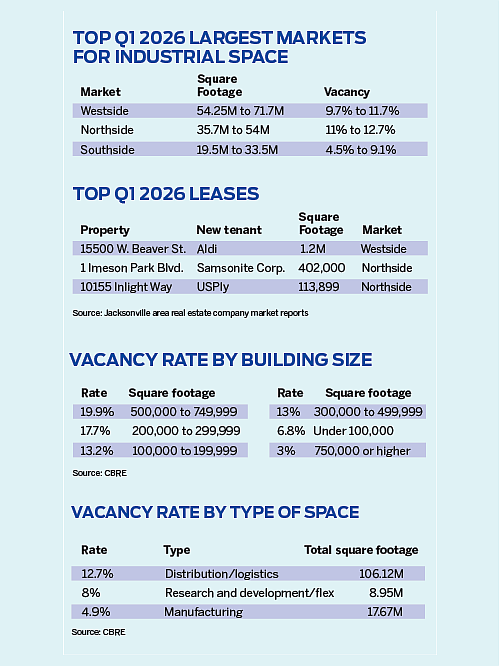
The West Jacksonville industrial market is the largest in the area, with up to 71.7 million square feet of distribution, logistics and manufacturing space, market reports found.
The commercial firms measure the areas differently.
North Jacksonville is the second largest at up to 54 million square feet, and the Southside is No. 3 at up to 33.5 million square feet.
CBRE found that 901,000 square feet of active construction during the first quarter was concentrated in North Jacksonville.
That amount was down 10.9% from the last quarter of 2025 and 83% from the 5.3 million square feet underway in the first quarter of 2025, it said.
The number of projects under construction dropped to three in the first quarter of 2026 from five the previous quarter and from 22 in the first quarter of 2025.
Net absorption was negative in the first quarter, meaning more space was vacated than filled, CBRE reported, noting that some major tenants left their buildings. North and West Jacksonville and Clay County all experienced negative net absorption.
Positive absorption was concentrated in the Southside and St. Johns County.
Colliers reported that a decline of speculative building represents a “market normalization” that allows existing space to be absorbed.
Colliers reported that tenants are looking for 10.4 million square feet of space in the market, averaging 208,085 square feet each. That indicates about 50 active tenants might be looking.
At least four “active requirements” top 1 million square feet.
One of those is Johnson & Johnson Vision Care’s proposed 1 million-square-foot packaging and distribution facility in Northwest Jacksonville at a site identified as Airport Commerce Center north of Jacksonville International Airport.
The contact lens manufacturer proposes to invest $500 million into expanding its production equipment and capabilities in its Deerwood Park facility at 7500 Centurion Parkway in South Jacksonville and invest $50 million into building a packaging and distribution center in Northwest Jacksonville.
Ed Randolph, city director of economic development, said previously Johnson & Johnson was working with a developer to build up to a 1 million-square-foot packaging and distribution facility in Northwest Jacksonville.
Jacksonville City Council gave final approval April 28 for Johnson & Johnson Vision Care to receive $12 million in city incentives to construct the packaging distribution facility and install new high-tech equipment at its Southside campus.
The incentives would be two Recapture Enhanced Value Grants.
One is a five-year, 60% grant of up to $1.5 million for the construction of the facility. The other is a five-year, 40% grant of up to $10.5 million for the equipment.
Industry sources say two of the 1 million-square-foot prospects have settled on North and West Jacksonville, but those tenants and locations have not been confirmed.
“After a period of normalization, Jacksonville’s industrial market is clearly gaining traction in Q1 2026,” wrote NAI Hallmark Vice President Jason Purdy in the company’s first-quarter Jacksonville metro market report.

“With a sizable pipeline of active requirements and tenants growing more confident in making decisions, the market is shifting from pause to momentum,” Purdy wrote
Foundry Commercial summarized that after four years of “robust” speculative construction, the first quarter of 2026 “shows a significant downshift” with 1.2 million square feet under construction and “modest new construction on the near term horizon.”
Rental rates remained steady or slightly higher, with the highest rates in Southside.
Cushman & Wakefield said the slowdown in construction could temper rent growth as fewer new projects at premium pricing are completed, and double-digit vacancy rates could ease the rental rates sought by landlords as tenants have more space options.
CBRE reported there is 132.73 million square feet of rentable industrial space in the market, with 11.3% vacant.
By market type, distribution and logistics space dominates the industrial market at 106.12 million square feet of rentable space, and also has the highest vacancy, at 12.7%.
Manufacturing space is second at 17.67 million square feet, with a vacancy rate of 4.9%.
Research and development along with flexible-use space is third at 8.95 million square feet and 8% vacancy.
CBRE says the national business cycle is 5 years old, but growth appears resilient despite “clear risks on the horizon” that include the sustainability of gross domestic product growth, global energy prices and inflation.