
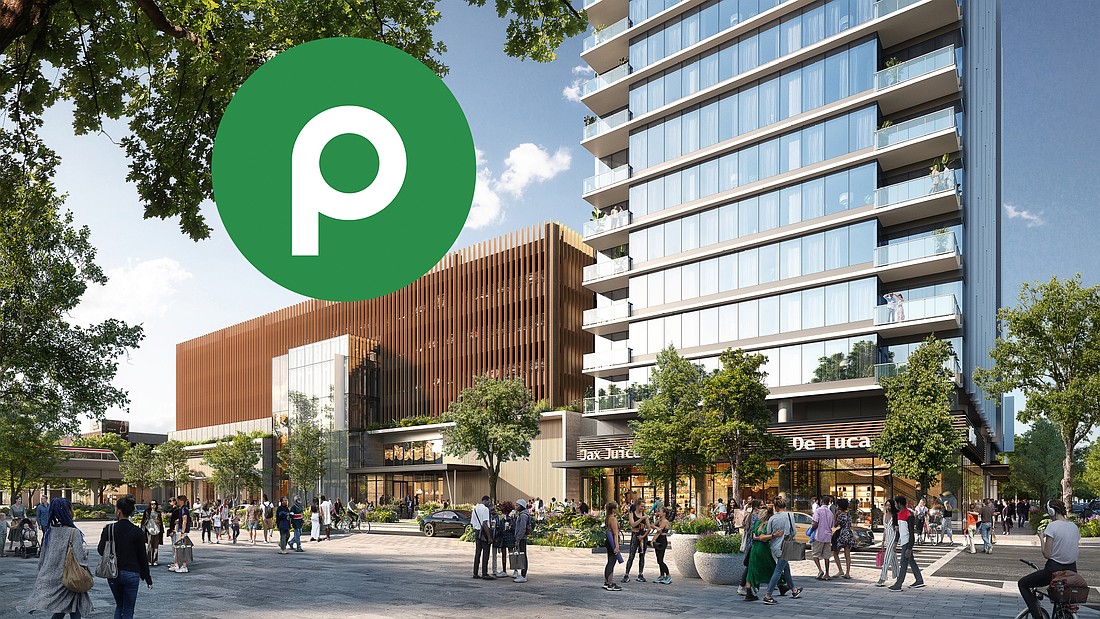
The CEO of Gateway Jax says the developers are making progress in talks with city leaders to revise an incentive package for their Publix-anchored mixed-use tower in Downtown Jacksonville after the original deal was paused by City Council.
Bryan Moll, the principal of the development partnership, said during an Aug. 6 interview that in deferring legislation for $48.6 million in incentives for the project, Council gave his group and the city an opportunity to refashion an agreement to address concerns of some Council members over a $28.5 million completion grant that is part of the package.

Moll made his comments two days after Council Ordinance 2026-0541, which contains the incentives for the $138.6 million project at 119 W. Beaver St., was deferred in the Aug. 4 Finance Committee meeting. During that meeting, committee Chair Will Lahnen said he hoped the deferral, which was requested by the Downtown Investment Authority, would result in “a way to where we can avoid a big cash completion grant.”
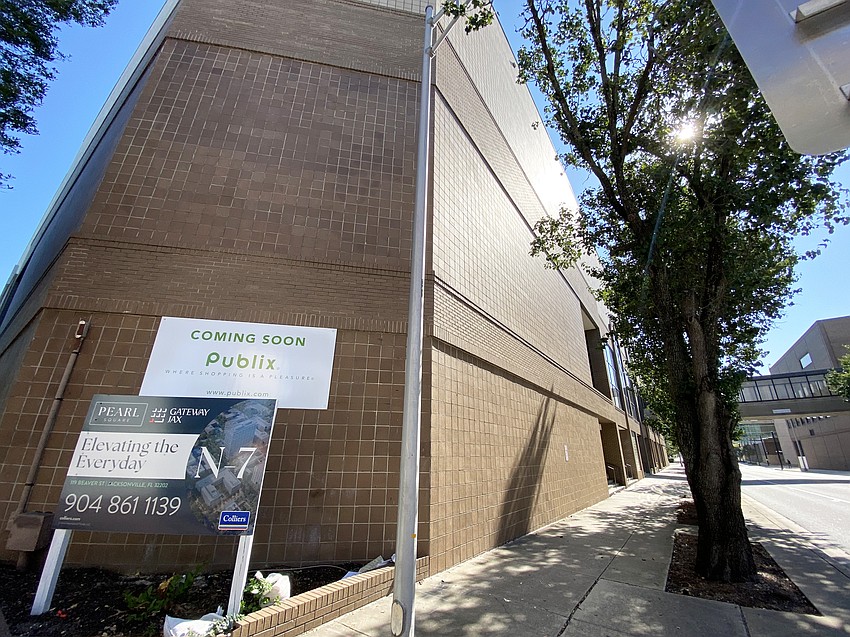
For the Block N7 project, Gateway Jax plans to replace the former First Baptist Church main auditorium with a mixed-use, 15-story tower that would include 500 apartments, 400 integrated parking spaces and a 31,000-square-foot Publix. The tower is part of the more than $750 million Pearl Square district under construction in Downtown’s North Core district north and west of City Hall.
Moll has called Block N7 Gateway Jax’s most important project, as it would provide a full-service grocery store to serve the district’s residents, commuters and visitors. Without it, he said, “it would be much more difficult, if not impossible, to do what we’re doing at this scale.”
During the Aug. 6 interview, Moll said Gateway Jax’s discussions with the DIA, Mayor Donna Deegan’s office and Council members have yielded ideas that would reduce the completion grant for the project while mixing in a greater percentage of Recapture Enhanced Value Grant funding and forgivable loans. A REV grant is a refund on ad valorem tax revenue generated by a new development or property enhancement.
One option under consideration would reduce the completion grant by as much as half, he said.
Moll said Gateway Jax and city leaders had made “a ton of progress” in recent months toward revising the incentives.
The Council deferral, he said, was “not any kind of roadblock.”
“It really is just to buy everybody a little bit more time to kind of circle around some of these ideas.”
Lahnen and like-minded Council members say that after years of committing grants to projects without budgeting for them and with little regard as to when they would come due, Council strained the city’s ability to pay them off.

With REV Grants, the city essentially forgoes a portion of revenue it could receive, while completion grants involve payouts from the city’s operating funds and therefore involve drawdowns of existing funds.
During the Aug. 4 meeting, Lahnen said he hoped Gateway Jax could come back with a package that upped the amount of REV Grants and “greatly minimizes” cash payouts.
Noting that the city has approved nearly $40 million in completion grants for four other Gateway Jax projects, Lahnen said he also was open to possibly restructuring the timing of payouts for those projects to free up funding now for Block N7.
In August 2024, Council approved $98.58 million in incentives for Gateway Jax’s first four projects in its more than $750 million Pearl Square district. Those comprised $59.63 million in REV Grants and $38.95 million in completion grants.
Moll said Gateway Jax was exploring the possibility of seeking an adjustment in the packages for those projects to free up completion funding for Block N7.
“We’ve looked at using one or multiple of those projects to ‘transfer’ them over into N7,” he said. “It would mean that we’d need to make up for that transfer through additional REV Grants or something like that.”
Moll said he and his partners were aware that the city’s Downtown revitalization strategy calls for incentives to be reduced over time as more projects come online and Downtown development becomes more self-sustaining from higher rents, more retail and restaurants, etc.
The incentive package for Gateway Jax’s Hotel Merrydelle project reflects that recognition, Moll said. For that project, a redevelopment of the historic Ambassador Hotel at 420 N. Julia St., the DIA board approved $10.1 million in loans with no completion funding attached. City Council has yet to consider that incentive.
“We’ve come up with an idea of sort of a long-term, low-interest loan where we pay the whole thing back to the city,” he said. “That works very well in that project.”
He said the approach wouldn’t be as viable for Block N7 but was an option in what he called Gateway’s “tool belt” of ideas.
Lahnen has expressed support for the project but said the investment in it must be balanced against the city’s needs at-large.
He introduced successful legislation this year to set aside funding in the current year’s budget to pay off completion grants next year.
Council also approved a related bill from Council member Chris Miller requiring the city to designate funding sources in its budgets for any completion grants expected to be due in that year. The bill also restricts the city from funding those grants through debt spending.