

It’s been nearly four years since ChatGPT burst into browser tabs in a launch so fast and unprecedented that OpenAI says it hit a million users in five days.
Almost overnight, artificial intelligence stopped meaning something abstract and became a tool you could open on your laptop and ask to write an email.
That novelty phase is over.
What’s replaced it, in Jacksonville and in cities like it, is a harder and less flattering question: Now that everyone has had several years to use the tools, who actually is good at it?
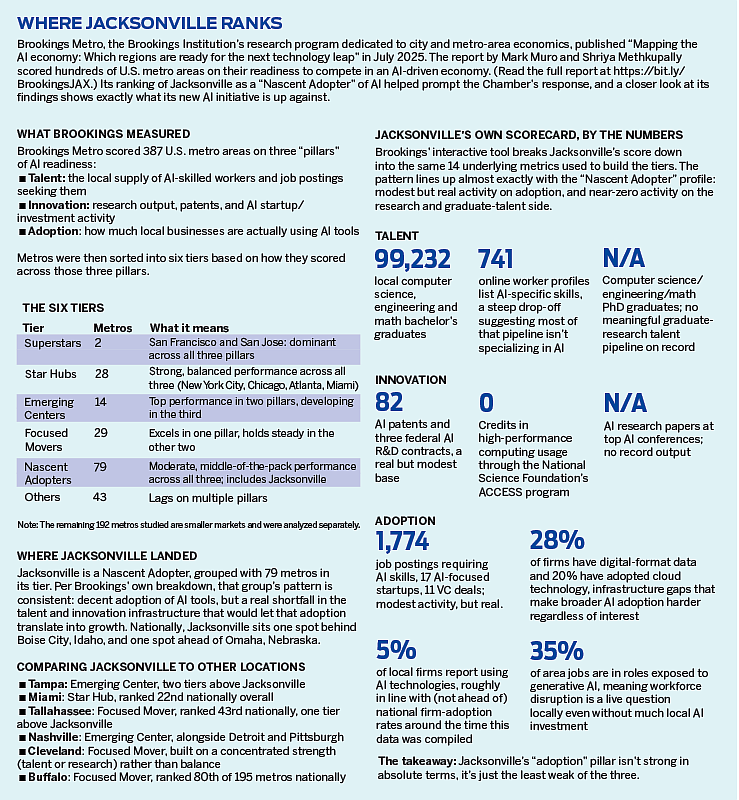
A Brookings Institution study set out to answer that, ranking roughly 200 U.S. metro areas by AI talent, innovation and adoption and sorting them into six tiers, from a pair of Superstars (San Francisco and San Jose) down through Star Hubs, Emerging Centers, Focused Movers, Nascent Adopters and Others.
Jacksonville landed in the Nascent Adopters tier, ranked as a city keeping pace on adoption but falling behind on the talent and innovation that turn adoption into an actual economic edge.
The city isn’t alone in that tier; 79 others landed there. And all share an underwhelming assessment as metros that have adopted AI tools at a decent clip but haven’t built the talent pipeline or research base to turn that adoption into a real economic advantage.
For Carlton Robinson, chief innovation officer at the JAX chamber, that ranking wasn’t just a data point. Rather, it was the kind of sting that demands a response. It’s also, he says, the moment that pushed the chamber to treat AI readiness less like a novelty and more like civic infrastructure.
The result is the chamber’s newest initiative: The Center for Applied Infrastructure, launched this year and built around what Robinson calls “human agency,” the idea that companies should first decide what has to stay human-led, then teach people to build their own AI use cases around it.
“That, to me, is the secret sauce of this technology, and leading with what I’d call human agency,” he said. “If we can teach and educate more humans to do that, the outputs are going to be really good. That’s going to be the race here in Jacksonville: Getting our institutions, higher education, in line, and really helping individuals build use cases.”
It’s not Robinson’s first swing at this kind of work. He built JAX Bridges, the chamber’s entrepreneurial education program, into one that has served more than 1,800 business owners before he turned his attention to AI.
What follows is a conversation with Robinson about what CAI actually does, who it’s built for, and what some in Jacksonville’s business community need to do to climb out of “Nascent,” before the gap with higher-performing cities gets harder to close.
(This conversation has been edited for length and clarity.)
Jacksonville Daily Record: The Brookings Institution report came out last year, which mapped AI readiness across U.S. metro areas and placed Jacksonville in a tier called “Nascent Adopters.” To put it mildly, this assessment wasn’t very flattering. What was your reaction when you saw that ranking in the study?
Robinson: First, I thought it was a really good report in terms of highlighting the importance of AI readiness. I thought we would appear higher, because Nascent Adopter was just a little bit higher than not using it at all, and that was a little bit alarming to me based on relationships in the business community. I thought we should be higher, and I knew companies that were doing amazing things and leading in this space. So I would say I took it a little bit personally, just loving Jacksonville and the business community and wanting us to be leaders and forward thinkers. That (ranking) didn’t frame us that way, so I think I took it a little personally.
JDR: So it was alarming, in your view?
Robinson: Yes, alarming. Here at the chamber, we’re representing the business community. We’re promoting it on our London business mission, and on our leadership trips all over the U.S. We’re hoping to attract both talent and businesses to Jacksonville, and we want to keep what we have as AI becomes a significant part of how we work. We need to have a really good story about what Jacksonville is doing and where we’re going, and at that moment, when I read the article, that wasn’t the case. Part of that is our responsibility at the chamber, and that was definitely a spark for me.
JDR: Did that report directly lead to the creation of the Center for Applied Infrastructure, or was that already in motion and the report just confirmed the direction you were headed?
Robinson: Giving you a short timeline: When I read the article, we were already engaged in running pilots for our GenAI program. We ran those for two years before we launched in January (2026), but we didn’t have all the other elements. What this report led to, for me, is that yes, we were engaged in integrating AI into some of our business practices, but as a chamber of commerce, we weren’t looking at this from an infrastructure perspective. The study definitely shed light on that for me, and the development of more infrastructure around AI is what helped us have the vision for the Center for Applied Infrastructure. Without the article, I don’t think we would have been as focused on all the different layers of AI readiness.
JDR: Where, in your opinion, based on that Brookings study, does Jacksonville actually fall short? Is it the talent pipeline, innovation and research, how widely businesses are adopting AI, or all three?
Robinson: That’s such a hard question. Obviously, the University of Florida will be launching classes (at its graduate campus in LaVilla) in a couple months, and AI runs across all of those programs. When we look at AI-related research, that’s where we haven’t had as many assets in our ecosystem. I’d like to talk about this from an ecosystem perspective: what makes an ecosystem stronger, and what makes us middle of the road. I think we’ve been middle of the road primarily because we haven’t had the research component, the higher-level research. Most of the communities ranked in the top tier have what’s called R1 research institutes. Those institutions have the opportunity to do a higher level of investigation. They have doctoral students, and a lot of that work churns and develops the community and produces outputs that impact both the business community and the community at large. We haven’t had that here in Jacksonville, and I think the University of Florida is really going to bring that as a major asset for us, in addition to our existing universities.
In terms of talent, when you have more research, you’re also attracting research talent into the community. So while we have a growing workforce, in terms of the research piece and specialized AI clusters, we haven’t had that here in Jacksonville. Those are two areas that are growing; we’re now starting to build on those assets, and I think that’s probably the major thing for us.
There was even an article recently about Dun & Bradstreet being an AI-first company, and the transition they’ve made over the last nine to 12 months. We have companies like FIS, PaySafe, Dun & Bradstreet, Johnson & Johnson, Florida Blue. These are large companies deeply engaged in AI. One of the things we have to do a better job of is telling our story.
JDR: If this study is redone in five or 10 years, are you confident Jacksonville will move up, and what would need to happen for that to be true? You mentioned the UF piece. But on the business adoption side, is it more a matter of smaller businesses getting their arms around it?
Robinson: I think if they reconvened this study in 12 months, we’d be up two levels, and here’s why: No. 1, education-wise, all of our institutes of higher learning have some type of offering for AI, and the University of Florida is going to add a different level of offering. Here at the chamber, we have an offering that’s more applied AI than just education. All of those things together give us the ability to increase what I’d call AI sentiment. The better we can educate and orient our workforce and our talent around leveraging AI, the more we can do with it, and I feel really good about where we are this year compared to last.
The next area is having some of those leading companies doing amazing projects. If you look at NLP Logix, they’re doing amazing work; I’d count them as a bellwether for Jacksonville. They’ve worked on so many different projects outside of Northeast Florida, in addition to those large companies I named. Put all of that together and we have incredible momentum, and I think we’ll have one or two companies in the next six to 12 months that do something really amazing in AI that puts us over the top.
It’s about momentum, and then highlighting the work we’re doing. As the chamber, we’ve got to create forums where we’re highlighting use cases from Jacksonville-led companies that are impacting not just Jacksonville and the state of Florida, but the entire United States. That’s something other communities do a really good job of, and we’ve got to be better. We’re doing the work, we’ve got the talent, we’ve got the people, but we’ve got to highlight that and share it with the world.

JDR: Let’s speak to the skeptics a little bit. You’ve talked in the past about wanting Jacksonville to be known for a “human agency” approach to AI, using it to make workers better at their jobs, not replace them. If that actually happened, what would it look like from the outside?
Robinson: This, to me, is the most exciting element of AI. If we think about our companies here in Jacksonville, roughly 85% or so are small and medium-sized firms, and those two segments account for about 75% of employment. If we’re able to help those companies be more competitive, they can compete outside our region, bring more revenue in and attract better talent to Jacksonville.
How can they do that? We can teach and orient them on how to leverage AI to amplify performance. What does that mean? I can take an employee with their current knowledge and, using different types of AI, help accelerate their learning velocity and the speed at which they’re performing. There are really big opportunities for us, at every level, to increase performance.
Now, there are some management decisions organizations will have to make, and this is the challenging part. There’s a cost to technology, and we’ve got to manage our current and future costs the same way we manage employee costs. That’s what a lot of organizations are struggling with right now: What’s the optimal mix to maintain a competitive advantage? From a skeptical point of view, it’s easy to say AI is going to cost jobs, and that’s going to be true for some of our lower-level jobs. But at the same time, it’s going to create jobs that don’t exist today.
I’ll give you two examples. We hear a lot about AI agents; I think everyone in the workplace has talked about building an agent for this or that. But say you have 10 AI agents doing amazing things: who’s going to manage them? That has to be a human, someone who understands workflows, data, information and technology. But if you look online today, there are very few job descriptions for that role. The more companies use this technology, the more they’re going to need people who understand it and can manage it, and people who understand human oversight and human workflows. Those things don’t get talked about enough when we discuss AI. I think we’re mostly discussing the tool versus human agency, how we as humans are going to leverage this in our workplace for competitive advantage, how we’re going to use this technology to make ourselves better. That’s a really exciting thing.
But we’ll have to keep having forums and talking about how we’re developing use cases, so the general public hears more about the use cases we’re developing and the impact we’re having, instead of only hearing that a company implemented AI and it’s costing jobs. I think there will be a mix of all of those things, but I feel very strongly that our small and medium-sized firms here in Jacksonville will have a really good head start, and we’ll have the community to support them.
JDR: Staying with small and medium-sized businesses: JAX Bridges was built for entrepreneurs and smaller business owners. Is CAI aimed at the same audience, or are the bigger players in town part of the audience too?
Robinson: With the Center for Applied Infrastructure, we’re approaching this very similar to our JAXUSA framework. JAXUSA is about economic development, and we focus on larger firms, retaining them here in Jacksonville and relocating others. The Center for AI is also from an economic development perspective, but it allows us to contribute at all three levels — small, medium and large. With our larger firms, it’s a discussion connected to our JAXUSA partnership, part of the five-year strategic plan JAXUSA does. For medium and small, we have a few more offerings. The entire GenAI program is geared toward workers at all three levels, not just small business owners.
JDR: How do you rate AI sentiment right now?
Robinson: In our program, we rate this in a few categories, but if we put it in three areas: AI negative, AI neutral and AI positive. There are others, but those are the three most important today.
AI negative: There are people who have bad feelings about AI, either they don’t understand it, they fear it could replace them, or they just don’t like it because it hasn’t been introduced to them properly. We have to address that as leaders and ask why, because that bleeds into not only how people feel but the impact on the organization. That’s part of business culture now.
Those who are AI neutral maybe don’t feel bad about it, but they still need to know why we’re doing this, what the right use case is. I’m not against it, but help me understand it. That’s a significant group.
And then those who, like me, are AI positive and feel really good about the technology. That doesn’t mean they’re positive about everything about AI, it just means they see the benefit and have identified some use cases. Those are the three areas of sentiment organizations have to capture, address and at least discuss. If we can move people from AI negative to at least neutral, that’s a big win for the organization. You don’t have to move someone from negative straight to positive, just to neutral, because that gives you a chance at implementation, engagement and finding ways to cultivate AI.

JDR: What’s the feedback you hear most often from those who have gone through your program?
Robinson: There are five total sessions, and the first two and a half sessions have no AI in them at all. We’re focused on whether they understand the technology they’re using to perform their job and run their business, and whether they understand the workflows that exist in their business. That foundation is the most significant part of our program, because we’re forcing them to look at their organization and really understand what’s happening before they integrate or practice applying AI. Most participants are surprised by that, because they come in thinking we’re going to dive directly into the tech, when the reality is we’re diving directly into the business, understanding how it works, and then evaluating where AI could fit. The biggest takeaway from our program is that most people come in thinking about AI as a tool, and they leave thinking about it as a competitive advantage.
JDR: Give me your elevator speech to a business owner, to get them to come take this class.
Robinson: My elevator pitch to a business owner, or even to someone in the workplace, is this: If we want to gain a competitive advantage in the marketplace, we need to identify use cases in our business that allow us to be more efficient, to scale and to increase our learning velocity. What I mean by that is, if I can help my workers learn something faster, acquire a skill faster, build an AI partner faster than the general public is able to do, they’ll gain a competitive advantage, which often leads to business performance. That’s my pitch, whether to a small or medium-sized business owner or someone working for a large organization.
JDR: And there’s really nothing to lose by getting a better understanding of what’s in play, because AI is going to be stitched into everything anyway. Whether it’s accounting, payroll or inventory software or whatever applications a small-business owner uses, it’s going to be part of it, if it isn’t already. There’s really no downside to understanding it better.
Robinson: Absolutely not. I think this is one of the most amazing periods to be in the business community, primarily because those who adopt some form of AI use case are going to find an advantage. Say you have two individuals, equal in knowledge and expertise, same degree. If one has an iPhone 1 and the other has an iPhone 17, which one do you think is going to perform better?
JDR: Well, it would be the 17, but if they don’t understand what it can do, it’s still just a brick, right?
Robinson: It’s still a brick, right. But if they do know what they’re doing with it, the advantage is significant. What we’re really driving home for all of our participants in the business community is that if we can equip our community with these tools, and with the right mindset of humans leading AI, not just in the loop but leading it, that gives Jacksonville as a whole a competitive advantage. We’re training and educating talent in a way that others aren’t. We’re attracting talent because we’re in alignment with leading-edge technology. Our institutions all have the drive to integrate this into what they’re doing, and I think that helps shape the future Jacksonville story around AI. That’ll be very positive for us, both from an economic development standpoint and a business competitiveness standpoint.