
The St. Augustine City Commission unanimously approved an amendment to its Neighborhood Grant Program July 27, a move aimed at ensuring funding flows to the community organizations it was designed to benefit.
The amendment is designed to reserve funding from the grant program, worth up to $3,000 annually, for community groups without their own independent revenue sources. The change makes homeowners associations and Community Development Districts ineligible for the awards because they can collect assessments or fees from residents and property owners.
The grant program was started in 2007 and, according to the city, is designed to help community organizations plan and implement small-scale initiatives. It was later restructured by the city in 2024, when officials changed the grant cycles from annual to quarterly, reestablished eligibility requirements and expanded access to both formally organized and less-established neighborhood groups.
A staff review identified organizations with other funding sources available under state law that had been applying for and receiving awards, according to Community Services Director Jaime Perkins.
“It was found that we were providing grant funding to a number of organizations that actually are statutorily authorized to receive funds from their members or parcels that are within their communities,” she told the commission. “This change will ensure that the neighborhood grant program funds remain focused on projects that have the broadest public benefit.”
Perkins said the change is based on Florida statutes governing homeowners associations and Community Development Districts, which provide those entities authority to collect assessments or fees from property owners. Those organizations with established authority to collect those funds will no longer be eligible for the grants, she said.
Perkins said neighborhood organizations that raise money through donations or fundraisers would not be affected.
“This change will allow the limited grant resources to be prioritized for neighborhood groups and community organizations that do not have a dedicated funding mechanism,” Perkins said.
Vice Mayor Barbara Blonder supported the amendment, saying HOAs already have the ability to fund improvements through resident assessments and do not provide the same broader community benefit as neighborhood organizations eligible for the grants.
“Many of these homeowners association communities are gated and not accessible to the public, so I don’t think it’s appropriate for city grant funds to be used for those communities when they already have the ability to assess their residents for improvements,” Blonder said.
Eligible organizations
The program remains open to formal and informal nonprofit neighborhood organizations, associations and councils within city limits or defined municipal boundaries.
To qualify, groups must:
• Have at least three active members and dated documentation showing the organization has been active for at least 365 days before applying.
• Not be “familial-oriented” organizations comprised predominantly of members related by birth or marriage.
• Include formal meeting minutes reflecting a majority board vote in support of the application if the organization operates with an established board of directors.
Formally organized groups with two or more consecutive years of record-keeping data, such as meeting logs, attendance sheets and past project history, receive higher competitive scoring.
The program has previously awarded grants to non-HOA and CDD organizations including Best-Richardson African Diaspora, Emergency Services and Homeless Coalition of St. Johns County, Kids Bridge Supervised Visitation Center, Lighthouse Park Community Garden, Lincolnville Community Garden and St. Augustine Ravenswood Neighborhood Association.
Project guidelines and restrictions
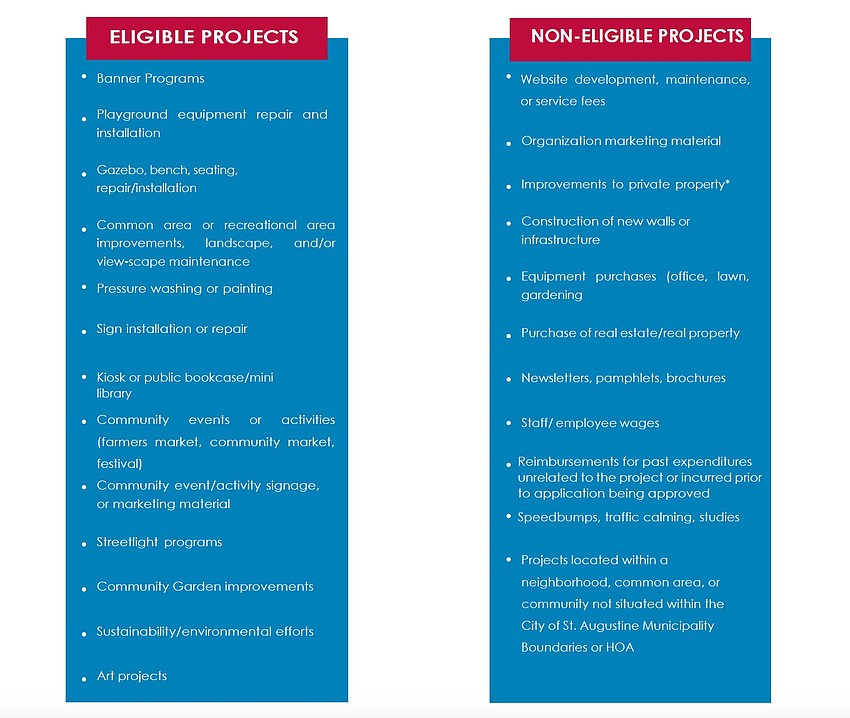
The program provides reimbursable funding for small-scale projects that demonstrate a clear public benefit in beautification, placemaking, neighborhood enrichment or community events.
Eligible expenses include public art installations, small libraries, gazebo and bench repairs, community garden improvements, banner programs and neighborhood markets.
Grant funds cannot be used for speed bumps; website development; recurring maintenance fees; marketing materials for the organization itself; improvements to private property; or expenditures incurred before grant approval.
Applications are accepted quarterly during the first 15 days of January, April, July and October. Awards are distributed on a first-come, first-served basis to projects scoring at least 15 points based on community or neighborhood beautification factors, including placemaking or revitalization, neighborhood enrichment initiatives, and programming and community events.
The approved amendment to the Neighborhood Grant Program takes effect immediately.