
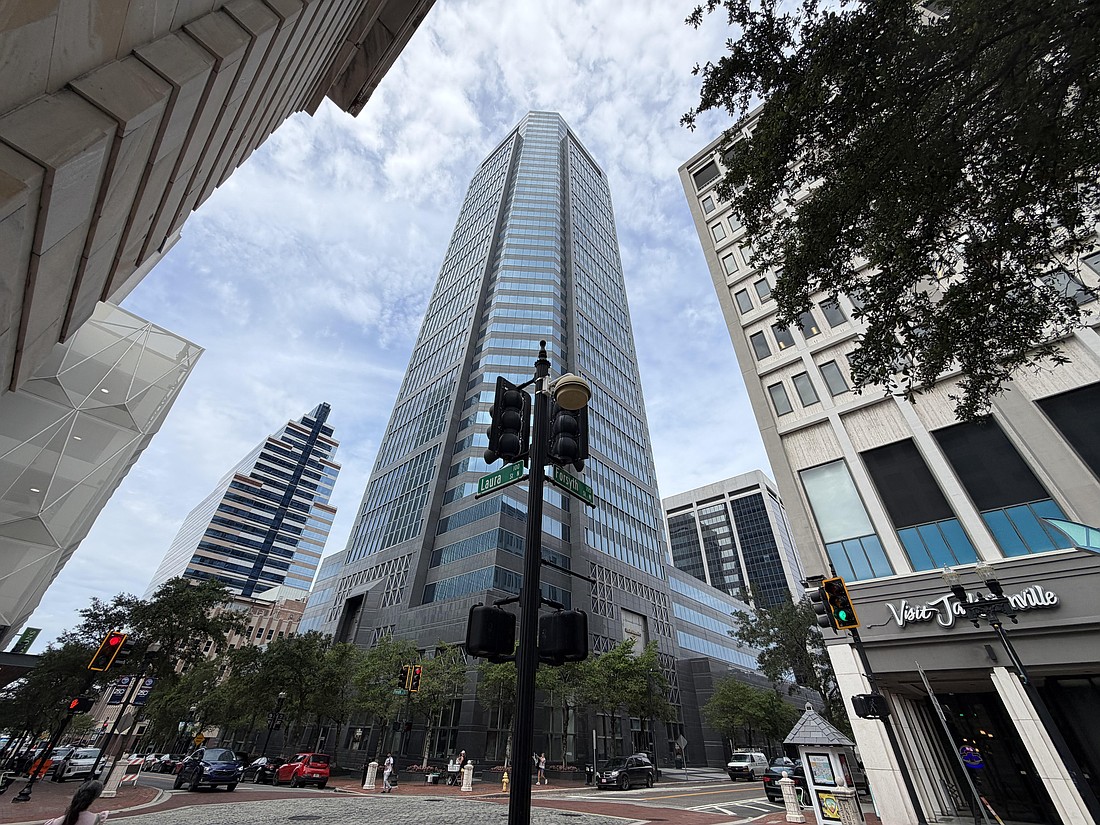
When Jacksonville’s tallest Downtown tower was built in 1990, the CEO leading the charge didn’t see a need to consider putting a name on top.
Barnett Banks Inc. built the 42-floor, almost 730,000-square-foot structure that rises to its pointed pyramid obelisk at 50 N. Laura St. in the city’s core.
“Charlie Rice said this is such an iconic building that it doesn’t need a name on it,” said Bill Nicholson, who worked with Rice, the former chairman and CEO of Jacksonville-based Barnett, which was Florida’s largest bank.
“Naming rights were never as important as they were on other buildings,” Nicholson said, noting that the names of other banks and financial centers Downtown might be visible on tower tops during Monday Night Football when the Jacksonville Jaguars play at EverBank Stadium.
“Nobody said, ‘Hey, that’s the Bank of America building, it just doesn’t have a sign.’”
Charles E. Rice Jr., known as Charlie, worked with Barnett for three decades and led it from 1979 to 1998, when it was acquired by NationsBank, which then merged with Bank of America.
Rice, who died in 2008, expanded Barnett from about $3 billion to $43 billion in assets, transforming it into the largest bank in Florida. The merger was, at the time, the largest in U.S. banking history.
Alex Sink, president of NationsBank’s Florida operations during the acquisition, also was consulted about the name.
“When NationsBank bought Barnett, I talked to Alex Sink about this, and we looked at the building and the way the building’s designed. It really wasn’t set up to put a name on it,” Nicholson said.
Nicholson is a principal with Jacksonville-based Heritage Capital Group, an investment banking and financial advisory firm.
He was Barnett’s director of commercial real estate from 1992 until the purchase and then joined Bank of America Securities as managing director. Over the years, he had offices on the 18th, 30th and 41st floors.
Bank of America remains in the building but has downsized its space.
For the first time in its 36-year history, the tower, originally known as Barnett Center, doesn’t have an anchor tenant and is being marketed as Jax Tower at 50 North.
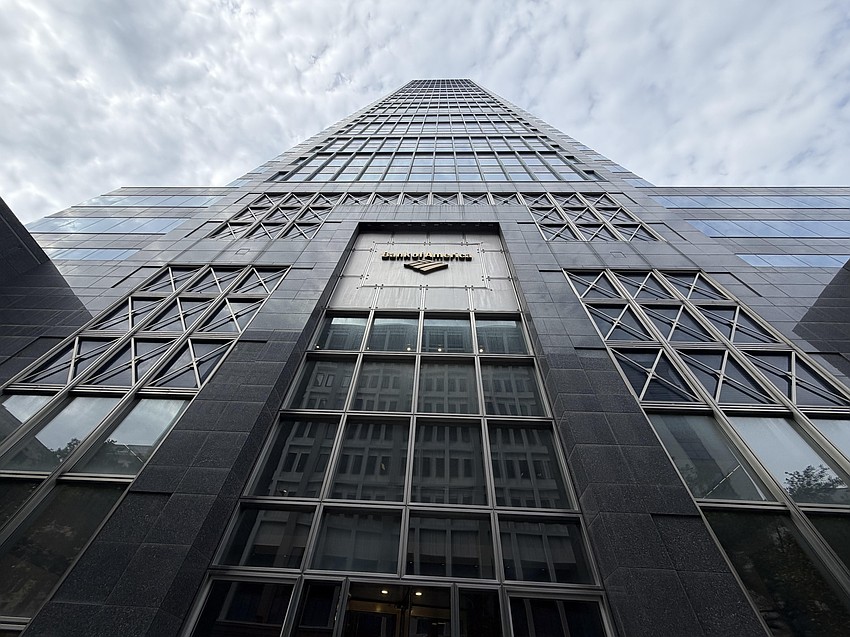
The Bank of America name, for now, remains above the street-level entrances on the tower, which dominates the 1.32-acre block bordered clockwise from the north by Forsyth, Laura, Bay and Hogan streets in the heart of the Downtown Northbank.
Nicholson isn’t fazed by news that Bank of America no longer has naming rights to the tower.
“Naming rights on Bank of America were never as important as they were on the other buildings,” he said.
“It’s an event, but it’s not that big of a deal.”
From Barnett Banks to Bank of America
Barnett Banks was a big deal in Jacksonville, and Bank of America is, too.
Charlotte, North Carolina-based Bank of America remains the largest bank in metro Jacksonville with $63 billion in deposits and a 53% market share, according to the Federal Deposit Insurance Corp., and its presence includes 25 branch financial centers and 10 stand-alone ATMs.
The FDIC regulates banks. Data was as of June 30, 2025, the latest period reported.
Bank of America has more than 8,200 employees in the Jacksonville area, including its Downtown headquarters, branch offices and a suburban operations center.
JAX Chamber ranks it tied with Amazon as the area’s third-largest employer at 8,000 employees, behind Baptist Health and Mayo Clinic.
The local numbers differ, but remain signficant, at resources.bankofamerica.com/local-market/fact-sheet/jacksonville/, which in a 2025 post shows 7,830 employees and 29 locations serving clients.
After the Barnett transaction, Bank of America sold the tower while maintaining anchor status as a tenant, topping out at 188,000 square feet of space there for a decade, from 1999 to 2009.
It then faced the same market forces as other banks and office users nationwide, significantly the 2007-09 financial crisis, Great Recession and federal financial reform regulations, and not long after, the COVID-19 pandemic in 2020.
The industry also experienced the explosion of online banking and the move toward branch openings closer to suburban clients; rent and parking challenges in downtown markets; and the pandemic response of hybrid and remote workforces.
Bank of America’s Downtown tower lease was updated in July 2024, dropping below what the financial institution needed to maintain naming rights.
A Bank of America spokesperson said its leased space dropped from 65,000 to 49,000 square feet, now taking 2.5 floors. That lease is for the five years through 2029.
“In doing so, the naming rights were turned back over to the building owners,” a Bank of America spokesperson said during a series of emails June 18-25.
The spokesperson referred questions to the landlord about the level it needed to maintain signage.
“We regularly evaluate our real estate footprint to align with evolving client behaviors and the needs of our business,” the spokeperson said.
“Our downtown Jacksonville office continues to support client-facing teams, serving clients who are increasingly using digital channels for day-to-day banking while still relying on in-person engagement for more complex needs.”
That indicates that Downtown is where the substantial or complicated deals are done with the top executives.
Charlie Rice worked out of the top floor, where the bank also had an executive dining room and boardroom.
For a time more recently, the floor and its view were open to the public as the Skyline Dining and Conference Center.
It is now leased by the MicroLumix Bioscience Technologies headquarters.
As the anchor tenant
In years past, an anchor tenant could land the ability to negotiate naming rights by leasing 25% to 40% of a building, Nicholson said.
“That’s now probably down to 10% to 15% and that’s a sign of the times and indicative of a market, particularly in many downtown areas, that is fragile and less robust than it used to be,” he said.
At its peak, Bank of America leased about 27% of the tower. Its space now is 7%.
From another perspective, the bank leases about a quarter of its peak presence.
Bank of America closed its lobby branch office and its inside ATM as of June 25, 2024. It maintains an exterior ATM on the south side of the tower.
The Downtown Bank of America offices include those of Merrill Lynch.
In 2009, Bank of America bought the former Merrill Lynch & Co. Wall Street investment firm, which now operates as the bank’s wealth management division.
The spokesperson said that Bank of America and Merrill Lynch now lease floors 24, 37 and half of 36, and the bank continues to maintain its executive presence there, led by Mark Bennett, president of Bank of America Jacksonville.
The original Merrill Lynch lease in the tower was executed in 1992 for 30,000 square feet, increasing to 32,000 square feet when remeasured in 1996 in an administrative change.
That size was reduced by 2,000 square feet in 2007 and by another 1,000 square feet in 2021.
While Bank of America has its name prominently on the north and south faces of the structure above street level, the spokesperson said keeping those up is a decision by the landlord.
In three years, the Bank of America lease comes up again.
The suburbs
While Bank of America has downsized its presence Downtown, it has been investing at least $200 million in upgrading its identity in the suburbs.
The bank has been renovating its Jacksonville Operations Center that was developed in 1989 for Barnett Banks Inc. at 9000 Southside Blvd. in The Avenues area of South Jacksonville.
After the Barnett acquisition, the bank sold the office park but leases a large portion of it for its customer contact operations call center and technology-operations support.
“We have a significant presence in Jacksonville and have made substantial investments in our campus to provide modern, collaborative space for many of our teammates. Our approach reflects how and where our employees work most effectively, while ensuring we continue to serve our clients and the community,” the spokesperson said.
It leases several buildings in what is now the Gramercy Woods business park from New York City-based Ladder Capital Finance LLC.
Asked what role the Southside campus will play in the Downtown lease negotiations for 2029, the spokesperson responded:
“We continually evaluate our footprint, lease terms, building spaces, etc. based on needs and changing market conditions.”
Bank of America said in October 2021 it would renovate and update 800,000 square feet of space among five buildings – 200, 300, 400, 500 and 600 – in phases over several years.
The $200 million investment includes construction of a six-tier, 1,447-space parking garage at a job cost of $24.66 million on the northernmost parking lot in Gramercy Woods.
As of year-end 2023, Bank of America anticipated completion of the projects over the following two years.
Auld & White Constructors and Marand Builders Inc. of Jacksonville Beach are the contractors for the renovations.
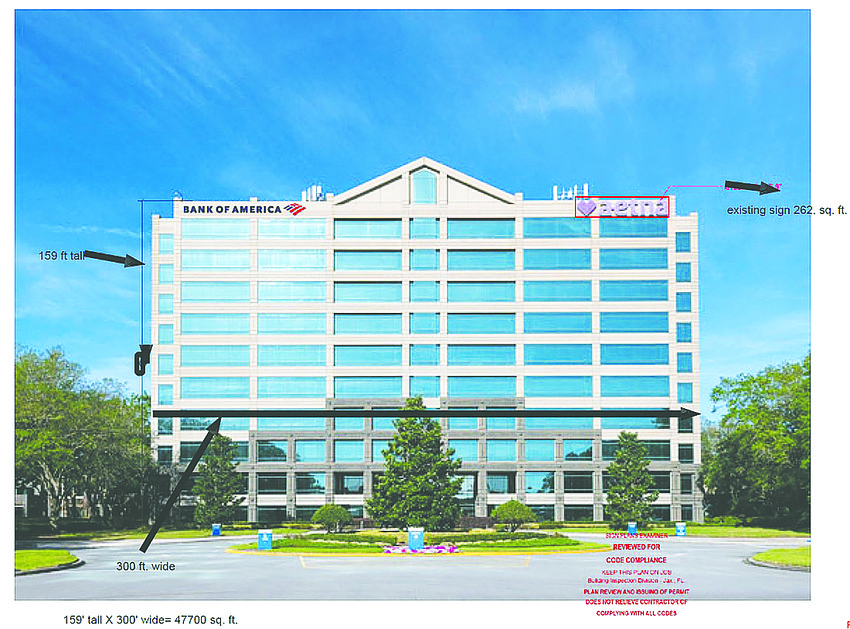
Bank of America also is remodeling space in the 10-story Building 100, which it leases from another landlord, at the entrance of the business park, and has put its name on the top east and west sides. Another tenant, Aetna, also has signage up.
Bank of America leases three floors and 78,700 square feet of space in Building 100.
Bank of America also owned the 52.23-acre Merrill Lynch suburban office park, with about 590,000 square feet of office space, in Deerwood Park North, which is 6 miles up Southside Boulevard.
The bank and Merrill Lynch used the park for some functions but sold the property in January 2025 for $42 million to Intercontinental Exchange Inc. for the ICE Mortgage Technology Division headquarters.
Bank of America consolidated its functions from there to Gramercy Woods.
Marketing the tower
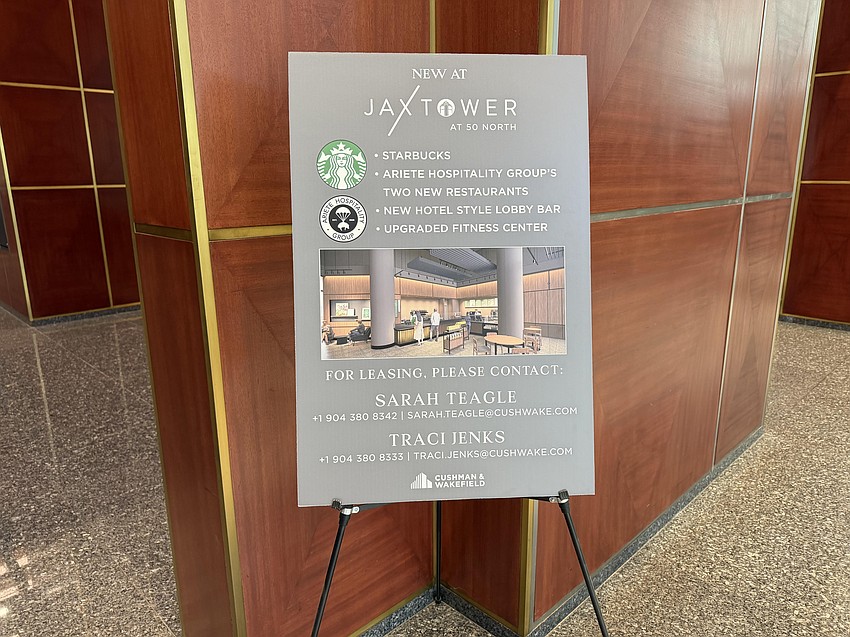
The Cushman & Wakefield leasing team of Senior Director Traci Jenks and Sarah Teagle, senior associate of office brokerage, is marketing the Downtown high-rise as Jax Tower at 50 North.
Teagle said June 16 the tower has 698,015 square feet of rentable space and is 70% occupied.
One of their tower tenants happens to be Mayport Venture Partners LLC, a venture capital firm led by President and CEO Dan Rice, Charlie Rice’s son.
The tower now has about 210,000 square feet available for lease that can accommodate an anchor tenant who wants to put its name on the tower.

Teagle said ownership has been investing in the tower’s proposed ground-floor restaurants, a water chiller system, HVAC and other infrastructure and amenities. Chick-fil-A recently opened a temporary lunch counter in the lobby to test the market.
Teagle said she and Jenks have shown the space to large prospective tenants that she declined to identify.
A naming-rights deal may not require a tenant to lease a specific amount of space but instead would be part of a negotiated package deal, she said.
Sign design
Barnett Banks chose a design that didn’t allow for tower-top signage.
While the tower cannot accommodate traditional signs at the top of its obelisk design, Teagle said technology could allow projected signage onto the tower, assuming city approval.
In 2008, Bank of America looked into putting illuminated signs near the 42nd floor on all four sides of the building, requesting a special sign exception from the city’s Downtown Development Review Board for the size.
The exception would allow the area of the signs to be 562 square feet per sign, which exceeded the allowable 400-square-foot limit.
A board member wanted to restrict it to two sides, saying four would make the building look cluttered.
A Bank of America sign company representative said the bank wanted the signage visible from all directions, but said that due to the height of the tower, the small size wouldn’t be.
No decision was made.
“We are digging in more on what type of signage would be allowed at the top of the building,” Jenks said.
Jenks has inside knowledge of the building. Her first job when she moved to Jacksonville was with Barnett and she worked on the 12th floor.
“It was a special treat to get to have lunch on the top floor in the executive dining room.”
Tower ownership
Property records show the 729,185-square-foot high-rise was built in 1990 to house the headquarters for homegrown Barnett Banks Inc., which was founded in 1877 by William Boyd Barnett.
Cushman & Wakefield says it remains the tallest office building between Atanta and Miami.
Barnett moved from the 18-story Barnett National Bank Building on the neighboring block.
Its investment into its tower included the obelisk design by international architect Helmut Jahn that punctuated the Downtown skyline, sparking visiting schoolchildren to label it “the pencil building.”
Barnett was sold in January 1998 to NationsBank Corp., which then bought BankAmerica Corp. in September 1998. For a brief time, the tower was known as NationsBank Tower.
The merger agreement filed with the Securities and Exchange Commission said NationsBank would change its name to BankAmerica Corp., which it did in July 1999. It then became Bank of America.
That’s when the property began changing ownership, too.
Through Jacksonville Tower Associates, Parmenter Realty Partners of Miami bought the building in July 1999 for $74.72 million from NB Holdings Corp., the successor to Barnett Banks Inc.
The Hertz Investment Group, a California-based real estate investment and management group, bought the tower from Parmenter Realty Partners in July 2014 for $88 million.
In December 2020, current owner Group RMC of New York City bought the property through Jacksonville Tower Florida Realty LP from Hertz Jacksonville One LLC for $75.5 million.
The property includes a five-story, 42,000-square-foot adjacent bank building and a nine-story parking garage at 25 W. Forsyth St.
Jenks said she was part of two of the tower sales.
She was with Lincoln Property Co., which handled NationsBank’s real estate work, when Parmenter bought it.
And she was part of the Cushman team representing Hertz in the sale to Group RMC.
“The building has a very special meaning to me,” she said, having started her career there, helping to sell it twice and now marketing it.
“I hope to be working with the property for many years to come,” she said.
Wells Fargo, too
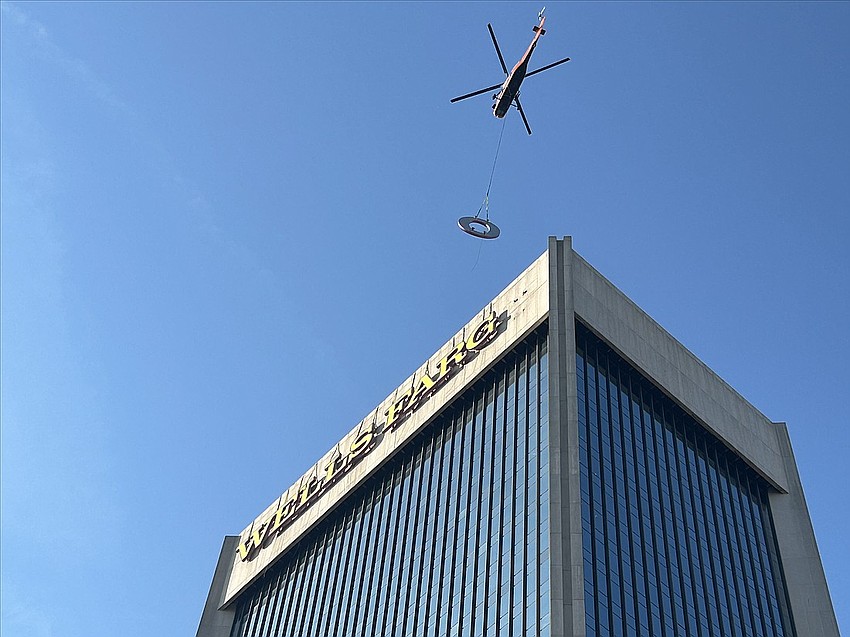
Bank of America is one of two large banks that gave up naming rights Downtown.
In 2024, Wells Fargo Center across the street became 1 Independent as owners of the 37-story structure began negotiating for a new anchor tenant.
San Francisco-based Wells Fargo had its name on the 1 Independent Drive tower since 2011 but downsized its leased space.
A new anchor would be the fifth name since the high-rise was built in 1975 for Jacksonville-based Independent Life & Accident Insurance Co. and was known as the Independent Life Building.
Encompassing an entire city block next to the Riverwalk, “Wells Fargo Tower spans 655,000 square feet with striking architecture that stands out as an icon in the Jacksonville skyline,” says a marketing program.
Market sources said Wells Fargo occupied from 105,000 to about 110,000 square feet of space in the high-rise but would drop to less than 50,000 square feet in October 2024.
Market sources said Wells Fargo reduced its lease from space among seven floors, which included a branch office in the lobby, to two floors.