
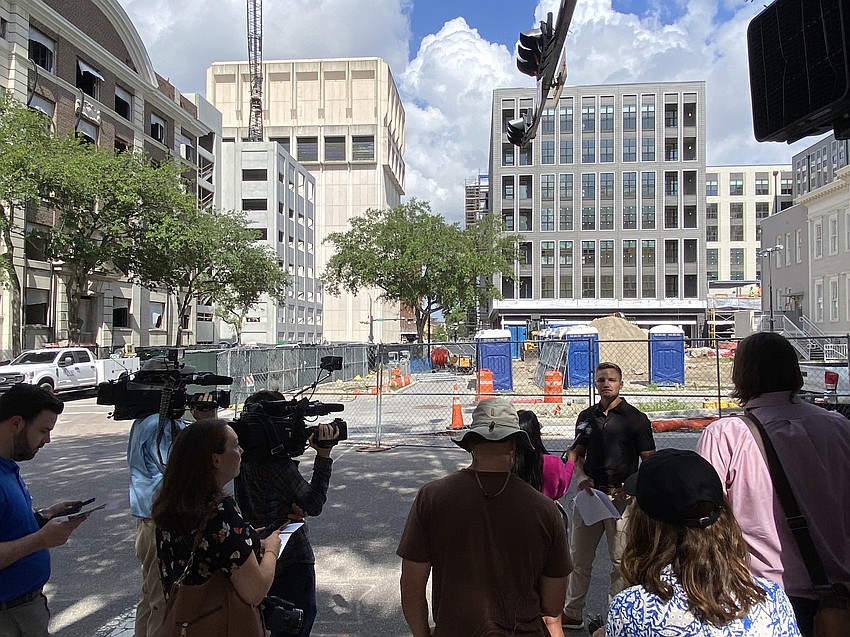
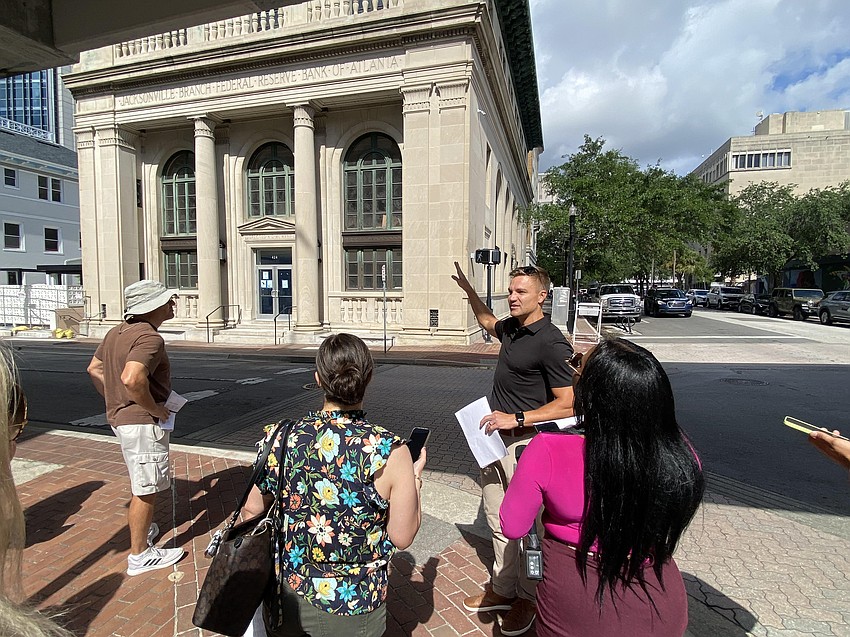
As Gateway Jax prepares to seek Jacksonville City Council approval of incentives for a mixed-use project that includes a full-service Publix grocery store, the CEO of the group said May 19 it was critical to the success of Gateway’s Pearl Square development.
During a media tour, Gateway principal Bryan Moll said that without a full-service grocery store, “it would be much more difficult, if not impossible, to do what we’re doing at this scale.”
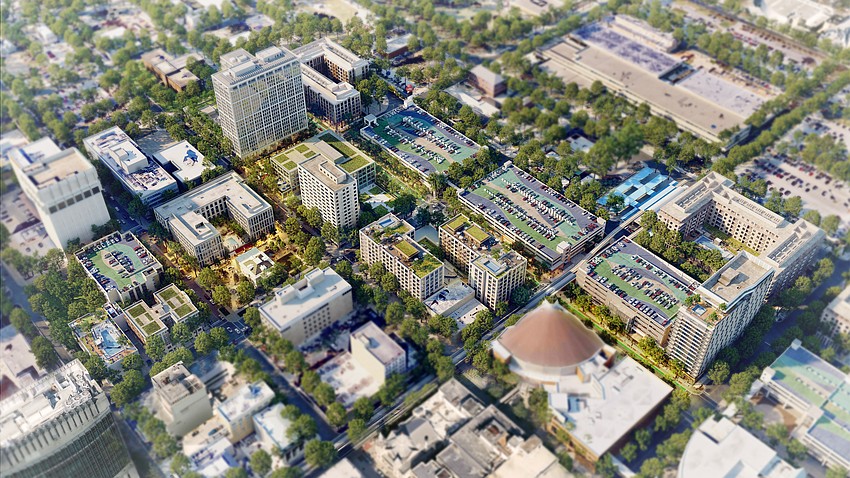
Moll made the remark after showing active construction sites for several projects in Pearl Square, where he noted that the most recent estimated cost of $750 million had likely climbed closer to $1 billion.
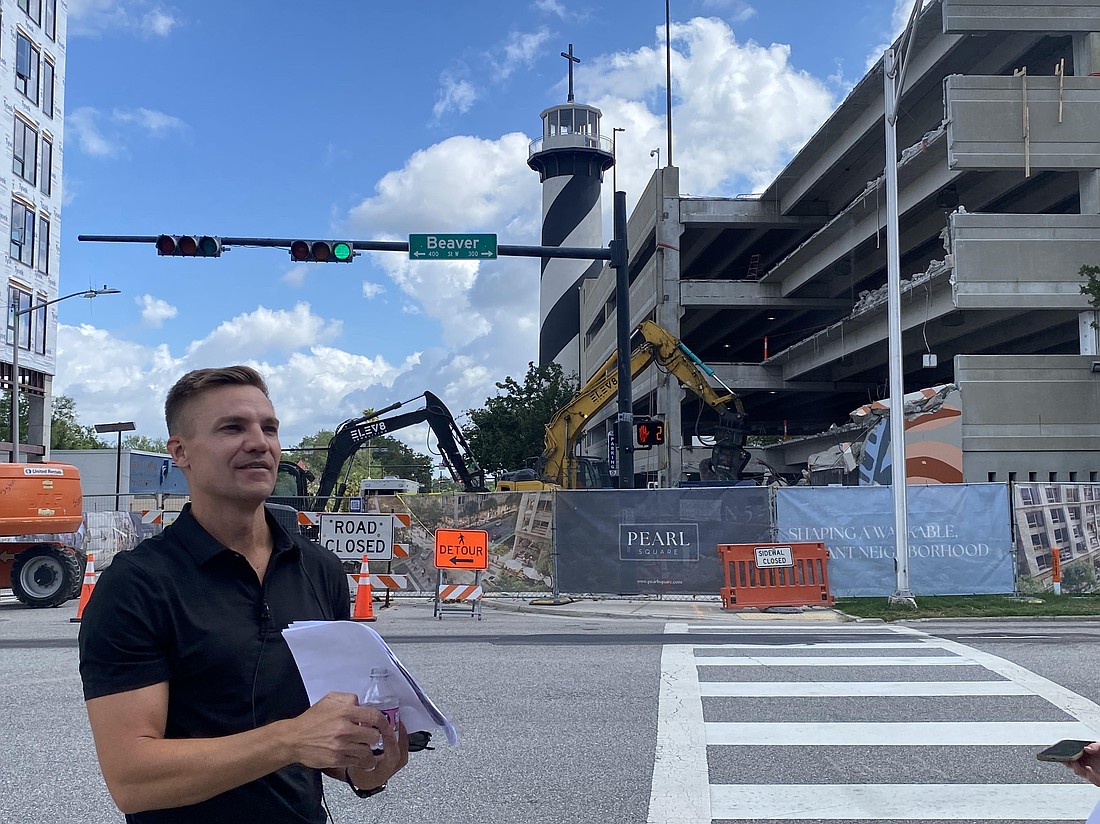
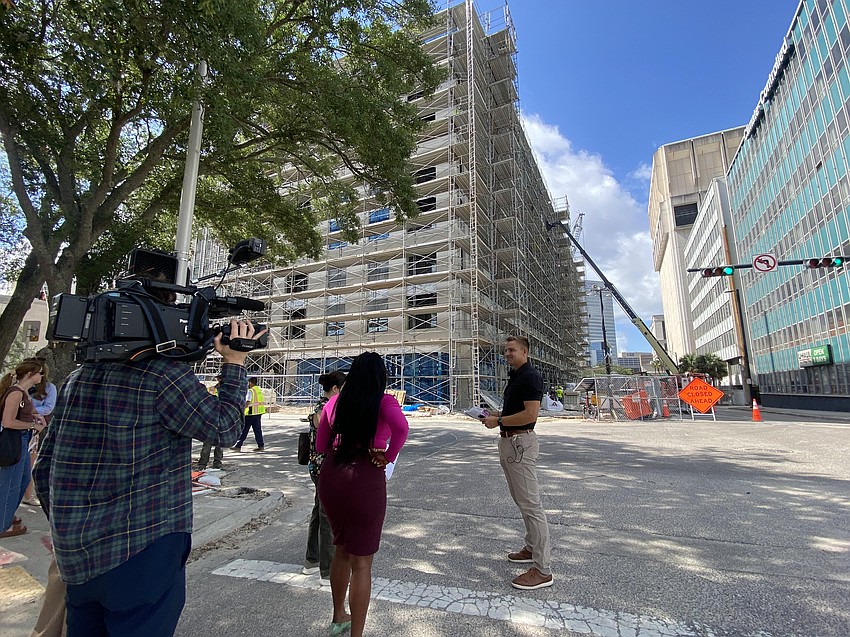
The projects included the Vandeveer apartments and retail development at 515 N. Pearl St., where Moll said leasing was expected to begin in late summer; Hotel Merrydelle, the former Ambassador Hotel, where a parking garage is under construction; and the former “lighthouse” parking garage, where demolition is underway to clear space for retail and a corner restaurant.
The tour ended at the proposed Publix, the former First Baptist Church main auditorium at 119 W. Beaver St. Gateway plans to raze the building and replace it with a mixed-use, 14-story tower that would include the grocery store.
The incentives debate
In December 2025, the Downtown Investment Authority board voted unanimously to recommend that Council approve a $49.66 million incentive package for the project, including a $28.25 million completion grant.

But after that vote, the project became a flash point in a Council debate about whether the city had overcommitted incentives for Downtown revitalization, particularly with completion grants. Those grants, unlike tax rebates, involve payments from the city’s operating fund.
Some Council members have pushed the city to curtail or shut off completion grants, saying they threaten to push the city budget into deficit.
Moll said during the media tour that Gateway, in which he partners with JWB Real Estate Capital and DLP Capital, believes completion grants eventually should be phased out. They and other incentives are designed to create a wheel effect in which redevelopment raises property values, increases tax revenue and attracts new developers and property owners.
But Moll and others say Downtown has yet to reach a tipping point where incentives are unnecessary.
Still talking
Moll said during the tour that conversations between Gateway and Council members were ongoing, including alternatives to completion grants.
“We’re open to any and all ideas,” he said.
However it is funded, Moll said, the Publix development must occur for Gateway to realize its vision of investing $2 billion in Downtown. He said the project would support growth of Downtown’s residential population and help attract retail that will propel further development.
“The most important thing we’re doing is this site,” he said.
Moll said demolition work on the building is expected to begin in June.
Among other notes from the tour:
• Gateway is working with the city and the Florida Department of Transportation on a “road diet” for a portion of Beaver Street that runs through Pearl Square. That project would include removing one lane of traffic from the four-lane street in each direction, adding bicycle lanes and wider sidewalks, building landscaped medians in sections and raising intersections.
It’s designed to slow vehicles and allow for safer walking and bicycling. Moll said he hoped construction would start this year.
• Moll said Gateway’s plans for a lot it recently purchased at 220 Beaver St. would elevate the cost of Pearl Square closer to $1 billion.
The original plan comprised five properties with an estimated cost of $419 million. Today there are nine properties. Moll said preliminary plans for 220 Beaver St. included for-sale condominiums. In total, Gateway owns 26 acres in 33 blocks in and around Downtown.
• Plans for Pearl Square include 2,500 parking stalls, part of what Moll called a plan to make parking “as frictionless as possible.” Garages will include signs at entrances showing how many spaces are available, plus red lights and green lights above stalls to help drivers find open spaces. Valet service also will be available in the district.
• As the Jacksonville Transportation Authority prepares for a second round of public meetings to draw input on what to do with its Skyway elevated tram system, Moll said Gateway Jax would prefer options that allow it to continue moving people Downtown.
During the fall meetings, JTA says it will present options that include keeping the Skyway as-is, investing in more cars, incorporating it into the Ultimate Urban Circulator of autonomous vehicles, demolishing it in favor of U2C at-grade vehicles or turning it into an elevated walkway. Moll said he believed ridership would increase as Downtown’s resident population grows. He said he disfavored the walkway idea given that a portion of the Emerald Trail runs under the Skyway route.
“I don’t think we need to create something like the Emerald Trail right above it,” he said.
• Moll said Gateway Jax has had discussions with three hotel groups for its proposed tower in Riverfront Plaza, the former Jacksonville Landing site, and hoped to announce in June or July which one would be its hospitality partner in the project.
In December 2025, Gateway Jax acquired a city-owned development pad at Riverfront Plaza in exchange for the former Interline Brands Inc. building and grounds at 801 W. Bay St. The city conveyed that property to the University of Florida for its graduate campus in LaVilla.
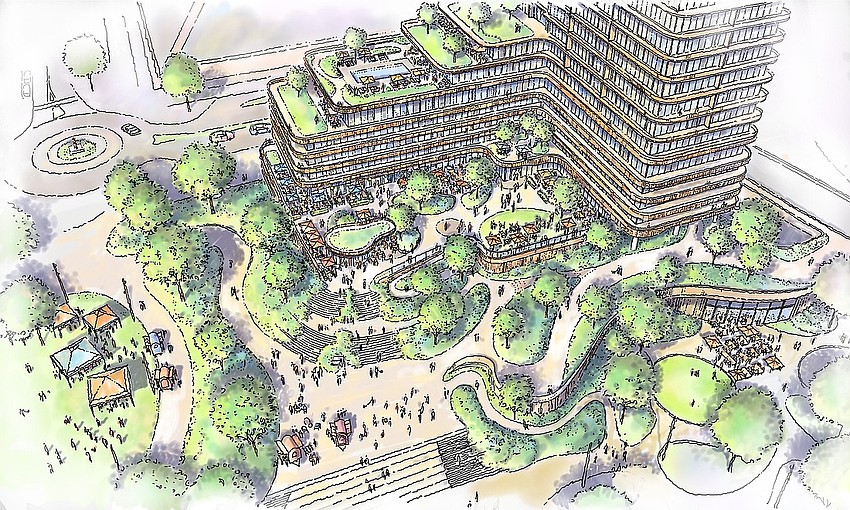
In June 2025, Jacksonville City Council voted to direct the city to exchange the Riverfront Plaza pad plus an option on an adjacent property for the Interline Brands buildings. In its agreement with the city, Gateway Jax committed to building a 17-story tower that would include a hotel, condos, restaurant and retail square footage, and public spaces.
Moll said Gateway planned to present an incentives request to the DIA on a timeline that would send legislation to Council by the end of the year.