
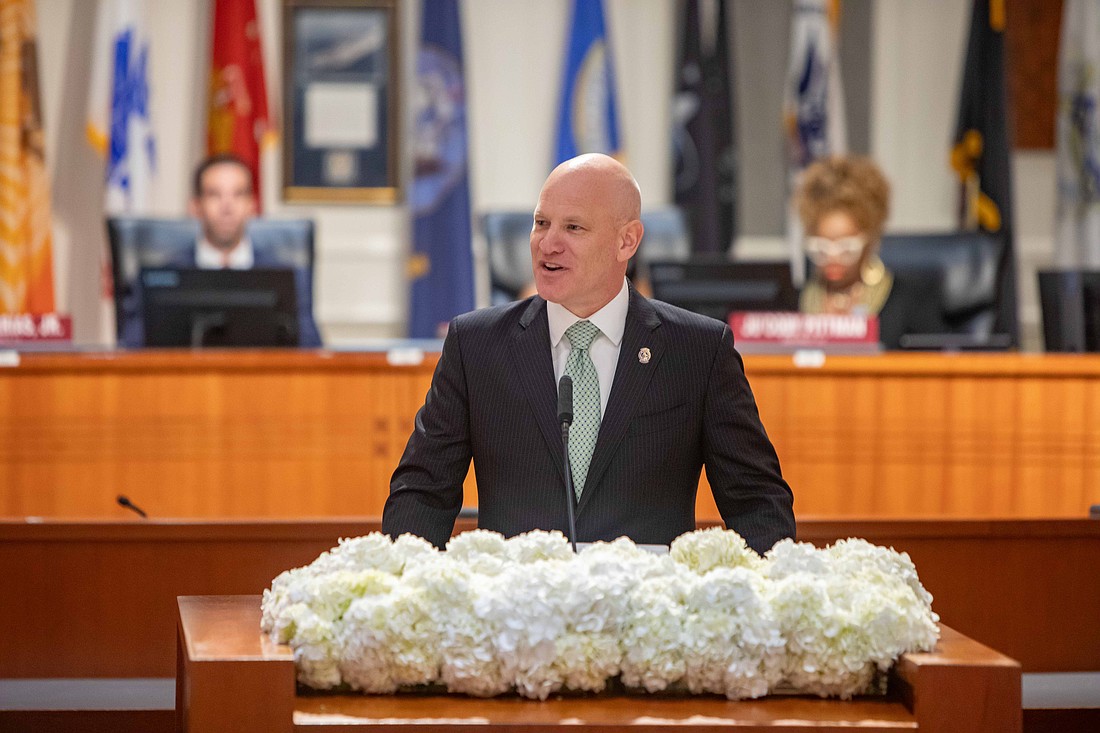
The city of Jacksonville and its City Council will need to focus on core city services while facing possible revenue loss from Florida property tax reform, new Council President Nick Howland said.
In a June 8 interview, less than a month before he began his leadership of Jacksonville’s 19-member Council, Howland called for the city to adopt more creative means to fund business and economic development, both in Downtown and across the city.
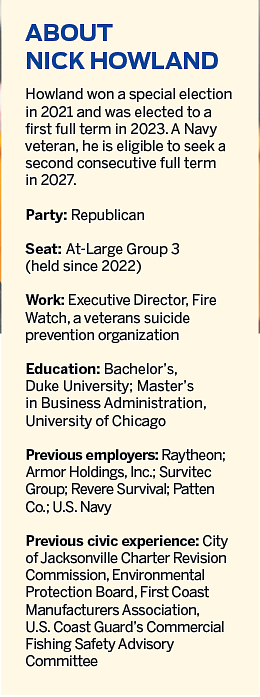
Howland, who served as Council vice president in the 2025-26 cycle, supported a millage rate reduction during that year’s budget cycle and said he would support the “Save Our Homes from Excessive Property Taxes” ballot measure that could reduce city revenue by more than $300 million within three years. But with those budget projections looming, he said this year is the time to begin bracing for the impact.
On the city budget
Ahead of Mayor Donna Deegan’s scheduled budget presentation to Council, Howland said he supported taking a hard look at the city’s spending before property tax reform could affect city revenue.
Florida voters are scheduled to decide in November on a measure that would increase the state’s homestead exemption from $50,000 to $150,000 by fiscal year 2028, and $250,000 by FY29. Council auditors estimated that the $250,000 exemption, along with a cap on the increase of assessed values for commercial properties, would cut more than $300 million in FY29.
Howland and incoming Finance Committee Chair Will Lahnen want to begin setting aside funds in a contingency account should voters approve the measure, which needs 60% of the vote to pass.
“We’ll work together with the administration to see where we can focus all spending on the core, given the revenue uncertainty,” Howland said. “You can expect a good partnership between the mayor, myself, (Chief Administrative Officer Mike) Weinstein and Chair Lahnen, and so we’ll have to take a fine-tooth comb (to the budget).”
In this budget season, and potentially others, Howland said, the city will have to focus on the “essential” services that residents expect before expanding the reach of city government.
“To me, the core role of local government is public safety, infrastructure and essential services, and by those essential services, I mean sidewalks, roads, lighting, drainage, trash pickup, parks — all the things that taxpayers rely on local government to do,” Howland said. “In the face of, again, uncertain future tax collections, we need to make sure we’re focusing all available resources on the core.”
On Downtown and business incentives
Addressing an audience June 2 at the Downtown Development Forum, Deegan said the property tax exemption, if passed, would essentially kill the city’s ability to fund Downtown development.
In a June 8 appearance on WJCT News 89.9’s First Coast Connect program, Howland said the city might not “have the money” to provide a $28.5 million completion grant to a proposed Publix in the Gateway Jax Pearl Square development.
One alternative pitched by Howland: having private companies pay out completion grants for the city, while the city pays back those grants over time, with interest.
For example, if the city wanted to spend $12 million on a completion grant for a Downtown project but did not have the funds, it would have a third-party company pay the grant. In return, the city could give that company tax breaks large enough to make the grant a worthwhile investment.
“The net present value of the future discounted taxes would have to be something higher than that, that gives them a spread that makes it worthwhile for them to invest,” Howland said.
“You’ve got to model it out. One would think that having (Hotel Merrydelle) Downtown — if you wouldn’t otherwise get it without the completion grant paid by the third party — having that hotel Downtown will increase property value writ large,” Howland said, referencing a planned Pearl Square hotel under consideration for $10.1 million in city funding.
As of the June 8 interview, conducted in his Council office, Howland said he had spoken to several business leaders in Jacksonville, as well as JAX Chamber, and that there was some interest in the proposal. However, nothing was final.
“We’re all kind of looking at it and mulling over. Everyone thinks it has a lot of potential. Will it die in the details, is the question,” Howland said. “I’m going to have to form a team to take a look at it.”
The potential property tax reform could also serve as an incentive to bring business to Jacksonville, Howland said.
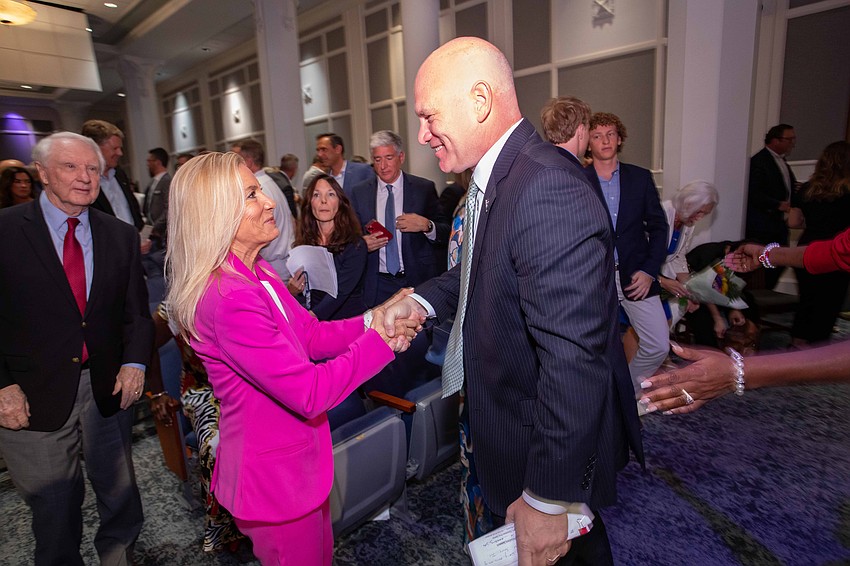
“Milton Friedman’s idea of job creation is creating an environment conducive to jobs wanting to relocate there, so having lower taxes for your employees to pay is helpful,” Howland said, seated across from a picture of his father and American economist Friedman, a Nobel Prize winner.
“Employees are going to want to work in the state of Florida.”
Howland also floated expanding Jacksonville’s shipbuilding capacity to match a U.S. Navy directive to build new ships quickly. This plan, Howland admitted, is not fully developed.
“The Navy’s new shipbuilding plan calls for significantly more and significantly smaller vessels. That potentially could be done by BAE Shipyard or Fincantieri Shipyard (at JaxPort). It’s a priority in the national defense plan, particularly among the industry base, to expand its shipbuilding and ship repair capabilities,” Howland said.
“I’d like to see Jacksonville participate in that, so I’ll be focused a little bit on that as well as I can."
On affordability
Howland said he supports property tax reform based on a need to increase affordability for Florida residents. But he added that affordability could also come from creating jobs and housing within Jacksonville.
“You give a family a meal, you feed them for a night. If you give a family a job, you feed them for a career,” Howland said. “If we can’t support all the nonprofit initiatives that we’d like to do, all the ancillary things we’d like to do for folks, if we can at least make Jacksonville the ideal place for a business to locate or grow and grow jobs here, we’re giving families careers.”
Howland, who has been on Council since 2022, has also pushed for companies to move to economically challenged areas.
One of his earlier pieces of legislation, Ordinance 2022-0726, allowed companies to receive city incentives even if they did not pay their employees the Florida median wage — provided those companies were in an economically distressed area or a Community Redevelopment Area, or invested $10 million in a project.
“I couldn’t help thinking then that we’re probably missing out on a lot of companies, a lot of great jobs,” Howland said, adding that the companies using that waiver are “creating great jobs.”
Howland also said in order to lower the cost of living for Jacksonville residents, the city would have to incentivize private projects to build affordable housing.
“If we don’t have housing that working-class folks can afford to live in, then we’re failing,” Howland said. The city, he said, should incentivize private developers with federal tax-exempt bonds and, where possible, low-interest loans to make their projects “pencil” and expand the supply of affordable housing.
Some companies are exploring workforce housing for households earning 80% to 120% of area median income, Howland said, rather than the 60% tier. “If we truly are a working-class town with manufacturing, logistics and services, we need to make sure that we are an affordable town at the same time,” he said.
On JAA
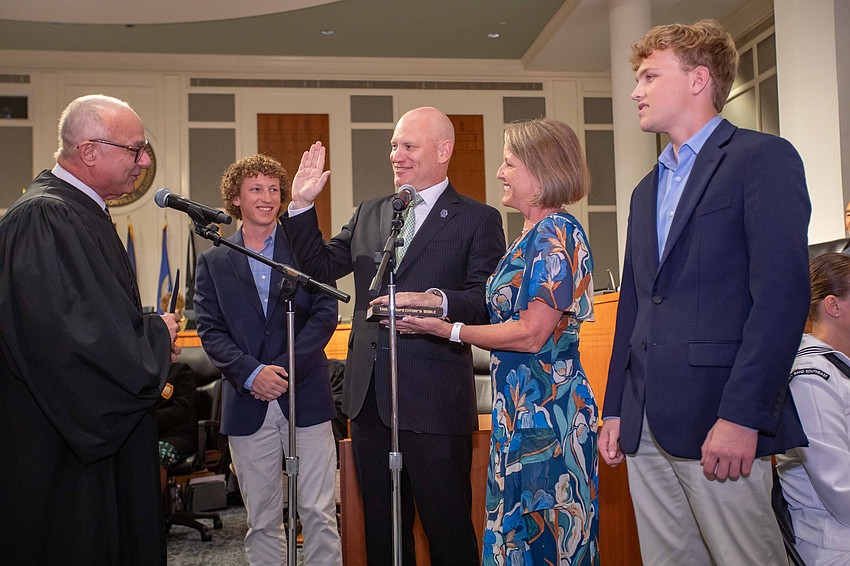
Howland, who serves as Council’s liaison to the Jacksonville Aviation Authority, has pushed to make Cecil Airport and Spaceport an economic development hub.
“Cecil represents the single greatest opportunity for job growth in the city of Jacksonville,” Howland said. “I anticipate they’re going to figure out how to do it, and I would encourage them to not waste any time and move with a sense of urgency.”
Howland said he expects aerospace to be a major part of future economic growth in Florida, as the number of launches from Cape Canaveral increases each year.
“We’re not going to be ever into vertical launch or vertical (landing), but we can be there for space and aerospace logistics, and you can see it right now,” Howland said. “That’s why Boeing has doubled down — and they even tripled down — on its maintenance, repair and overhaul facility, because they think it’s an ideal place for logistics. Otto (Aerospace) is going to be manufacturing there, because they think it’s an ideal place for manufacturing and logistics.”
Otto, the Texas-based aircraft manufacturer that plans to move to Jacksonville, recently released renderings of its planned Cecil Airport campus.
The company is developing a business jet, the Phantom 3500, that completed its preliminary design review in February.
The company says the design reduces drag by 35% and fuel use by more than 60% compared with traditional business jets. Otto says it expects the first flight in 2027.
“Things are progressing. They’re already moving on the site and starting to prepare the site. ... They’re already starting to hire,” Howland said.