
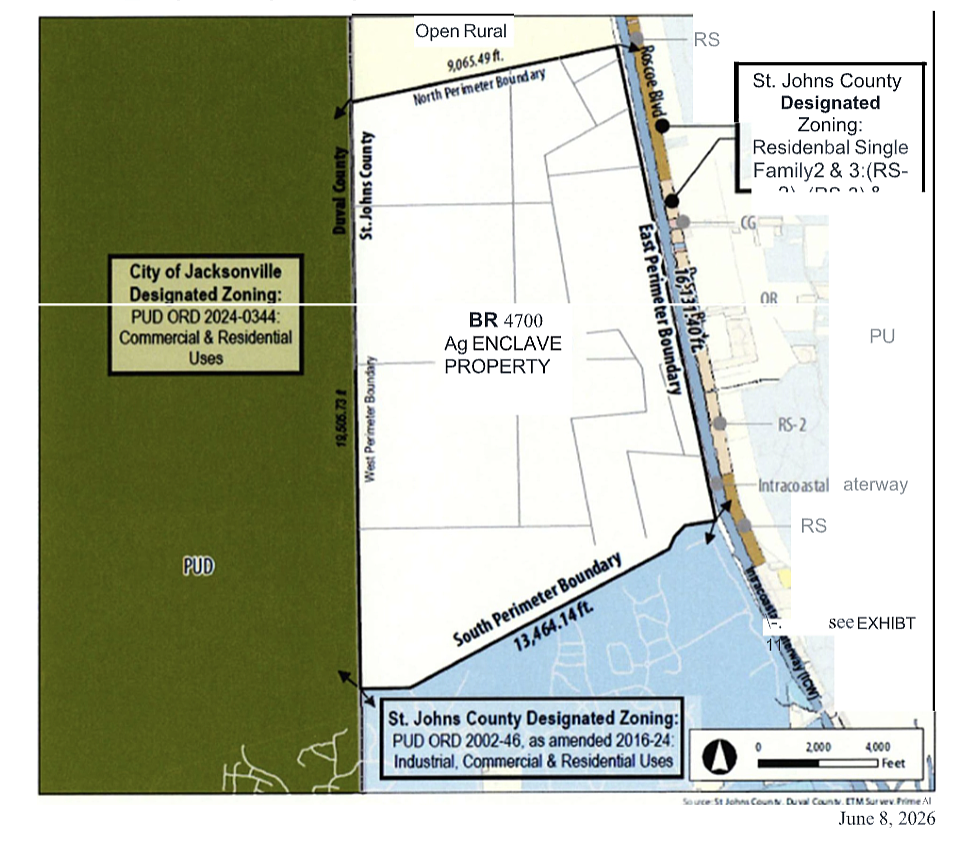
In a proposal facilitated by a new Florida law creating a faster approval process for developing agricultural land, the founding family of Winn-Dixie has taken the first step toward developing 4,462 acres it owns in northern St. Johns County.
The Davis family, through the limited liability company BR4700 LLC, filed an application with the county seeking certification of the property as an Agricultural Enclave.
Florida Senate Bill 686, signed April 24 by Gov. Ron DeSantis and effective July 1, allows for a streamlined review process for residential development on land certified as an Agricultural Enclave.
To qualify, a property must be unincorporated, undeveloped and under single ownership. It also must be at least 75% surrounded by existing development, located in a county with fewer than 1.75 million residents, and have met the eligibility requirements as of Jan. 1, 2025.
The Davis family filed its application for Agricultural Enclave certification July 1, the day SB 686 became law. The filing calls for a proposed development density of up to one residential unit per gross acre, allowing as many as 4,462 units on the property under the state law.
The PARC Group, the developer working with the Davis family on the proposal, issued a statement confirming it had sought the certification.
“Agricultural Enclave is a state designation that allows for a streamlined review process for single-family development that is consistent with surrounding land uses,” the statement said. “This process supports responsible long-range planning in areas near existing infrastructure and population centers that can efficiently accommodate future community needs.
“The PARC Group, working in partnership with the Davis Family, has a long history of creating high-quality, master-planned communities in Northeast Florida, including Nocatee, eTown, and EverRange. These communities reflect a continued commitment to thoughtful planning, meaningful infrastructure investment, preservation of natural areas, and the creation of connected neighborhoods with parks, trails, amenities, and community gathering places.”
The proposed community is planned for one of the county’s largest undeveloped tracts with Intracoastal Waterway access, bordered by the Duval-St. Johns county line to the west, the Intracoastal Waterway to the east and the northern edge of the Nocatee development to the south.
How the legislation works
Under the statute, landowners bypass the traditional comprehensive plan amendment process and instead apply directly for agricultural enclave certification.
When a property is certified, counties must treat the proposed development as a conforming use and cannot deny it based on consistency with the comprehensive plan, future land use designation, zoning or traffic impacts.
The legislation states enclave development projects “must be treated as a conforming use, notwithstanding the local government’s comprehensive plan, future land use designation, or zoning.”
There are restrictions. The new law bars landowners from using the fast-track development process if their property sits within such protected ecosystems as the Everglades, the Wekiva Study Area or the Florida Wildlife Corridor.
Additionally, the fast-track system cannot be applied to land inside Florida’s most populated counties, property near military bases or any parcel already bound by a conservation easement.
The law generally applies to parcels of up to 1,280 acres but creates a separate category allowing applications on properties as large as 4,480 acres when they are substantially surrounded by dense residential development.
A third pathway applies to parcels smaller than 700 acres within urban service districts and allows certain commercial and industrial development.
When an application is filed, county staff has 30 days to prepare a compliance report evaluating whether the property meets the statutory requirements. The county commission then has 30 days to approve or deny certification. If no action is taken within 90 days of filing, the application is automatically approved.
Under the law, county staff is required to issue a written compliance report by July 31 and the county commission must hold a public hearing to approve or deny certification by Aug. 31.
If certified, the property receives agricultural enclave status under state law, eliminating the need for rezoning or comprehensive plan amendments that typically require planning and zoning agency and county commission action. Residential development would instead proceed through administrative review.

The Davis application
BR4700 LLC is connected through state corporate records to the Davis family. It has held most of the land since November 1994, when it paid $9.3 million for it.
The company owns 4,569 acres across 21 parcels along the Palm Valley Road, San Pablo Road, County Road 210 and 20 Mile Road corridors, but in its filing it seeks enclave certification for 4,462.09 acres, keeping the application under the law’s 4,480-acre cap. The acreage is based on a survey completed June 18 by Jacksonville-based ETM Surveying & Mapping Inc. The filing was prepared by attorney Ellen Avery-Smith of the Rogers Towers law firm.
The application does not name a proposed community, describe housing types or amenities, or lay out a phasing plan. The residential intent and unit count are established only through the density figure required to demonstrate statutory compliance and through a related reference in a letter from JEA confirming water and sewer capacity.
To support its application, BR4700 submitted affidavits addressing each of the law’s eligibility criteria.
A land use analysis prepared by Donald Fullerton of Prime AE Group found the property is bordered on 84% of its perimeter by land designated for residential, commercial or industrial development — exceeding the law’s 75% threshold — and that 51% of the surrounding land is already developed, above the required 50%.
The same analysis found the property is surrounded by existing and authorized residential development projected to reach at least 1,000 residents per square mile at build-out, a density test required for parcels larger than 1,280 acres.
The Davis property is bordered to the east by the Intracoastal Waterway, with Palm Valley and Ponte Vedra Beach beyond it. The family’s Nocatee development abuts the property to the south, and its Estuary PUD development is adjacent to the west across the Duval-St. Johns county line.
The application states St. Johns County’s population is estimated at 348,336, under the law’s 1.75 million cap.
BR4700 also submitted letters offering to enter into binding agreements with St. Johns County, the St. Johns County School District and JEA to pay for or contribute land toward its proportionate share of road, park, school, water and sewer improvements.
In a June 29 letter, JEA confirmed it has the capacity to serve the property, referencing a development scenario of up to one residential unit per gross acre.
The Winn-Dixie grocery chain, now The Winn Dixie Company LLC, traces its origins to brothers William Milton (W.M.) and Carl Davis, who were partners in a small general store in Burley, Idaho. Through expansion and acquisitions, W.M. Davis’ four sons established Winn-Dixie Stores Inc. in 1955.
More about the law
The state Senate approved the bill on a 34-2 vote Feb. 26, and it cleared the House of Representatives on a 90-20 vote March 11.
It was sponsored by state Sen. Stan McClain, R-Ocala, a homebuilder, and carried in the House by state Rep. Adam Botana, R-Bonita Springs. The law sunsets Jan. 1, 2028, though properties certified before that date retain their status.
The legislation is part of a broader pattern of state preemption of local land use authority in Florida. The Live Local Act, signed in 2023, similarly limited local zoning authority by allowing multifamily housing by right in commercial and industrial areas when affordability requirements are met. SB 686 instead creates a fast-track approval process for qualifying agricultural land without an affordability requirement.
Proponents of the legislation said it is designed to protect property owners and developers from excessive local governmental restrictions on development. Opponents said it would weaken local governments’ ability to manage growth and maintain environmental protections.
“We’ve continued to work with the stakeholders on this and try to come up with a good balance of ensuring that people’s property rights are protected and yet still allow for the public to be involved,” McClain said April 22.
A shift from the Nocatee playbook
The scale of the proposed project echoes the Davis family’s Northeast Florida footprint, including the 14,000-acre Nocatee master-planned community developed over two decades in partnership with The PARC Group.
Nocatee relied on years of regional planning and negotiations that produced public infrastructure improvements, including the 2,400-acre Nocatee Preserve, the Nocatee Parkway, land for Davis Park and sites for five public schools.
Because certification under SB 686 is largely administrative, the proposed enclave project may not require the same negotiated public benefits that accompanied Nocatee’s approvals.
Next steps
The next St. Johns County Board of County Commissioners meeting is scheduled July 21, when the Davis family enclave application could be discussed, including between commissioners or through public comment. No agenda has been published as of July 9.