

Citing confirmations from Jacksonville City Council members, Daily Record news partner News4Jax reported June 14 that the Culinary Institute of America has selected Jacksonville as the site of its Southeast campus.
The New York-based institute voted on a site in June but has not announced the results of that vote. News4Jax said Council members confirmed to reporter Briana Brownlee and photojournalist Jesse Hanson that the institute had chosen Jacksonville.
News4Jax quotes Council member Jimmy Peluso, whose District 7 includes Downtown, as saying, “We are going to be this massive hub for the Culinary Institute of America, and since we got selected, it’s kind of putting the ball back in our court, or at least the Downtown Investment Authority’s court, to negotiate a deal with CIA.”
Council voted 16-2 on May 26 in favor of Ordinance 2026-0419, which expresses Council approval for the CIA campus and authorizes city staff to negotiate a finalized incentives agreement with the institute. Members Rory Diamond and Mike Gay voted no, and member Will Lahnen was not present.
The approved legislation does not bind the city to an economic development agreement. Rather, the ordinance serves to encourage the CIA board to select Downtown for its Southeast campus and confirms Council support for up to $35 million in incentives.
During a June 23 meeting of the Council Special Committee on the Future of Downtown, DIA CEO Colin Tarbert told the committee the Culinary Institute had voted on a site but had not publicly revealed its selection. Tarbert said the institute was organizing an announcement involving local partners in the project.
Corner Lot and Aspect Real Estate Group, partners in the project, submitted the only response to a DIA notice of disposition for a 0.8-acre portion of a 2.6-acre property along the St. Johns River Northbank. Disposition is a process by which city-owned property is transferred to the private sector for redevelopment.
The DIA documents said the property would also include space for Project Caymus, which was identified as an academic institution that would operate culinary demonstration and teaching kitchen facilities and offer professional development and continuing education programs.
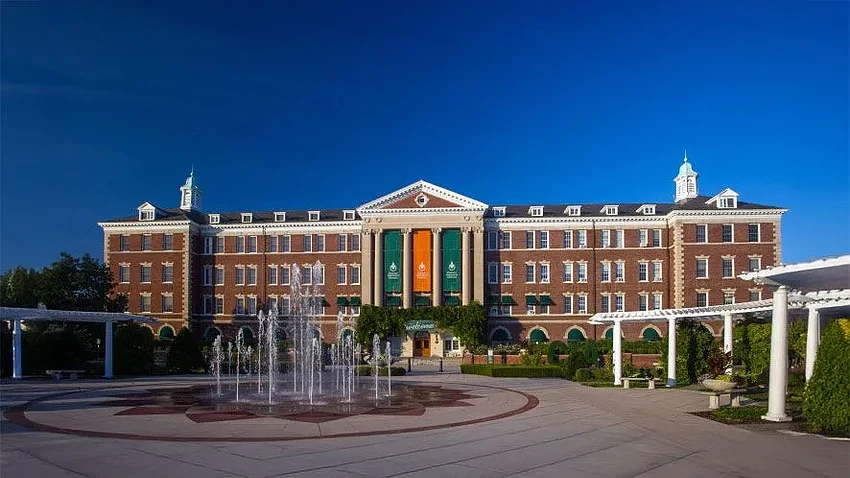
Project Caymus has been identified as the Culinary Institute of America.
The institute’s Southeast campus is planned as part of a proposed 14-story tower with a hotel and conference center at 330 E. Bay St. on the site of the demolished Duval County Courthouse.
The ordinance says the city incentives would go toward the CIA establishing a 50,000-square-foot campus Downtown. It says the city’s Tourist Development Council has pledged $1 million for the project.
Under proposed terms in the supporting document, the city would provide $8 million in workforce development funding and $27 million from the Downtown Riverfront Residential Incentives Contingency Fund, which was established by Ordinance 2025-0385 and contains $30 million.
The document says the city of Jacksonville’s proposed commitments include possible use of funds from the city’s $150 million portion of its $300 million Community Benefits Agreement with the Jacksonville Jaguars. That agreement is tied to the $1.45 billion deal to transform EverBank Stadium into the team’s “Stadium of the Future.”

Funding per year would be $4 million in 2026-27, $6.25 million in each of the next two years, $8.25 million in each of the following two and $2 million in the sixth year.
Among other proposed commitments, the city would work with the developer to help obtain state funding.
The developer’s proposed commitments include providing at least 12 educational programs in 2026, establishing and maintaining a presence in Downtown Jacksonville until the new campus is complete. It also would pursue state and federal funding, including New Market Tax Credits.
Another commitment is to develop marina, public spaces and any additional parking needed for the site.
The state of Florida will contribute $2 million toward the project.
The Culinary Institute of America was established in 1946 in Hyde Park, New York. In addition to its home site, the institute operates two campuses in California’s Wine Country, one in San Antonio and one in Singapore.