
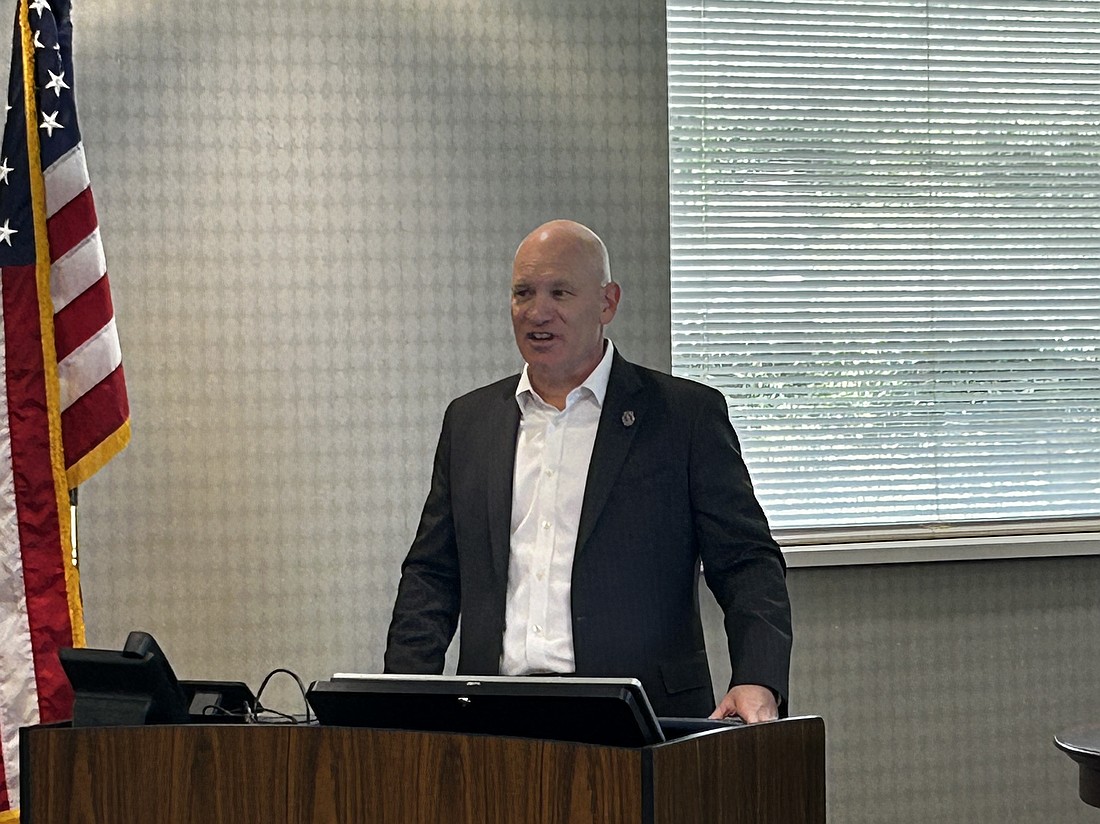
The Jacksonville Aviation Authority board voted July 16 to sue the city of Jacksonville, but also created a pathway toward avoiding a legal confrontation that has triggered concerns of weakening the city’s consolidated government.
The board voted 6-0 in favor of a resolution authorizing JAA to hire legal counsel to file the suit over allegations that Council, at Council President Nick Howland’s lead, has unlawfully interfered with JAA’s budget and operations. JAA also alleges that the city Office of General Counsel wrongfully claimed the Council’s actions were lawful and that the JAA does not have authority to sue the city under the city charter.
But board members also approved a motion to delay the action by 30 days, during which time the JAA will work with the city Office of General Counsel toward mediating the dispute and avoiding legal action. Board Vice Chair Fernando Acosta-Rua was absent.
Under the approved motion, board member Michelle Barnett, an attorney and former board chair, will represent the JAA in the mediation discussions.
“I don’t think anybody’s intention here is to sue the city. What we’re looking for is clarity” about the powers of Council and the independent JAA, board Chair David Hodges Jr. said. He added, “Everybody in this potential conflict loves the city of Jacksonville, and I think that’s the theme we take into this mediation.”
Howland has called the suit “likely illegal” and says JAA has refused to comply with local and state law. He said the action “undermines Jacksonville’s consolidated government.”
During the board meeting, Howland said JAA’s claims were false and inflammatory. Countering JAA’s contentions that Council unlawfully approved a budget transfer in 2025 over the authority’s objections, Howland said a recording of the August 2025 budget hearing in which the transfer was made showed the allegations were not true. He provided cards to board members containing a QR code for the recording and a list of times at which he said the recording provided proof refuting JAA’s claims.
“This lawsuit isn’t really about those allegations. They’re easily disproved when you watch the hearing,” he said. “This is about control.”
The special board meeting at JAA’s headquarters near Jacksonville International Airport drew a packed crowd. Howland, the Council’s liaison to JAA, sat with the board. Meeting attendees included Council members Mike Gay, Will Lahnen and Chris Miller. City and Council administrators also were on hand, including Michael Fackler, head of the OGC.
Conflict over the budget
JAA was created by the state of Florida but also is part of the state-approved city charter. Council votes annually to approve its budget.
JAA claims that in approving its 2025-26 budget, Council made an illegal $10 million transfer to help create a potential future JAA/Florida State College at Jacksonville Northeast Advanced Aviation Maintenance Training Center at a hangar at Cecil Airport in West Jacksonville, which is operated by JAA.
The authority, which leases the hangar to a private company, Million Air, opposed the transfer. It said spending the money would put it in breach of contract with the tenant and could bring punitive action from the Federal Aviation Administration.
The suit says the FAA has confirmed that the transfer “would likely constitute unlawful revenue diversion” of funds meant for airport operations.
Board member Solomon Brotman said during the special meeting that an unlawful revenue diversion could have consequences for the city.
“In plain English, JAA past and future funding could be confiscated, requiring the city of Jacksonville to refund tens or possibly hundreds of millions of dollars to the federal government, most probably from tax revenue,” he said, reading from prepared remarks.
JAA further says Council has mismanaged the city’s financial affairs and “now wants to pay for the consequences with other people’s money,” including by an attempt to “pickpocket the substantial reserves JAA has prudently accumulated — to fund the safe operation and expansion of the region’s airports — to instead fund Council priorities it lacks the money to fund itself.”
Michael Fackler, head of the city Office of General Counsel, told JAA board members during a September 2025 meeting that the city charter gives Council authority to move money within JAA’s budget, but JAA is not required to spend it in accordance with Council’s wishes.
At the July 16 board meeting, Howland said the Council-approved transfer was not an illegal diversion of revenue. He noted that it came with a condition that none of the funding would be spent unless JAA, FSCJ, the state and the FAA agreed to the expenditure.
“JAA has the funds now. We haven’t taken them, and we expressly prohibited spending anything without FAA approval,” he said. “JAA doesn’t have to spend any of the money that we allocated if it doesn’t want to.”
Disagreement over the OGC
Along with the budget transfer, the suit centers on a dispute between JAA and the city over whether JAA can take independent legal action against the city.
In September 2025, Fackler told the JAA it had acted inappropriately by requesting an opinion from an outside attorney on the actions of Howland and Council.
In an opinion sought by JAA, former Florida Supreme Court Justice Alan Lawson of the Tallahassee-based Lawson Huck Gonzalez law firm said Council had exceeded its authority and that JAA’s options included taking legal action against the city.
“When that counsel advised the City had overstepped its limited fiscal authority and violated JAA’s State-granted autonomy to govern and manage its own affairs, the City’s General Counsel (who simultaneously represents the Council) disagreed and purported to fire JAA’s independent counsel,” the proposed suit reads.
Fackler told the board in September the city charter established the OGC as counsel for the JAA and that only the OGC could issue binding opinions on JAA matters involving internal conflicts with the city.
Repeating a point he made in September, Fackler told the board at the special meeting that the OGC is the chief legal officer for JAA and that the state designated his office as the arbiter for any internal disputes.
Saying JAA had not asked him for a legally binding opinion on its claims, Fackler said, “Give us an opportunity to answer the questions you have instead of running off to a court.”
JAA, in its suit, accuses the Office of General Counsel of providing “legal cover” for Council’s unlawful actions and leaving the authority no choice but to seek relief from the courts.
The aftermath
Howland said after the vote he was disappointed that the board approved the resolution but pleased for the 30-day mediation period.
“I would have preferred a no on the resolution and I would have preferred that this thing get deferred,” he said. “There are several clauses in that resolution that they offered that are just flat-out untrue.”
Hodges said he was confident Barnett would negotiate a “great solution” with the city.
“I think the ideal resolution is that we come out of that 30 days with clarity on who reports to whom, how that can go and then we go forward as a group,” he said. “That’s what we’re looking for: clarity.”