
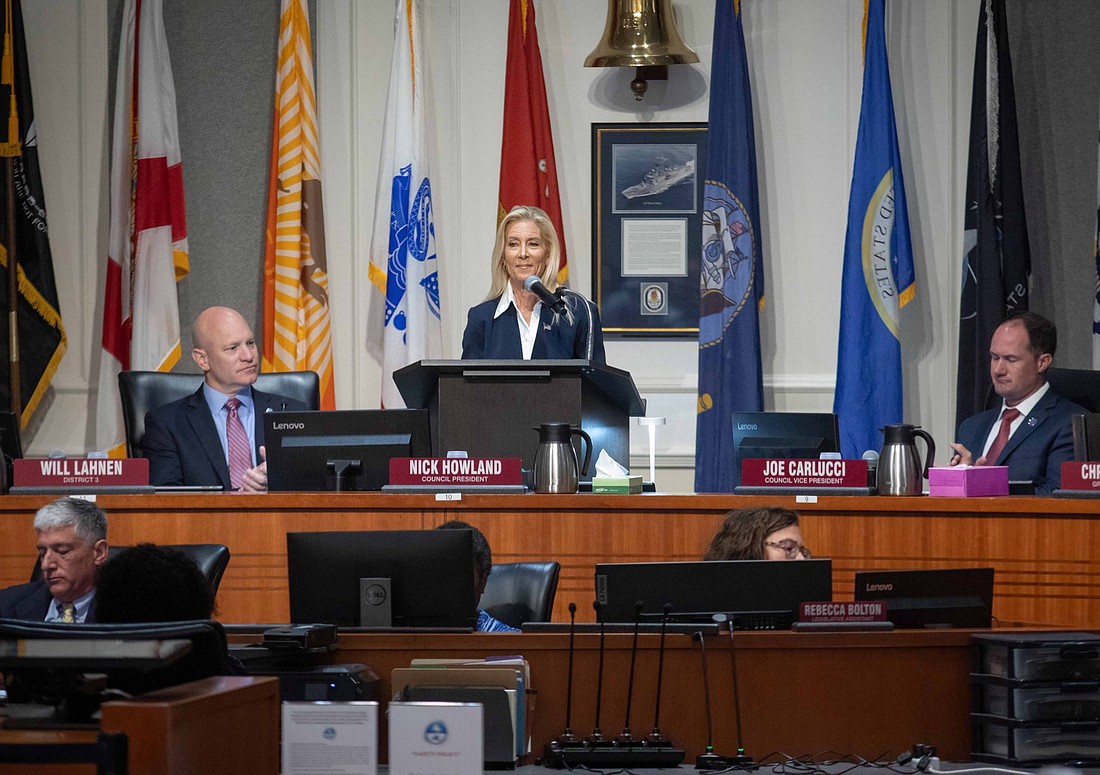
In the first vote toward setting the city of Jacksonville’s budget for the 2026-27 fiscal year, City Council members agreed to hold Duval County’s maximum millage rate steady from FY26.
With a 17-1 vote on Ordinance 2026-0500 during a July 28 meeting, with Council member Rory Diamond voting no and member Ken Amaro absent, Council members decided to keep Jacksonville’s maximum millage rate at 11.1919.
One mill is equal to a $1 tax for every $1,000 of assessed property value. In Jacksonville, a property owner would pay $11.1919 worth of tax on every $1,000 of assessed property value.
The millage rate for the Beaches’ contribution to city revenue was capped at 9.238 mills, while the rate for the town of Baldwin’s contribution was capped at 7.4373 mills.
The vote does not set Duval County’s millage rate for the fiscal year. Rather, it simply establishes the expected maximum rate for the coming year, and it would be “nearly impossible” to raise the rate, Council auditor Phillip Peterson said. Council members could still lower the rate during coming budget hearings in August and September, though members have indicated they’re more interested in saving city funds in case a November ballot measure increases Florida’s homestead exemption.
If passed, the November ballot measure would increase Florida’s $50,000 homestead exemption to $150,000 in FY2028 and $250,000 in FY2029, with the amount indexed to meet inflation each year thereafter. City Council auditors estimated that as a result, the city would lose $300 million in property tax revenue in FY2029.
Even if the millage rate is kept flat, property tax revenue in Duval County are expected to rise as home values increase and new construction increases the tax base. Mayor Donna Deegan’s administration estimated that ad valorem revenue for the city would rise 6% in FY27. If the city wanted to keep ad valorem revenue flat, it could set the millage rate at 10.6789 mills, according to the ordinance.
Council is set to begin considering Deegan’s proposed $2.03 billion budget, which includes a 1%, $22.58 million increase from the FY26 budget, during its first Finance Committee budget meeting Aug. 10. Meetings for the committee will are scheduled each Thursday and Friday of the final three full weeks of August, beginning at 9 a.m. each day.