
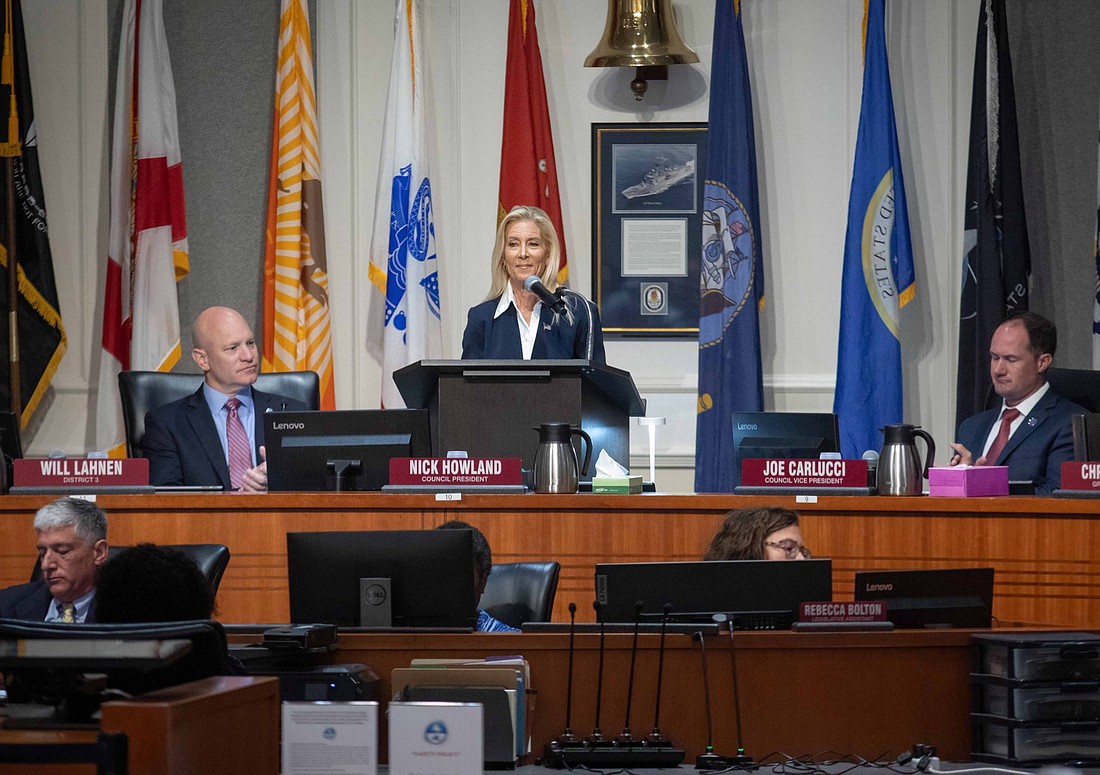
Jacksonville Mayor Donna Deegan delivered a $2.03 billion budget to the City Council for review, focusing on public safety, infrastructure and return-on-investment during a 25-minute speech July 20.
The budget, with a 1%, $22.58 million increase from the approved fiscal year 2026 budget, includes $1.07 billion for the Jacksonville Sheriff’s Office and the Jacksonville Fire and Rescue Department, along with $586.11 million in the first year of the city’s capital improvement plan.
The budget also has $301.6 million for city services such as public works, parks, libraries, planning, economic development and more. The administration included $148.27 million in “people investments,” which focus on healthcare, housing and nonprofit spending, along with $502.89 million in what the administration called “other expenses,” focusing on interlocal agreements with the Beaches and Baldwin, pension obligations and debt service.
“Taxpayers do not owe government the benefit of the doubt. We owe taxpayers proof — proof that we know the money is not ours,” Deegan said in her address. “In our analysis of the economic value generated by city services, each tax dollar provides nearly $3 in return. With that in mind, every spending decision we make, every one is geared to make Jacksonville more affordable, and we do that by making it healthier, safer, more competitive, more prosperous and more prepared for the future.”
While the administration did not propose an increase in the property tax rate, it budgeted a 6% increase in property tax revenue, which it said was “driven by growth in value and new properties” in a handout provided to reporters.
The city’s revenue would be driven by $1.29 billion in property tax revenue, $225.95 million in state-shared revenue, a $151.48 million contribution from JEA and a $122.84 million utility service tax.
Budget priorities
Among other budget priorities, Deegan included the following in her speech and budget highlights:
• $34.95 million for roadway resurfacing, a $13.2 million increase from the last budget. Additionally, Deegan budgeted $6.18 million for sidewalk repair and $5.75 million for new sidewalks, saying she heard about needed roadwork in “every town hall, every interview, and even chats along my morning run.”
• $25 million for septic tank phaseout projects, a $16 million increase from the last budget. The city is working to phase out dilapidated septic systems around Jacksonville and connect those homes to JEA’s water and sewer systems.
• $4 million for the Eastside Community Benefits Agreement. Established as part of the CBA with the Jacksonville Jaguars for the “Stadium of the Future,” the Eastside is set to receive $40 million from the city over the next seven years. The Jaguars are expected to contribute $2.5 million to the Eastside for the next 30 years, though they are not expected to contribute to the city’s grants program.
• $6.3 million for affordable housing and $4.71 million to address homelessness. Deegan said that while “compassion alone would hopefully compel us to act, but fiscal responsibility does too,” citing a return on investment for getting residents “back on their feet.”
• $62.2 million for citywide parks, including $27 million for the Museum of Science and History relocation and park design, $25 million for the second phase of Riverfront Plaza, $8 million for the Emerald Trail from Hogans Creek to the Riverwalk, $5.75 million for James Weldon Johnson Park and $5 million for Shipyards West Park.
• $673.61 million for the Jacksonville Sheriff’s Office and $400.13 million for the Jacksonville Fire and Rescue Department, an increase from $637.97 million and $387.45 million in the 2025-26 budget, respectively. The administration included no employee headcount increases outside of public safety roles in the FY27 budget.
Deegan’s proposed CIP budget featured a $99 million decrease in spending from FY26. In a post-speech news conference, the mayor said her administration had taken items out of the CIP if there was no plan to pay for them, in an attempt to reduce the city’s debt.
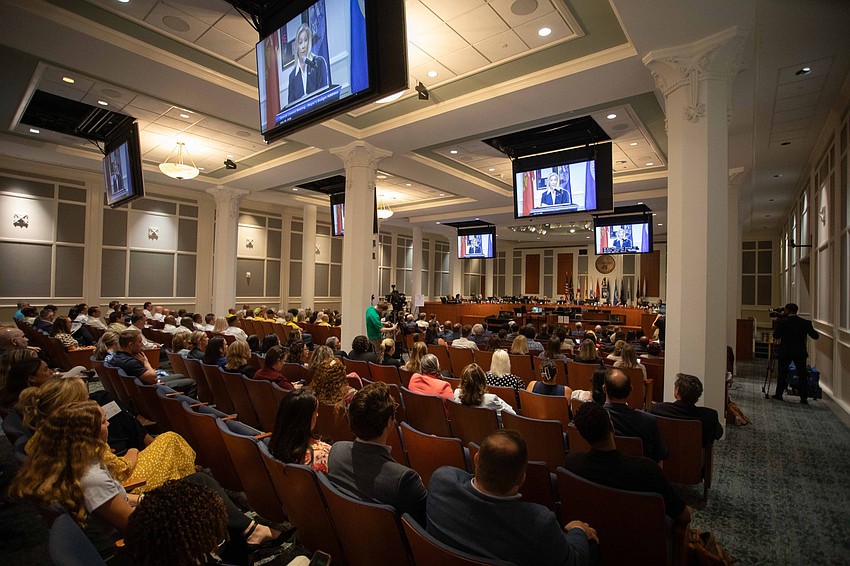
In her speech, Deegan also called for an end to deferring maintenance around the city, saying it only amounted to a debt to be paid later rather than offering savings to the city.
“The road that we fail to maintain becomes the road we must rebuild. The drainage project we delay becomes the neighborhood that floods again. The permitting system we neglect becomes the business that opens someplace else,” Deegan said.
“Fiscal responsibility does not mean refusing to spend. It means asking what works, what lowers future costs, and what makes Jacksonville more affordable to live in because the city simply works better.”
Council could consider preemptive cuts
With the budget in hand, the Council Finance Committee begins a three-month process to approve the budget.
The committee will take the month of August to review, and likely make changes to, the proposed budget. After the committee presents the budget to the full body, the 19-member Council is required under state law to pass a budget before the start of the city’s fiscal year Oct. 1.
Deegan delivered her fourth budget as mayor before Florida voters are set to decide in November on a constitutional amendment that would increase the state’s homestead exemption to $250,000. That exemption increase would result in lower tax bills for most Florida property owners and would decrease the city’s budget by more than 10% within three years.
Council members have weighed placing some of the money presented in the FY27 budget in a contingency account in case the property tax amendment, which needs 60% voter approval to become law, passes. Should the amendment pass, those funds would be placed in reserves to offset some of the initial costs of the revenue cut. Should the amendment fail, the city would spend those funds as planned.
Deegan, along with Rahman Johnson, the lone Democrat on Finance, opposed that plan, noting that revenue reductions tied to the November vote would be phased in over time and would not affect the city until FY28, when a $150,000 homestead exemption would kick in. The $250,000 exemption would apply to FY29.
“We have an entire year to respond should that vote go to people wanting to pass Amendment Three. So I think that we don’t need to be putting things under the line,” Deegan said in the news conference after her speech.
Council member Ron Salem said he was “astounded” that Deegan didn’t mention the November vote on Florida’s homestead exemption in her address, adding that he felt it was irresponsible of her and her administration not to present a contingency for the outcome should voters approve it.
“If you have a job and there’s a chance in November your salary is going to be reduced by 30%, would you not now begin to take steps to correct for that? Or would you just wait until November and react to whatever happens?” he said. “Most people would begin planning for that now.”
Salem, a Republican and former Council president, said he believed the appropriate way to contend with the budget uncertainty was to approve a budget with some cuts and other expenditures placed in contingency.
Salem said he believed Council should identify about $100 million in cuts, including items that could be restored.
Council member Will Lahnen, chair of the Finance Committee, said he was pleased that the budget included what appeared to be a net reduction of new positions outside of first responders, which he called an example of “government growing in the right direction.” He said a reduction in the capital improvement budget for 2026-27 also was a plus.
“When your CIP goes up, it just means you’re taking out more debt and having higher annual debt expense,” he said.
Noting that the effects of a raised homestead exemption would increase in steps, Lahnen said he didn’t see the need for “drastic cuts” in this year’s budget.
“But I want to at least try to stay flat and see what the property tax referendum brings to us, and then go from there,” he said. “If you’re a business in the real world and you’re facing revenue uncertainty, which is what we are right now, you want to preserve your cash on hand and you don’t want to start new things, specifically new things that are expense-only and don’t have an associated revenue.”
Salem and Lahnen both said they were speaking in broad terms about Deegan’s proposed budget and would know more once Council auditors dissect it.
Deegan expressed concern that spending contingency funds would require 13 Council votes. She said she wasn’t sure that many members would support restoring the funding, though she remained hopeful there could be another mechanism to spend the money if the amendment fails.
“My sincere hope is that we will keep our focus on the present and not let the next political season prevent us from working together to make progress, because Jacksonville is a city on the rise,” Deegan said.
“We’re a national leader for jobs and small business. More and more cranes are popping up all over downtown. The inventory of attainable housing is growing. Historically disinvested neighborhoods are seeing long-awaited infrastructure improvements. This momentum is both significant and fragile. It takes an active force to keep it going, and we cannot stop now.”
Deegan, a Democrat, is a candidate for reelection in 2027. The Council is majority Republican, with 14 of its 19 members in the GOP.