
Neptune Beach is exploring new development impact fees to fund future capital projects, part of an effort by city officials to address long-term revenue gaps and debt tied to the city’s utilities.
Impact fees are one-time charges on new residential and commercial construction collected at permitting. Under Florida law, impact fees can be used only to fund new infrastructure capacity required to facilitate future growth, including roads, parks, water, wastewater and police. State law strictly prohibits municipalities from using impact fee revenue to address existing infrastructure deficits, maintain current facilities or repay existing debt.
Neptune Beach would use the fees to help offset its investment in future infrastructure, allowing it to put more money into debt payments and to shore up its revenue gaps.
To advance the proposal, the City Council voted unanimously April 6 to issue a request for proposals to identify and hire a consulting firm to prepare an impact fee study and develop a fee structure. The study is required under Florida law before any fees can be adopted and must analyze at least 12 months of available data to inform its recommendations.
The 2-square-mile city is home to about 7,500 permanent residents, according to the RFP.
The RFP scope
The RFP says the consultant will evaluate municipal infrastructure needs over a 20-year forecast period across six categories: police protection, water, wastewater, transportation, public facilities and administrative costs.
Under Florida’s Impact Fees Act, the city must demonstrate that fees are proportionate to the infrastructure burden created by new development and that revenue directly benefits those developments. Local governments must prove a proportional connection between new development and public infrastructure demands, according to the Florida Department of Transportation.
The firm will be required to submit at least three drafts, which will be reviewed in public workshops and joint sessions with the city attorney’s office before potential adoption by the City Council.

How municipalities compare
Two months before the April 6 vote to move forward on the RFP, Neptune Beach Community Development Director Heather Whitmore briefed the City Council on how other municipalities structure impact fees, including how they are applied to public services, including emergency services and parks.
Across Northeast Florida and central Florida, impact fees vary widely depending on how jurisdictions structure infrastructure costs and growth funding priorities.
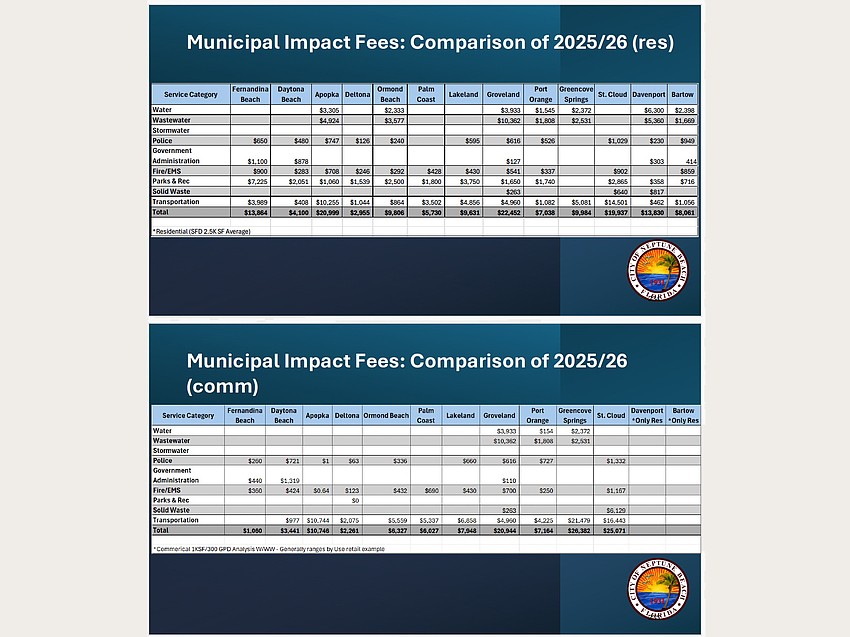
The comparison charts presented to Council show residential impact fees are typically assessed across water, wastewater, police, fire and EMS, parks and recreation and transportation, with some cities also adding solid waste and administrative costs.
Among residential averages, Apopka ($20,999), Groveland ($22,452) and Davenport ($13,830) are among the higher-fee jurisdictions shown. At the lower end, Deltona ($2,955) and Daytona Beach ($4,100) post the smallest averages. Port Orange ($7,038), Lakeland ($9,631) and Ormond Beach ($9,806) fall in the middle range.
Transportation and utility-related categories account for some of the largest shares in higher-fee cities, where roadway and water system expansion costs are more directly embedded in development charges.
Commercial impact fees show a similar spread. St. Cloud ($25,071) and Green Cove Springs ($26,382) are among the highest averages in the comparison set, while Deltona ($2,261), Daytona Beach ($3,441) and Apopka ($10,746) are significantly lower.
According to Whitmore’s presentation, Neptune Beach’s capital improvement program specifically outlines parks, transportation and utility projects across short- and long-term horizons, forming the basis for evaluating future infrastructure demands tied to growth.
The builders’ perspective
Northeast Florida Builders Association President Scott Brannock cautioned that impact fees, while authorized under Florida law, can increase housing costs and discourage new development. NEFBA represents the construction and homebuilding industry in Northeast Florida through policy advocacy, workforce training, networking and industry outreach.
Brannock, who is also president of Tidewater Homes LLC, said the organization supports impact fees when they are used as intended but opposes using them to fund existing infrastructure deficiencies or generate general revenue.
“Impact fees are often used for the wrong reasons. They are used, and sometimes they turn into a revenue stream. Sometimes they are used for fixing existing deficits. They are not used for expanding growth and capacity, and that is what an impact fee should be used for.”
According to National Association of Home Builders, Santa Rosa and Manatee counties in Florida have been investigated on impact fees mismanagement claims.
Although intended to fund new projects, Brannock said the fees ultimately trickle down to homebuyers and commercial tenants rather than developers and builders, increasing the cost of doing business and making housing less affordable.
“It’s a hidden tax … It’s not called a tax, but it is a fee that the end user is paying,” he said. “Housing is getting more and more expensive every single day, and implementing impact fees … makes it very difficult not only for people trying to come into that community, but it makes it more difficult for people that live in that community.”
“You’re starting to price out your middle-class homebuyer. Your first-time homebuyer? Forget it.”
Brannock said higher impact fees can discourage both residential and commercial investment by increasing development costs.
“You have higher fees, which then makes it more difficult to build. When it makes it more difficult to build, you have fewer permits. You have fewer permits, you have less jobs, you have less local revenue and you somewhat start to create a slowing local economy.”
Brannock also described what he sees as a lack of collaboration between local governments and the building industry before impact fee proposals advance.
“No one calls us and says, ‘Hey, we have an issue, and we don’t know how to fix this issue … How do we workshop this?’ It’s all retroactive,” he said.
Nassau County imposes impact fees on new developments, saying developers and not residents should pay the costs.
On its website, the county says, “When new development does not pay its fair share through impact fees, the financial burden shifts directly to existing taxpayers, who must then cover the cost of expanded infrastructure. For decades, Nassau County residents have been clear and consistent: new development should pay for itself, and the cost of growth should not be placed on the backs of current taxpayers.”
Clay, Putnam and St. Johns counties also utilize impact fees, while Jacksonville implements mobility fees, which are specifically used to mitigate the transportation impacts of new development, including renovating, expanding or converting existing systems, including roads, sidewalks, bike lanes, and transit facilities.
They cannot be used to solve existing traffic, transportation or operational deficiencies, according to jacksonville.gov.
Addressing utility fund deficits
While the proposed impact fees focus on infrastructure expansion for growth, Neptune Beach city officials face separate revenue gaps within existing operations.
In a Jan. 20 meeting leading up to the RFP vote, the City Council discussed findings of its finance committee, highlighting how sanitation, water and sewer funds have struggled to keep pace with operating costs over multiple years. Officials cited flat user rates alongside rising operational costs, including increased contract costs for solid waste service with Waste Pro.
Brent Rogers, City Council member and Finance Committee chair, said the city had “not done a good job ... keeping up with that,” noting sanitation costs increased over time as contractual obligations rose and adjustments tied to CPI were applied. He added that an administrative allocation of 13% to 14% is applied across utility funds to cover shared city services, further increasing pressure on utility accounts.
“We have a $900,000 IOU in our sanitation fund,” Rogers said, describing the shortfall as a subsidy from the general fund rather than full cost recovery through user fees. “We shouldn’t be subsidizing it out of our general fund — it’s just kind of hiding what the real cost is.”
The deficit carries into water and sewer operations, where council members noted rates have not been significantly adjusted in approximately seven years and have failed to keep pace with inflation.
Concerns were also raised about possible noncompliance with debt covenants tied to Neptune Beach’s water and sewer system, including reserve requirements and debt service coverage. Jaime Hernandez, Neptune Beach’s chief financial officer, said the utility system is required to maintain a reserve equal to about three months of operating expenses, adding that continued use of that fund balance for other projects could lead to its complete erosion.
“If we continue to use it for other projects, we will deplete that reserve,” Hernandez said.
No decisions
RFP responses were due May 20, and as of July 17, Neptune Beach continues to evaluate them. The item has not appeared on upcoming City Council meeting agendas. Messages to Council members and Mayor Cori Bylund for comment were not returned.