
A $1.8 billion toll road is reshaping how businesses and developers see Northeast Florida — and construction isn’t even finished.
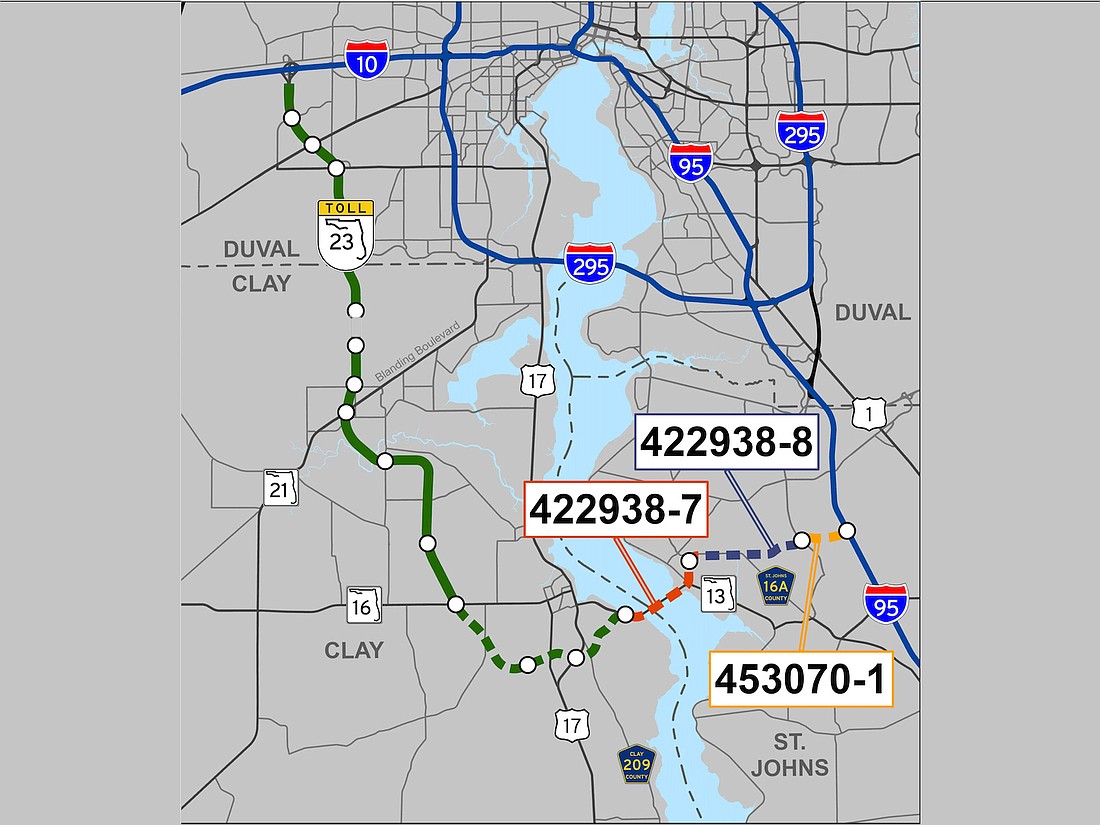
First Coast Expressway, also called Florida 23, is an approximately 46-mile thoroughfare designed to provide contiguous connectivity between Duval, Clay and St. Johns counties.
On its website, project engineer RS&H said the First Coast Expressway’s roots stretch back several years.
“It’s a longstanding idea, although the details have changed a bit over the years. We’ve worked with the communities and landowners to find the right alignment,” it says.
Duval County: The northern anchor
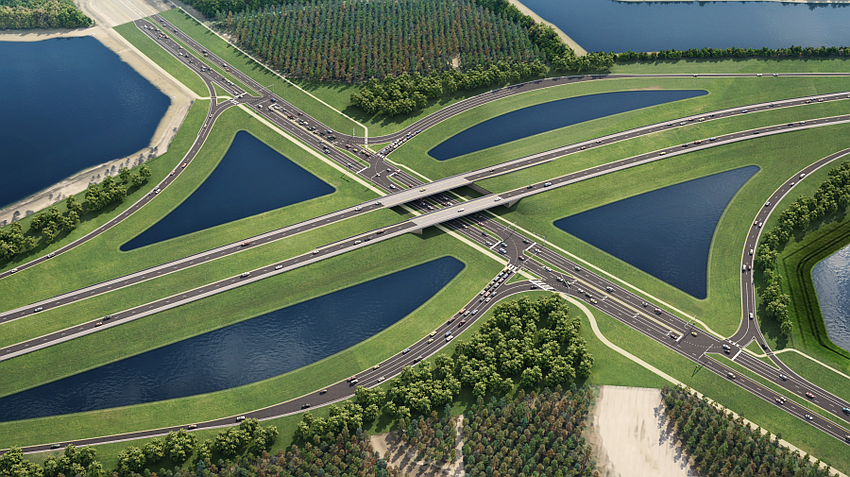
The 15-mile northwestern segment, the expressway’s first, was completed in summer 2019. Toll collection began July 13, 2019, according to the Florida Department of Transportation.
The road stretches from Interstate 10 to Blanding Boulevard in Duval County.
Ed Randolph, executive director of the Jacksonville Office of Economic Development, called the expressway “a welcomed project.”
He said the toll road has enhanced accessibility to and interest in Cecil Commerce Center, a 17,000-acre manufacturing, logistics and industrial aviation hub on Jacksonville’s Westside.
“At the northern end of that (road), we now have a high-speed interchange where Cecil starts,” Randolph said.
“That has had a tremendous impact on the growth at Cecil Commerce Center and Duval County, just because that access point off I-10 really allows trucks and companies that utilize the park to move products in and out to save time.”
Saving even minutes for companies operating fleets of trucks can mean significant cost reductions and has made the commerce park a more attractive option, Randolph said.
“It’s driving growth, specifically at Cecil, but really the entire county,” he said
Farther south, the expressway flows through OakLeaf Plantation, a 6,400-acre master-planned development by the Hutson Cos. that bifurcates the Jacksonville city limits and unincorporated Clay County.
While OakLeaf wasn’t designed with the toll road in mind, the community has benefited from the increased connectivity, including multiple retail centers and The Home Depot.
Its latest tenant is Walmart. The company announced Feb. 4 the opening of its “next generation” Supercenter at southwest First Coast Expressway and Oakleaf Plantation Parkway.
The 175,000-square-foot retail store and 4,365-square-foot liquor store at 10000 Omni Drive is on the Duval County side.
Randolph said the expressway was likely an important factor in Walmart’s decision.
Clay County: The central connection
The bulk of the expressway is in Clay County.
The second segment, which spans 28 miles, runs south and then east from Blanding Boulevard in Middleburg through Green Cove Springs. This leg includes seven interchanges.
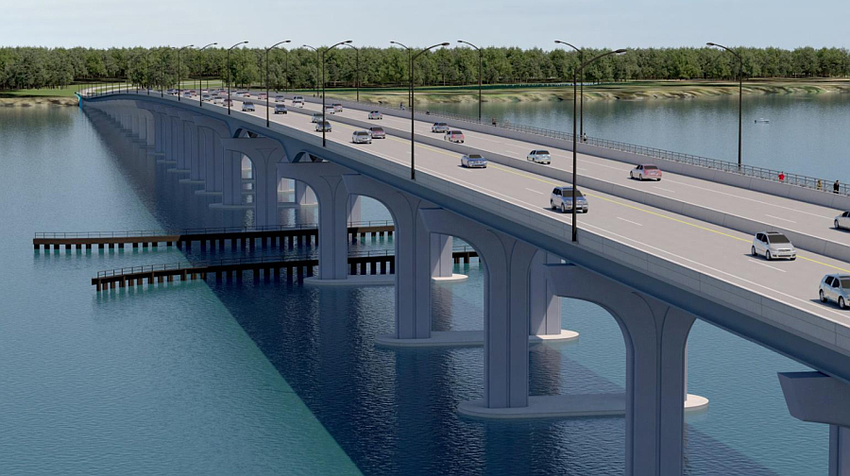
Future additions include a bridge that is under construction over Black Creek near the Lake Asbury community. It is expected to be completed in late 2026.
Use of the newest 18-mile stretch of the expressway reaching into Green Cove Springs began in August 2025, ahead of schedule.
A presentation in April at the 10th Annual First Coast Expressway Summit at St. Johns River State College estimated 5,000 to 8,000 cars a day are diverted off local roads as a result of the toll road.
Crawford Powell, president of the Clay County Economic Development Corp., said the First Coast Expressway has changed “everything” for attracting Class A and Class B industrial projects and other developments.
“Clay is in an enviable position that we have a lot of green space, especially along the expressway.”
Powell said two industrial parks are planned -— Peters Creek at 400 acres and the Rookery at 150 acres. The developers behind the projects haven’t announced further details, Powell said.
Both are near mixed-use residential developments in Green Cove Springs and Argyle Forest.
They include a D.R. Horton single-family community also called the Rookery, as part of a 560-acre Community Development District for infrastructure management, according to the company website.
An “agrihood” development called Saratoga Springs is planned on 2,240 acres designed around sustainable, farm-to-table living by Boston-based Freehold Communities.
Powell said both industrial projects have not made “hard development plans” public because they want to remain “flexible” as they approach potential tenants.
Clay County Assistant Manager Chereese Stewart pointed to Niagara Bottling, a $70 million plant that opened in 2022 in Middleburg, as an example of the types of businesses the county would want to see along the expressway.
“And they’re growing,” she said. “That’s the kind of industry we’re looking for along that road.”
Another is the $290 million IKO Industries manufacturing plant that broke ground in 2024 near U.S. 301 and County Road 218.
“It’s not only huge for that community, it’s also huge for the greater Northeast Florida area,” she said. “It’s where four counties meet. You’ve got Clay, Bradford, Baker and Duval.”
St. Johns County: The future corridor
The third and final segment of the expressway is planned for St. Johns County, running 2.7 miles from east of County Road 16A to just west of I-95.
A new structure replacing the Shands Bridge, built in 1963, also is being developed. At 9,300 feet long, it will have a 65-foot vertical clearance over the St. Johns River. The old bridge offered clearance of 45 feet.
“The First Coast Expressway is one of the most significant infrastructure investments shaping the future of St. Johns County. More than a new transportation corridor, it represents a catalyst for how and where the county will grow—economically, geographically, and strategically,” St. Johns County Director of Economic Development Christine Valliere said by email.
“With the Expressway opening new connections across the region, areas of northwest St. Johns County that were once harder to reach are becoming newly accessible. This shift creates new opportunities for smart, well‑planned development that supports both economic diversification and long‑term community value,” she said.
Valliere said the County Road 2209 corridor, positioned between the expressway and I‑95, “is emerging as an ideal hub for light industrial, logistics, and flex‑industrial development.”
That project represents a $73 million investment to improve county traffic flow and will stretch about 7 miles from I-10 in Duval County to I-95 in St. Johns County.
“This project represents a major investment in public safety and connectivity for our community,” St. Johns County Commissioner Sarah Arnold said at a ribbon-cutting for a segment that connects Silverleaf Parkway to International Golf Parkway.
“By improving this critical intersection, we’re not only reducing congestion, we’re enhancing safety with upgraded signals, turn lanes and better visibility.”
The St. Johns County expressway segment is scheduled for completion in 2031, according to FDOT.
The project is funded jointly by FDOT and the Florida’s Turnpike Enterprise.
“Ultimately, the First Coast Expressway offers St. Johns County a unique opportunity: the ability to shape its economic future with purpose, strategy, and resilience,” Valliere said.